The property slump and the DeepSeek moments are one story, not two
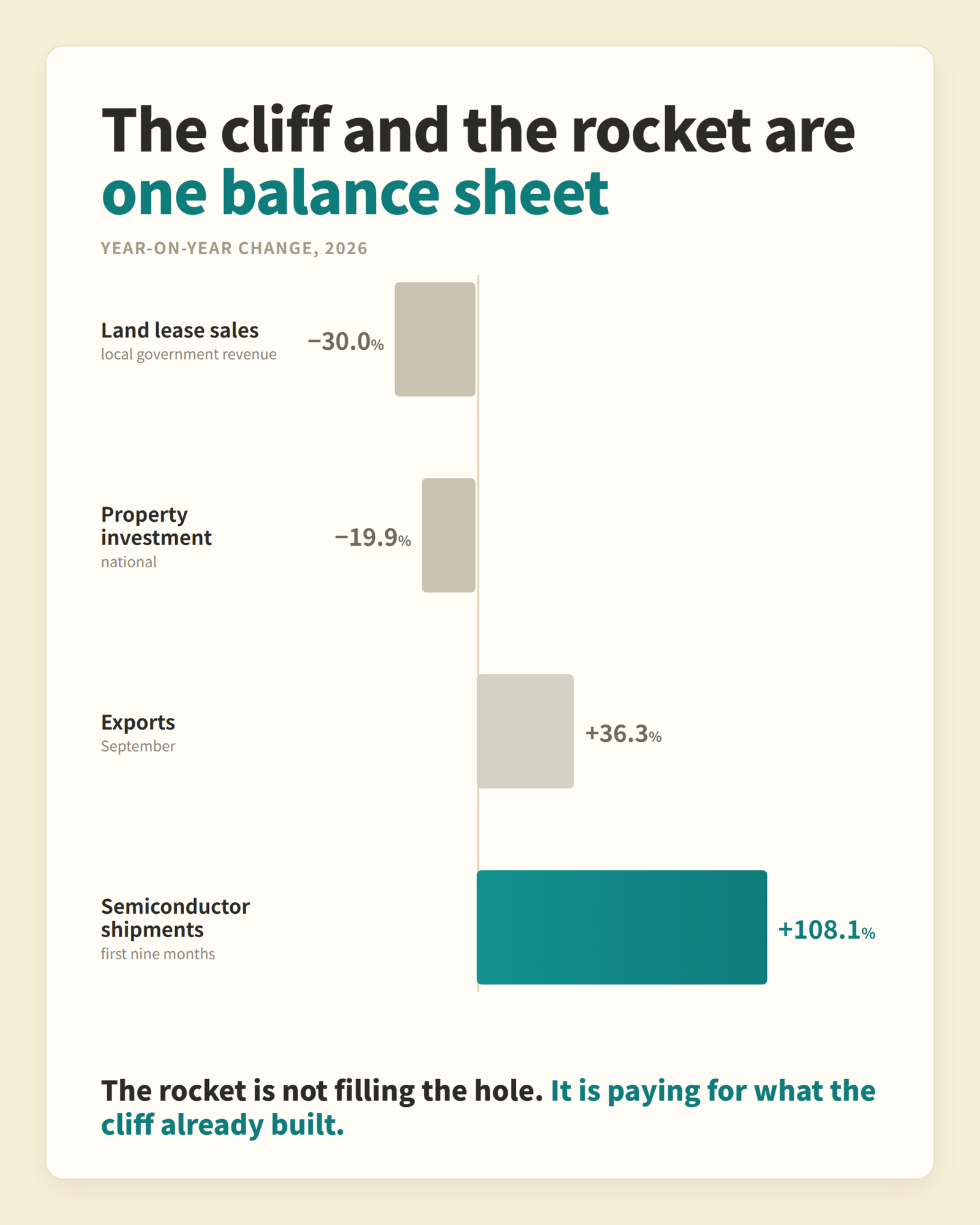
Last week in Bangkok, four of the most-quoted economists on China sat on one stage and largely agreed on a diagnosis. Property investment is down 19.9 per cent this year. Land-sale revenue, once the main source of local government money, is down almost 30 per cent. Total fiscal spending, on and off budget, has fallen about 2.5 per cent. Nomura’s Ting Lu called it “a true fiscal cliff”. Bank of America puts AI-related investment at less than a trillion yuan a year, far too little to fill the hole that housing left.
That same week, customs data showed exports up 36.3 per cent in September. Semiconductor shipments were up 108.1 per cent over the first nine months.
Western coverage tends to treat these as two separate stories. One is about a burst bubble and a long slump. The other is about DeepSeek moments and China Shock 2.0. Put side by side, they look like a contradiction. They are not. They are the same balance sheet seen from opposite ends.
The city as a fund
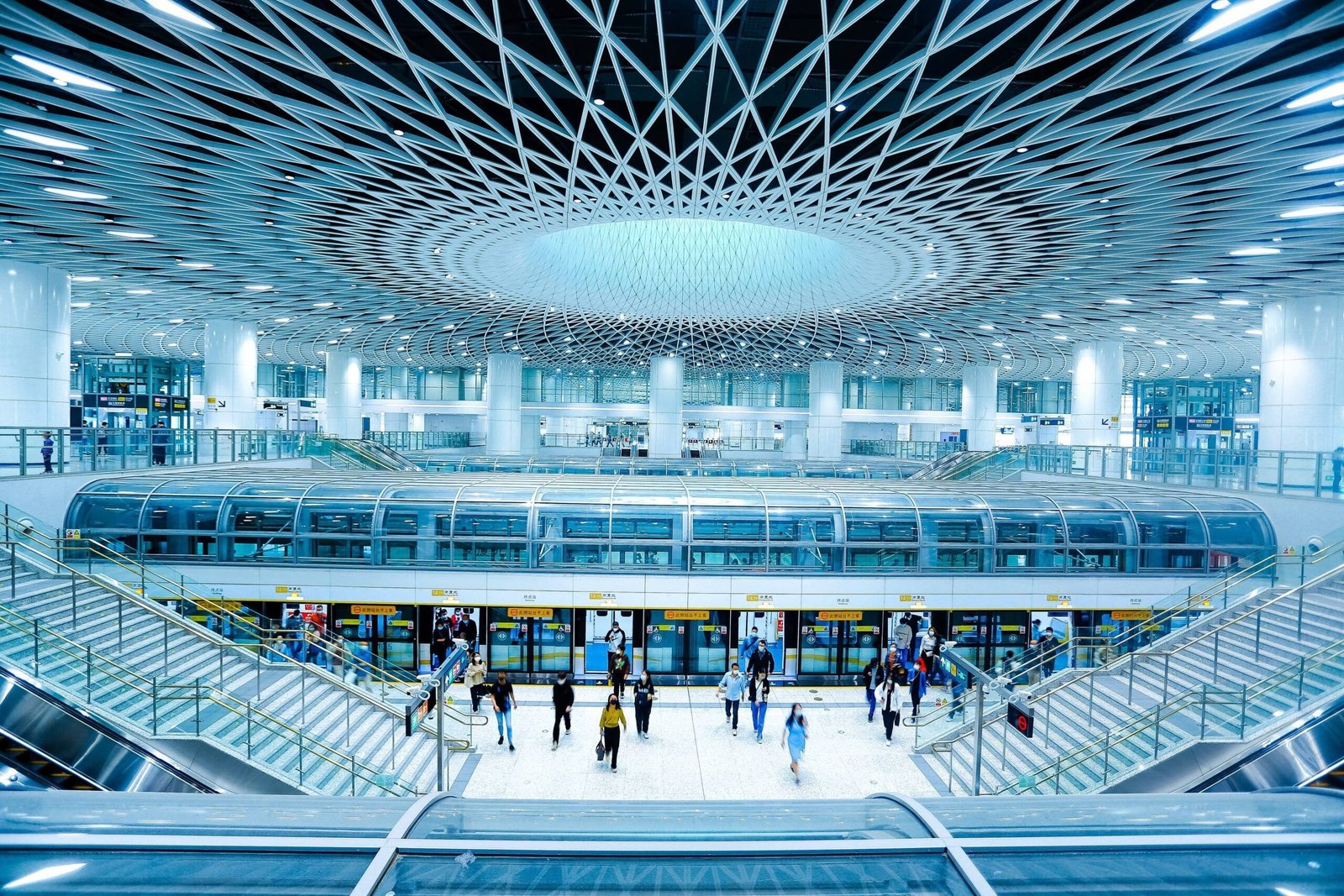
Visitors arriving in Shenzhen, Hangzhou or Hefei for the first time tend to say the same thing. The streets are clean. The metro is new. The airport looks like a set from a science-fiction film. Then comes the question nobody on the tour can answer: who pays for all this?
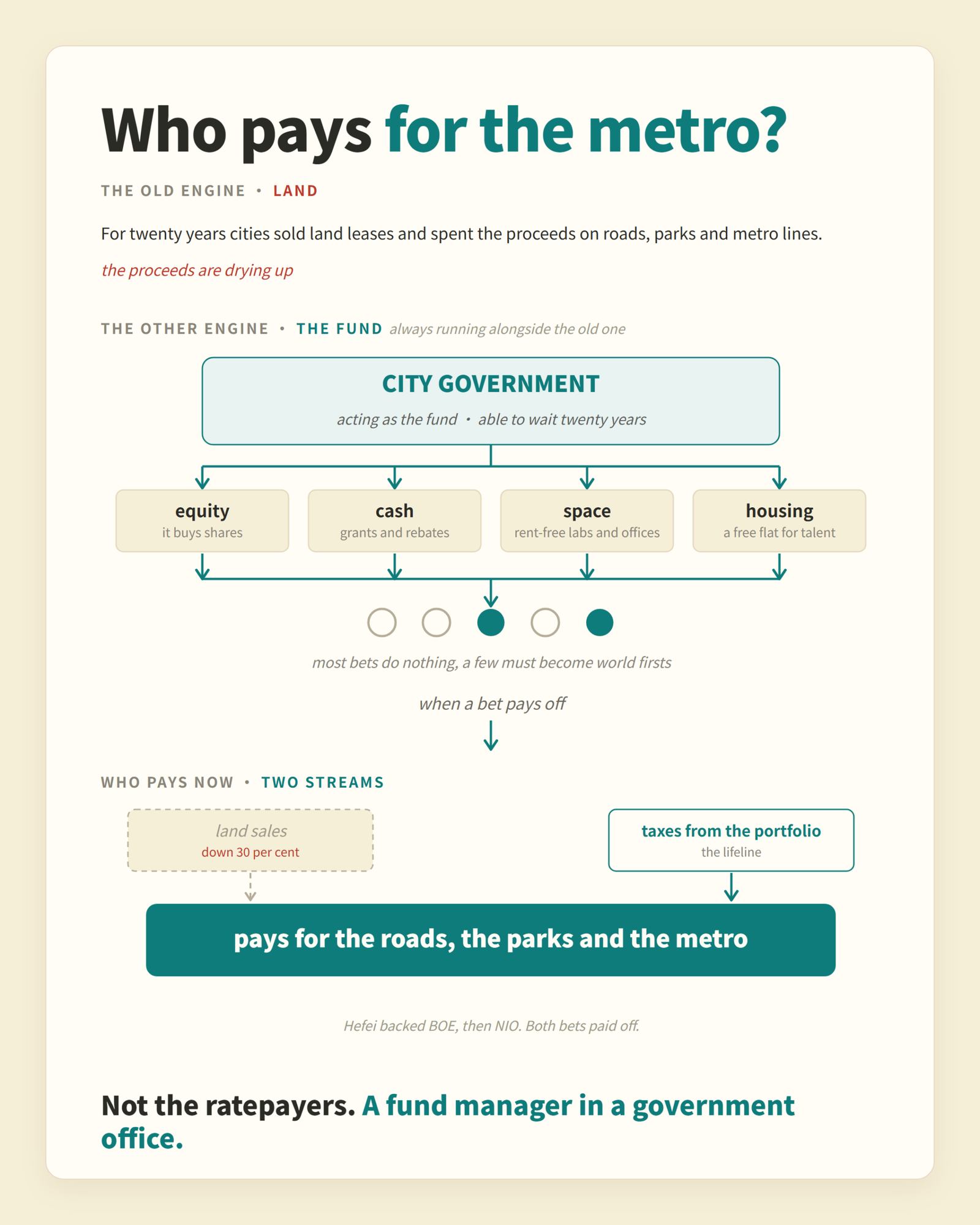
Not the ratepayers. A London borough or an American county funds its parks and potholes from taxes on residents’ property. China has no comparable recurring property tax. For twenty years the answer was land. Cities sold leases to developers and spent the proceeds.
That money is now drying up. What remains is the model that was always running alongside it. A Chinese city government behaves less like a town hall and more like a venture capital partnership. It picks companies and backs them with equity, cash grants, years of rent-free space and, for the right PhD, a free flat, hoping a few become world leaders. Then it waits. Private venture money lasts seven to ten years. Government money can now run for twenty. When one does, the taxes come back to the city and join the shrinking land sales as the money that pays for everything already built. Jobs and suppliers follow, but they are not what pays the bills. Hefei is the textbook case. The city put money into BOE when display panels were out of fashion, and into NIO in 2020 when the carmaker was close to collapse. Both bets paid off, and Hefei’s skyline shows it. Ordinary municipal rates cannot produce infrastructure on that scale. You need a few world firsts in the portfolio.
Taiwan already ran the experiment
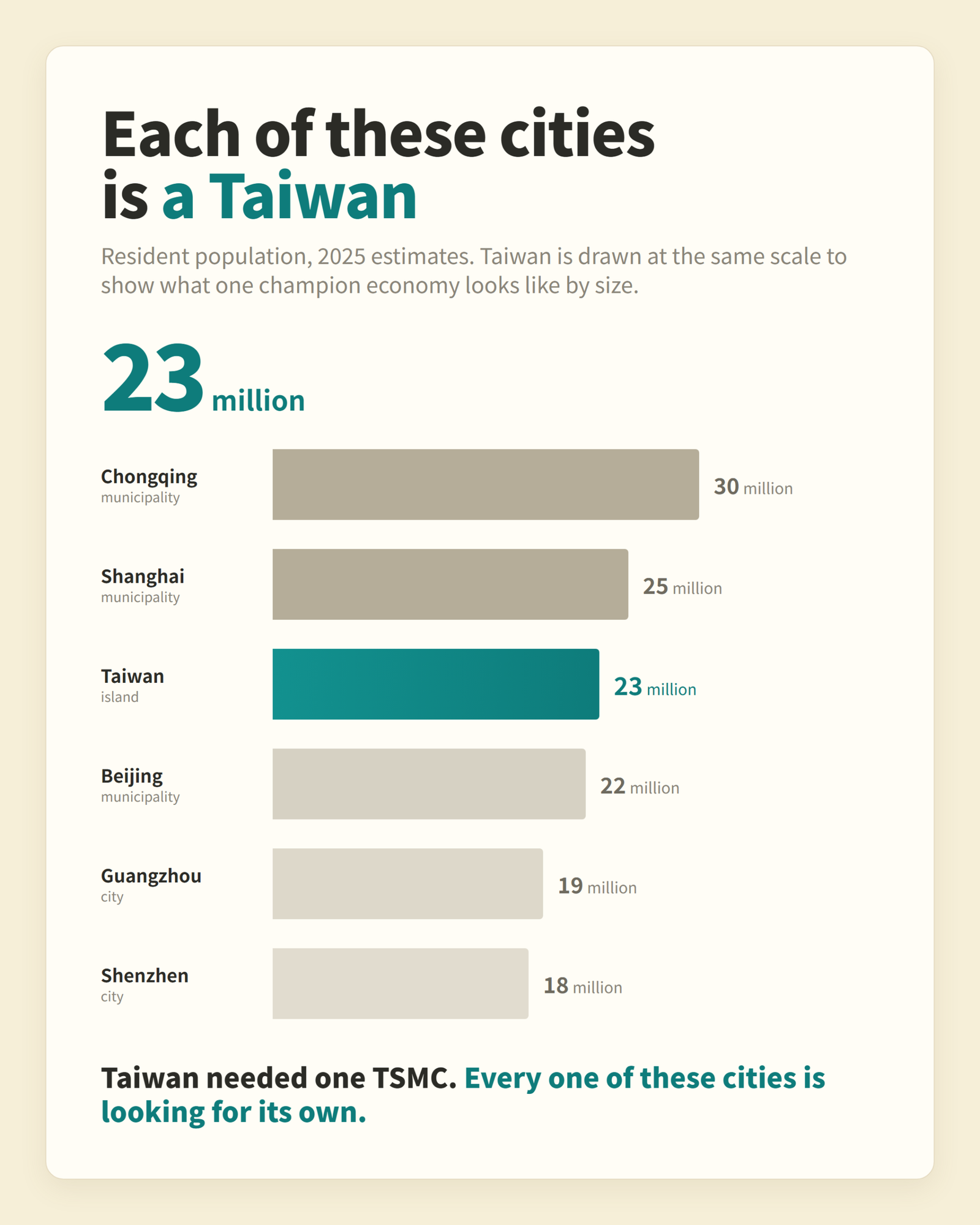
There is a precedent for an economy this size living off a handful of champions. Taiwan is an advanced economy of about 23 million people, at the stage where growth is supposed to settle into low single digits. Instead, on the back of TSMC and the semiconductor chain around it, it has recently posted growth that would flatter an emerging market, at times above 10 per cent.
Now look at China’s megacities. Shanghai has about 25 million residents, Beijing 22 million, Guangzhou close to 19 million, Shenzhen nearly 18 million, Chongqing more than 30 million within its boundaries. Each is a Taiwan-sized polity with its own budget and its own industrial plan. Each wants a TSMC. Every mayor and party secretary has seen what one champion can do for a population that size.
Incentives no one else has built
Put these pressures together and you get incentives that few other governments face. A city’s fiscal survival depends on its portfolio. An official’s career depends on the city’s growth. The central government rewards both. So local governments throw everything they have behind the companies on their patch, aiming to make them global leaders rather than national ones.
Jensen Huang put it plainly on the Lex Fridman Podcast in March. “China is not one giant economic country,” Nvidia’s chief executive said. “It’s got many provinces and cities with mayors all competing with each other.” That, he argued, is why the country can produce so many EV makers and AI start-ups at once, and why the ones that survive the internal fight come out strong. He is right about the engine. Seen from a city’s budget office, though, what he calls a contest between mayors is a contest for solvency. Contests for solvency do not end in handshakes.
That is why the game is zero-sum. A party secretary in one city has no interest in the rival EV maker or battery producer two provinces away. His promotion depends on his firm winning, which usually means theirs losing. Cities fight to the end over the same industries, and the overcapacity spills into export markets.
Washington and Brussels keep trying to fix this by negotiating with Beijing: an import quota here, a voluntary restraint agreement on plug-in hybrids there. In Bangkok, Goldman Sachs’ Andrew Tilton said cutting local-government subsidies would matter more, then added that it is “easier said than done”. He was being polite. Beijing cannot simply order local governments to stop investing. Whether a city’s bets come good decides its leaders’ careers and whether its budget survives. Asking a mayor to wind down his portfolio means asking him to give up both. The centre can sign the agreement. It cannot sign on behalf of three hundred cities.
Rich towns, empty coffers
The pressure goes all the way down. Beyond Guangzhou and Shenzhen, the Greater Bay Area is full of towns and sub-districts in Foshan, Dongguan and Zhongshan that are richer than many provincial capitals elsewhere. Some host hidden champions, manufacturers that lead the world in a single component.
I have school mates running the books at city, town and sub-district level. One of them said payroll is the day he dreads, because a tight budget could push teachers and civil servants past their pay date. Teachers there are mostly graduates of the best universities in the country, and a week’s delay could go over his head to the province, or to Beijing. So the squeeze lands everywhere else, including the money left over to bet on a company. From his desk, a city with a portfolio is a payroll he protects and a remainder he gambles.
Their finances are still tight. Tax revenue travels up through several tiers of government, and what comes back barely covers keeping the streets lit and the drains clear. A hidden champion does not cover the shortfall. These towns want to back the next ByteDance, the next Tencent, the next DeepSeek, because only a company at the top of the global value chain generates enough revenue to survive the trip through the fiscal system.
The upside of a burst bubble
The property crash has one side effect that matters more than the losses: space has become almost free.
When a local government fund backs a technology start-up, the deal often comes with several years of office and laboratory space at close to zero rent. Chinese founders do not need their parents’ garage. They move straight into towers that would otherwise sit empty. With new-home prices falling month on month in 49 of 70 large cities in August, landlords have every reason to accept a tenant who pays nothing now and may pay taxes later.
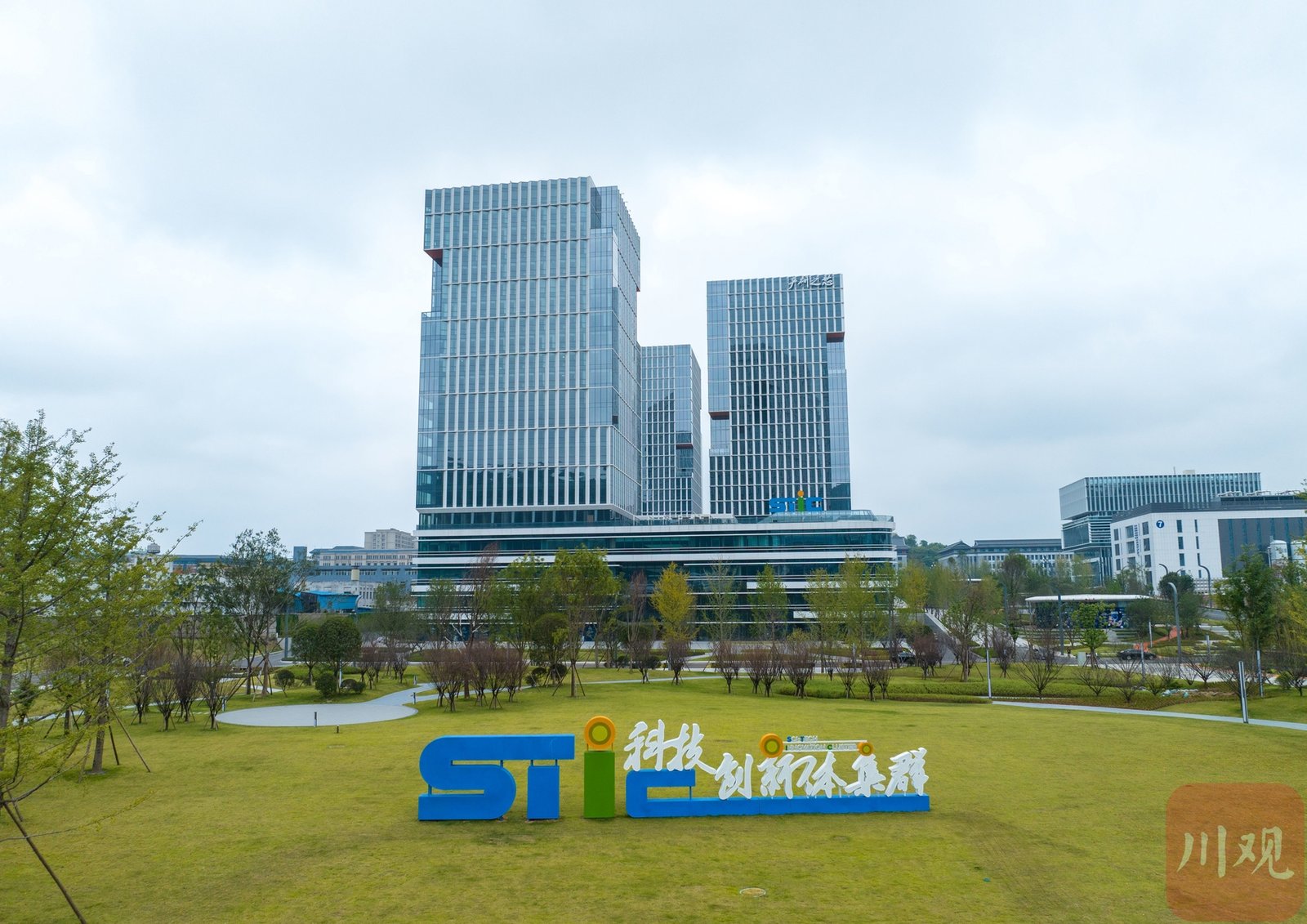
Some cities go further and give away homes. In many venture packages, a PhD from a well-known university who joins a start-up the city has chosen and funded can receive a flat worth several million yuan. Free. The flat is not discounted, and there is no subsidised mortgage behind it. And it is not in one of the notorious ghost towns. These are new flats in decent neighbourhoods in some of the strongest cities in the Yangtze River Delta and the Greater Bay Area. For a city with unsold stock on its books, a flat that houses a future chief scientist costs less than one that houses nobody.
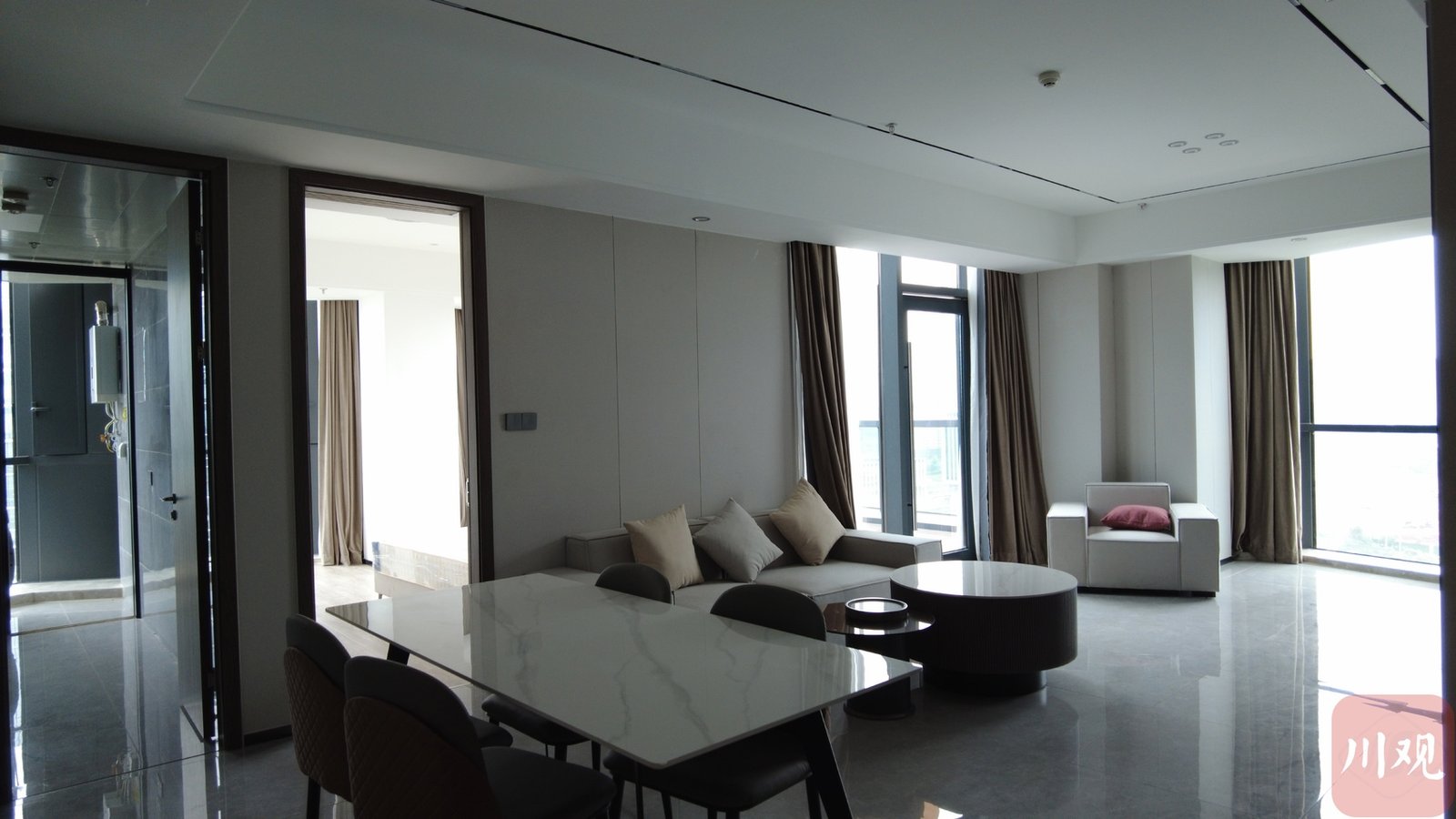
Foreign visitors see the same thing from the other side. A four-star room in a Chinese second-tier city costs about what a roadside motel costs in America. Call it what it is: surplus buildings rented out cheap. Owners lease them to hotel operators for very little, because some rent beats a vacancy with no end date.
What you will not hear at the summit
So the economists in Bangkok were right, and so are the people writing about China’s tech surge. AI investment will not replace property in the national accounts, and it was never meant to. For local governments, it is the only bet left that can pay for what they have already built. Having lost land as a source of revenue, they have pushed all their chips to the end of the table where the value chain is highest.
None of this shows up in the slides at high-profile China economic forums. Many people who have lived, worked and done business in China for years never see it either. City finances are opaque. The real numbers, what a district fund paid and what the rent waiver actually cost, are shared only within an official’s inner circle. Knowing someone is not enough. You have to be one of theirs. This is where guanxi stops being a cliché and becomes the price of entry.
The foreign visitor admires the metro and wonders who paid for it. The answer is a fund manager in a government office, who still needs one more company to become the best in the world.
Sources: property investment, land-sale revenue and fiscal spending, Ministry of Finance and National Bureau of Statistics, January to September 2026. Exports and semiconductor shipments, customs data for September and for the first nine months of 2026. AI investment estimate, Bank of America. Remarks by Ting Lu of Nomura and Andrew Tilton of Goldman Sachs at the Bangkok summit, October 2026. Jensen Huang, Lex Fridman Podcast, March 2026. New home prices, National Bureau of Statistics 70-city index, August 2026. Government venture money, national venture guidance fund briefing, National Development and Reform Commission, December 2025. Twenty-year life, ten years to invest and ten to exit, against the seven to ten years of a conventional venture fund. Guidance on the high-quality development of government investment funds, State Council Office, January 2025. Photographs: talent apartments at the Yibin University Science Park, Sichuan Online, June 2024.