Jensen Huang walked onto the stage at the Tempodrom in Berlin on 21 October and did not announce a new chip. Vera Rubin, already public, was confirmed as being in full production. The substance of the keynote was three operational problems: how to build compute capacity faster, how to control increasingly capable agents, and how physical AI gets into European factories and onto European roads.
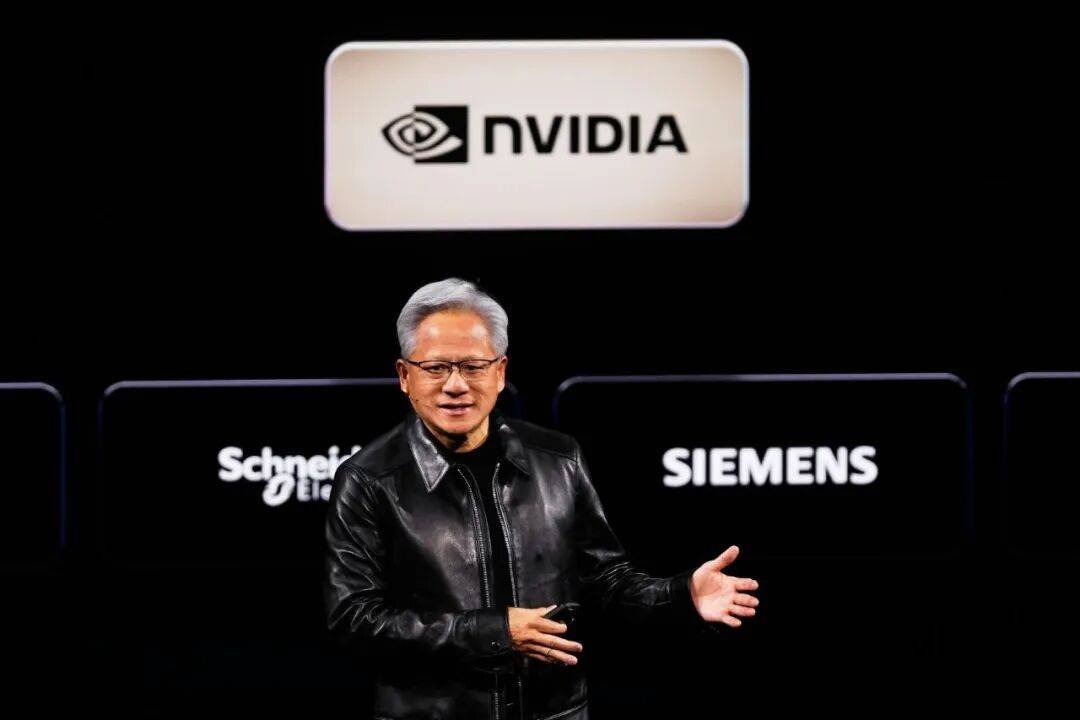
His framing was that the industry is inside the largest infrastructure buildout in human history. Demand is not the constraint. Throughput and deployment speed are.
The timing was pointed. Two weeks before the event, the Philadelphia Semiconductor Index was in its longest losing streak since 2008, as investors kept re-running the same calculation about when enormous GPU spending turns into returns.
A container is the product
The answer offered in Berlin is DSX POD. A full Vera Rubin AI factory is reduced to a modular reference design of seven liquid-cooled racks, roughly 17 km of internal cabling and 800V DC power distribution. Compute, networking, power and cooling are integrated and tested in the factory, then shipped in a container.
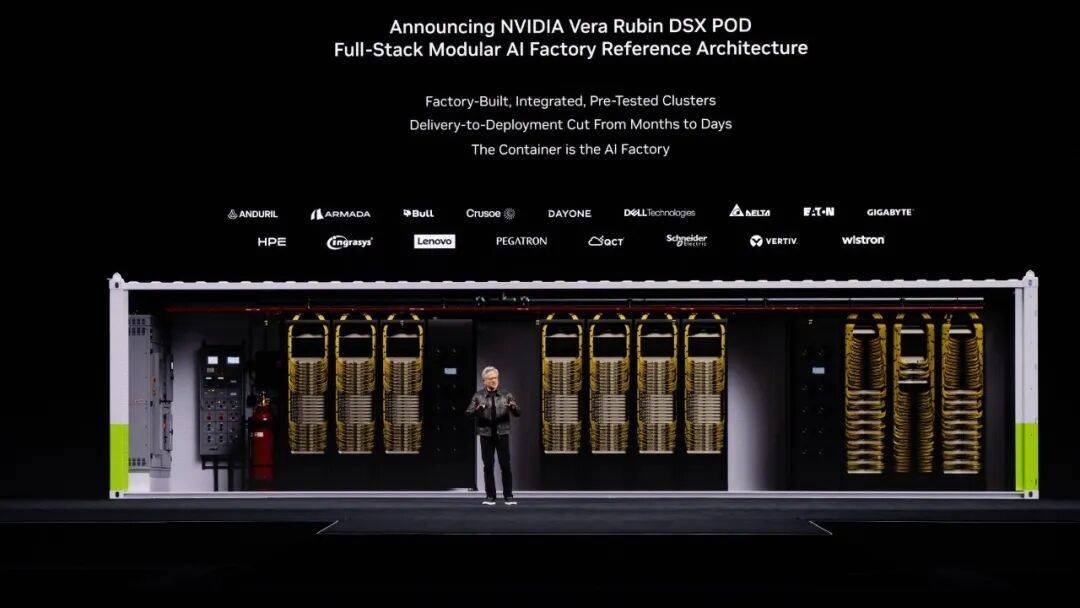
Dell, HPE, Lenovo, Schneider Electric and Vertiv build them, alongside Foxconn, Quanta and Wistron. Deliveries are expected to begin in early 2027.
On Nvidia’s figures, site deployment drops from about six months to as little as 14 days, assuming power, cooling and network are already provisioned at the site. That comparison matters because model release cycles are measured in weeks. A month of delay is a version of delay.
The real bottleneck is electricity
Huang describes the AI economy as a five-layer cake with energy at the base. As clusters scale, the binding constraint stops being silicon and becomes power.
Two power tools shipped alongside the hardware. DSX MaxLPS allocates wattage dynamically across GPUs, and Nvidia claims up to 30 per cent lower power draw for the same token output, which in practice means more GPUs inside an existing power envelope. DSX Flex links the data centre to the grid, shifting load according to price and supply conditions. In early tests simulating grid events, the load from a Blackwell Ultra cluster fell by up to 40 per cent.
Why Berlin, and why now
Huang’s conversation with German Chancellor Friedrich Merz circulated widely before the keynote. The message to a European government weighing AI regulation was that a tight leash may not be the optimal instrument when a new productivity wave is arriving.
Europe’s pitch to Nvidia is industrial: car plants, machine builders and chemical sites that could absorb physical AI. Europe’s problem is that the same governments are writing the energy and compliance rules that determine whether a container full of racks can be plugged in at all.
Editor’s note: This is an adapted translation of the original Sohu Tech report. It has been trimmed and restructured for readability for an international business audience. The full original (in Chinese) is at https://it.sohu.com/a/1091329230_413980.