MoSense, a company building full-body multimodal tactile systems, said on 26 October that it had closed an angel plus round in the nine figures. CDH Investments and Vitalbridge Capital led, with LimX Dynamics, Loongson Capital, Casstar, WestSummit Capital, Shanghai Pudong Venture Capital and an unnamed leading domestic humanoid manufacturer participating. Houlang Capital served as long-term exclusive financial adviser. Proceeds go to full-body tactile development, hiring, computing and a volume-testing system.
The company was incorporated on 21 May 2026, is headquartered in Zhangjiang in Shanghai, keeps a research centre in Shenzhen’s Qianhai, and was incubated out of a robot competition champion team at the Hong Kong University of Science and Technology.
Chief executive Yan Zhaoxu holds an interdisciplinary doctorate in microelectronics from HKUST and has taken several microelectronic devices into volume production. Chief technology officer Zhou Hang holds a robotics doctorate from the same university and was a senior algorithm researcher at Desay SV in Singapore, leading autonomous driving perception modules and working on world models and embodied algorithms. Chief financial officer Yang Mujun holds a doctorate in advanced materials from HKUST and previously worked at High-Flyer and ByteDance. Chief scientist Wen Weijia is a chair professor at HKUST and dean of the function hub at HKUST Guangzhou, and holds a second-class National Natural Science Award.
The gap is the back of the hand
The structural hole MoSense is aiming at is specific. Most existing tactile systems sit on the fingertips and pads of a dexterous hand or gripper, which covers fine local manipulation and leaves the back of the hand, the forearm, the torso and the sole of the foot unmeasured. Resistive, capacitive and vision-based approaches are limited by cost, coverage area and the number of modalities, which makes them hard to lay over a large continuous curved surface.
The company’s argument goes further. World models can train policies in simulation, and they degrade on a real machine. A large part of the reason is that the real machine lacks complete full-body tactile feedback, so physical interaction states cannot be mapped faithfully. The gap MoSense is trying to close is the tactile part of the simulation-to-reality divide.
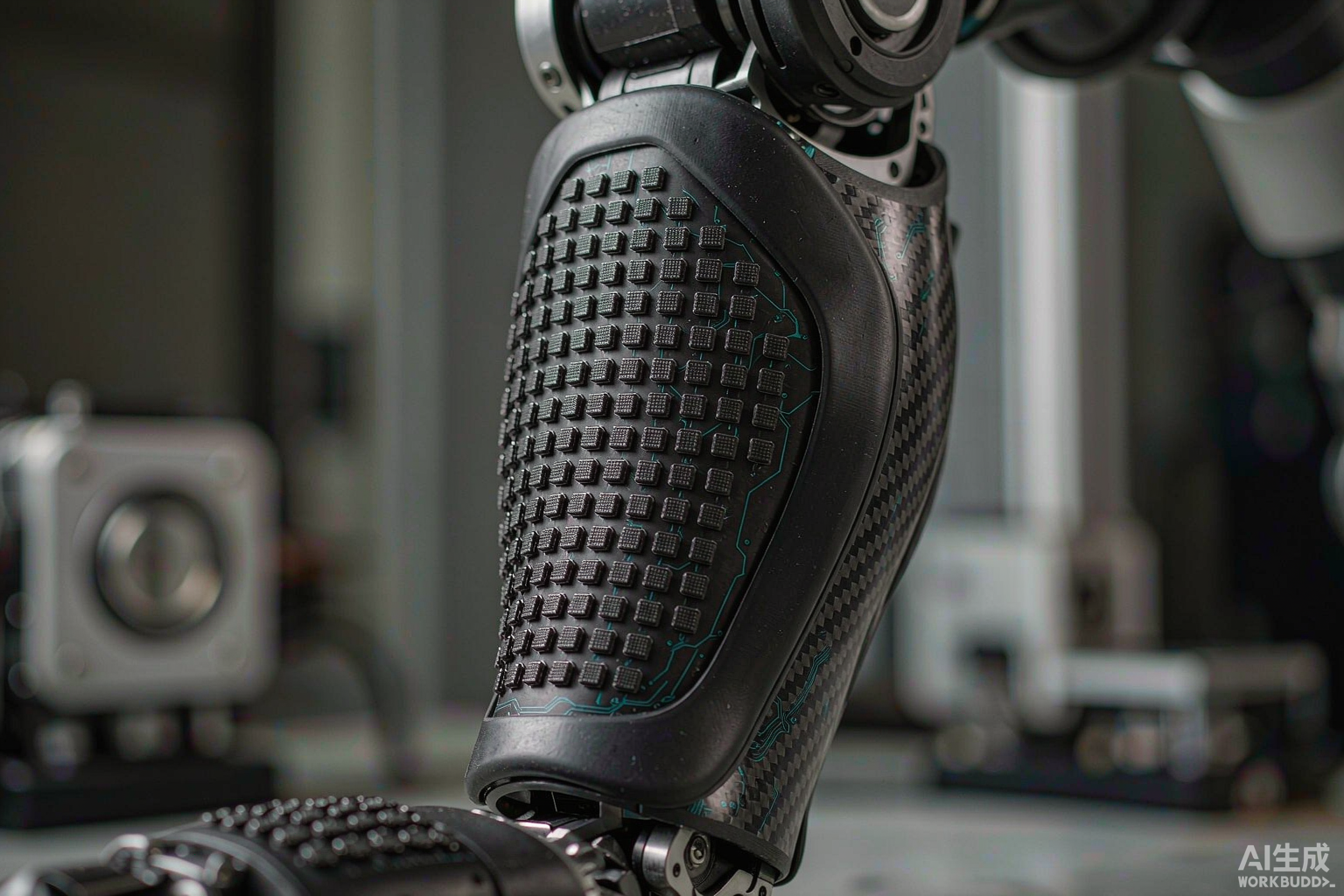
The core product is MoSkin, a multimodal metamaterial electronic skin based on electromagnetic metastructural mechanics. It covers hands, limbs, torso and feet, converts the rigid boundary of a robot body into a continuous six-axis force field, and captures force, temperature, slip, vibration and material at the same time.
Alongside the hardware the company is developing multimodal fusion algorithms, including a world-action tactile prediction model built on a latent-space gated fusion mechanism, which uses high-frequency multidimensional tactile feedback to correct low-frequency decisions and supplies physical priors from the whole body.
The modules have been optimised for volume manufacturing and support several flexible skin integration options. The company is extending into what it calls embodied engineering, applying adaptive airbag modules and flexible sensing to infant products, medical devices, home goods and automotive-grade applications.
MoSense won gold in the Shanghai round of the HKUST one million dollar entrepreneurship competition and set up a Shenzhen subsidiary in August 2026 to run South China operations. It has not disclosed revenue, a customer list or orders, and public information still sits at the stage of building a volume-testing system.
Editor’s note: This is an adapted translation of the original Gasgoo report. It has been trimmed and restructured for readability for an international business audience. The full original (in Chinese) is at https://www.gasgoo.com/apps/e060bad9eca91db7f01403fc7120041f/robot/news/70475906-/.