The awkward truth about humanoid robots in Chinese factories is that most of them arrive at sites nobody is willing to shut down for a retrofit.
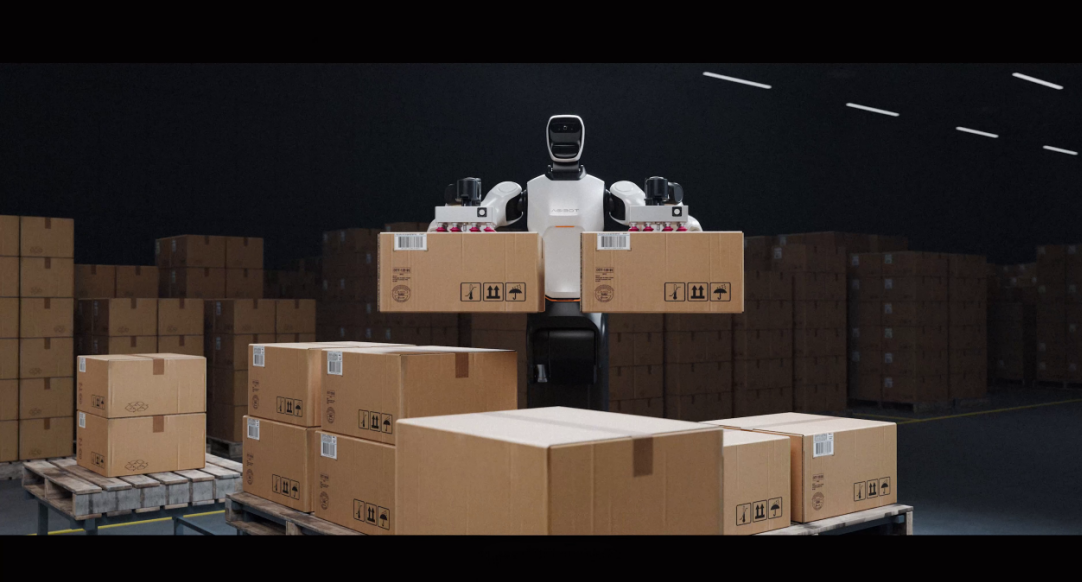
AgiBot, the Shanghai embodied-AI company known in Chinese as Zhiyuan, built its newest machine around that constraint. The Genie G2 Max, launched on 26 October under the company’s AI WAVE banner, is aimed at depalletising, material transfer and line feeding, and it is designed to fit an existing floor plan rather than replace it.
The load numbers are the headline. One arm carries 20 kg, the pair is rated at 40 kg, and peak dual-arm load reaches 50 kg, with repeat positioning accuracy of plus or minus 0.5 mm. AgiBot says that covers more than 95 per cent of the industrial bins and components currently moved by hand or by fixed automation.
The retrofit is the real product
Payload is the easy part to publish. The expensive part is everything around it.
G2 Max uses seven-degree-of-freedom force-controlled arms with vision-guided dual-arm force control, so it can handle cardboard boxes, European-standard returnable crates and irregular parts without a fresh teaching pass for each SKU. Its vertical working range runs from 0.1 m to 2.5 m and its horizontal reach covers 1.2 m, with a powered waist pitch joint that lets the torso lean forward for single-face depalletising. That last detail is the unglamorous one that matters commercially: pallets can sit flush against a wall, because the machine no longer needs the 1.5 m of clearance behind them that a gantry or a fixed cell requires.
AgiBot says the spatial adaptation is already running in a top-tier e-commerce warehouse, where the robot integrates with an existing goods-to-person shuttle system and completes full-box depalletising and empty-crate restacking at 80 and 75 boxes an hour respectively, inside the warehouse’s current layout.
Robots building robots
The second deployment is more pointed. On the T1 line at Qiyuan, G2 Max works as a precision handler on a joint assembly line, moving finished shoulder housings and hip joint assemblies from buffer areas to the final assembly station. That is a robot performing the kind of task that builds other robots.
Uptime is handled with dual hot-swappable batteries plus autonomous return to charge, which the company frames as covering the night shift that human labour does not want. Safety is built to industrial standards, with 360 degree multimodal protection combining 2D and 3D lidar, ultrasonics, bumper edges and physical emergency stops.
Software sits on Genie Studio 2.0, AgiBot’s embodied work platform, where customers compose tasks, validate in simulation and manage fleets. The company claims site adaptation measured in days rather than months, which is the claim that will decide whether this hardware leaves the demo floor.
The numbers to watch
Chinese humanoid makers spent 2026 competing on videos. The competitive ground is shifting to delivery, and delivery is measured in cycle time, re-teach hours and hours between failures, not in degrees of freedom.
A 50 kg payload humanoid that can be dropped into an unmodified warehouse is a genuinely different sales proposition from a 50 kg payload humanoid that needs a new cell built around it. AgiBot has published the specification. The orders will show whether the retrofit argument holds.
Editor’s note: This is an adapted translation of the original Gasgoo report. It has been trimmed and restructured for readability for an international business audience. The full original (in Chinese) is at https://www.gasgoo.com/apps/e060bad9eca91db7f01403fc7120041f/robot/news/70475937-%E6%99%BA%E5%85%83%E6%AD%A3%E5%BC%8F%E5%8F%91%E5%B8%83%E5%AE%89%E8%A7%84%E7%BA%A7%E9%87%8D%E8%BD%BD%E5%85%B7%E8%BA%AB%E6%9C%BA%E5%99%A8%E4%BA%BA%E7%B2%BE%E7%81%B5g2-max/.