Moonshot AI has not launched anything. The model’s name appeared in a teaser video, in an API config file, in a code editor menu, and then in an arena leaderboard under a codename, and the benchmarks people are running against it already tell a story.
The trail started in late September, when developers found a model identifier reading kimi-k3-1 in the Moonshot API platform’s configuration files. On 21 October an option labelled K3.1 appeared quietly in the Kimi Code model switcher, effectively a limited test for developers. Then two strong anonymous models appeared in the arena under the codenames Kibitz and Kalmia, with Kibitz performing particularly well on front-end and 3D code tasks.
Developers matched the codename to Moonshot’s naming pattern: K2.5 was Kiwido, K2.6 was Kiwire, K3 was Kivine, and K3.1 would be Kibitz.
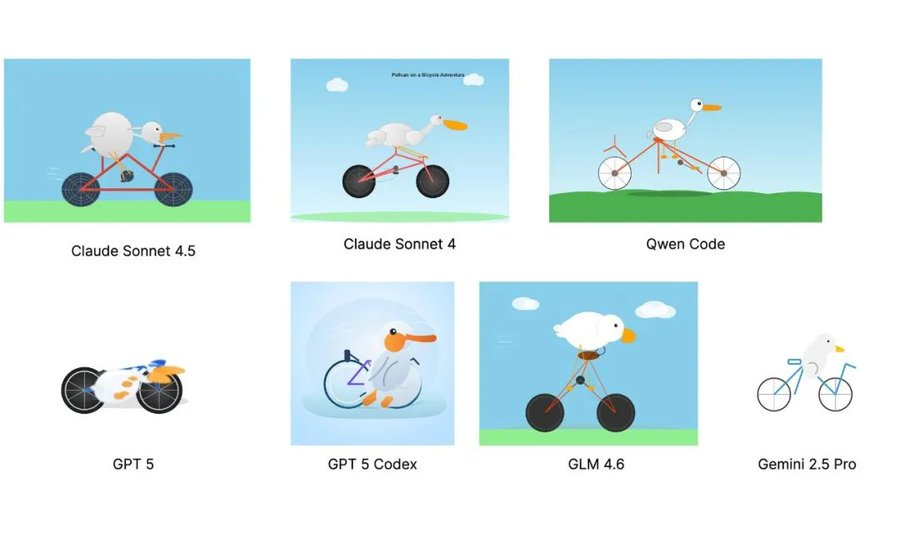
What the test actually measures
The standard probe in Chinese AI circles is a pelican riding a bicycle, drawn in code. The image cannot be retrieved from a reference set. The model has to reason about a bird’s anatomy and a bicycle’s mechanics, then compute the geometry and relationships in Three.js or a comparable library.
Early models produced abstract failures. The comparison circulating this week puts Claude Sonnet 4.5, Claude Sonnet 4, Qwen Code, GPT 5, GPT 5 Codex, GLM 4.6 and Gemini 2.5 Pro alongside the Kimi output, and the Kimi render holds centre of mass, wheel contact and scene composition.
One tester reported running a full 24-hour day and night cycle simulation, with light transitions frame accurate across the whole sequence. Another produced an interactive 3D helicopter model in 15 minutes, and a third rendered a steam train with every component exploded into a separate, correctly positioned part.
The cost comparison is where the claim gets sharp. Against GPT-6 Astra the two models produced comparable Minecraft-style builds, and Kimi K3.1 did it at roughly one fourteenth of the cost. Against Kimi K3 itself, the new model runs at about 70 per cent of the cost with better token efficiency. In frontier-model comparisons, testers reported token consumption at a fraction of the foreign models for equivalent 3D code complexity.
The weakness is honest
Not everything held. In a test asking models to approach Claude Opus 5.5 quality, Kimi K3.1 produced a running giraffe whose motion did not follow plausible biomechanics.
A merge request in the SGLang codebase added another detail, showing a new Medium thinking tier that expands the model’s reasoning levels from three to four, letting it allocate compute by task difficulty.
The lineage explains the direction. Kimi released the K1 visual reasoning model in December 2024, open-sourced the Kimi-VL series in April 2025 with 2.8 billion active parameters, and shipped the 2.8 trillion parameter Kimi K3 in July 2026, which took first place on the arena front-end code leaderboard.
The constraint nobody is hiding
A Nomura report cited in the Chinese coverage says Moonshot is developing a larger model expected to carry 5 to 6 trillion parameters, effectively doubling K3, and that compute shortage is the main obstacle to training it on schedule.
That single sentence is the whole story of Chinese frontier AI in 2026. The models are competitive at a fraction of the price, and the binding constraint has moved from talent and data to the physical supply of accelerators.
Cheap inference is a durable advantage. It is also what you build when you cannot build the biggest cluster.
Editor’s note: This is an adapted translation of the original Leiphone report. It has been trimmed and restructured for readability for an international business audience. The full original (in Chinese) is at https://www.leiphone.com/category/yanxishe/PZo9w14YeFSo4jmf.html.