Nvidia’s favourite cloud customer is now the clearest test of whether the AI build-out can pay for itself.
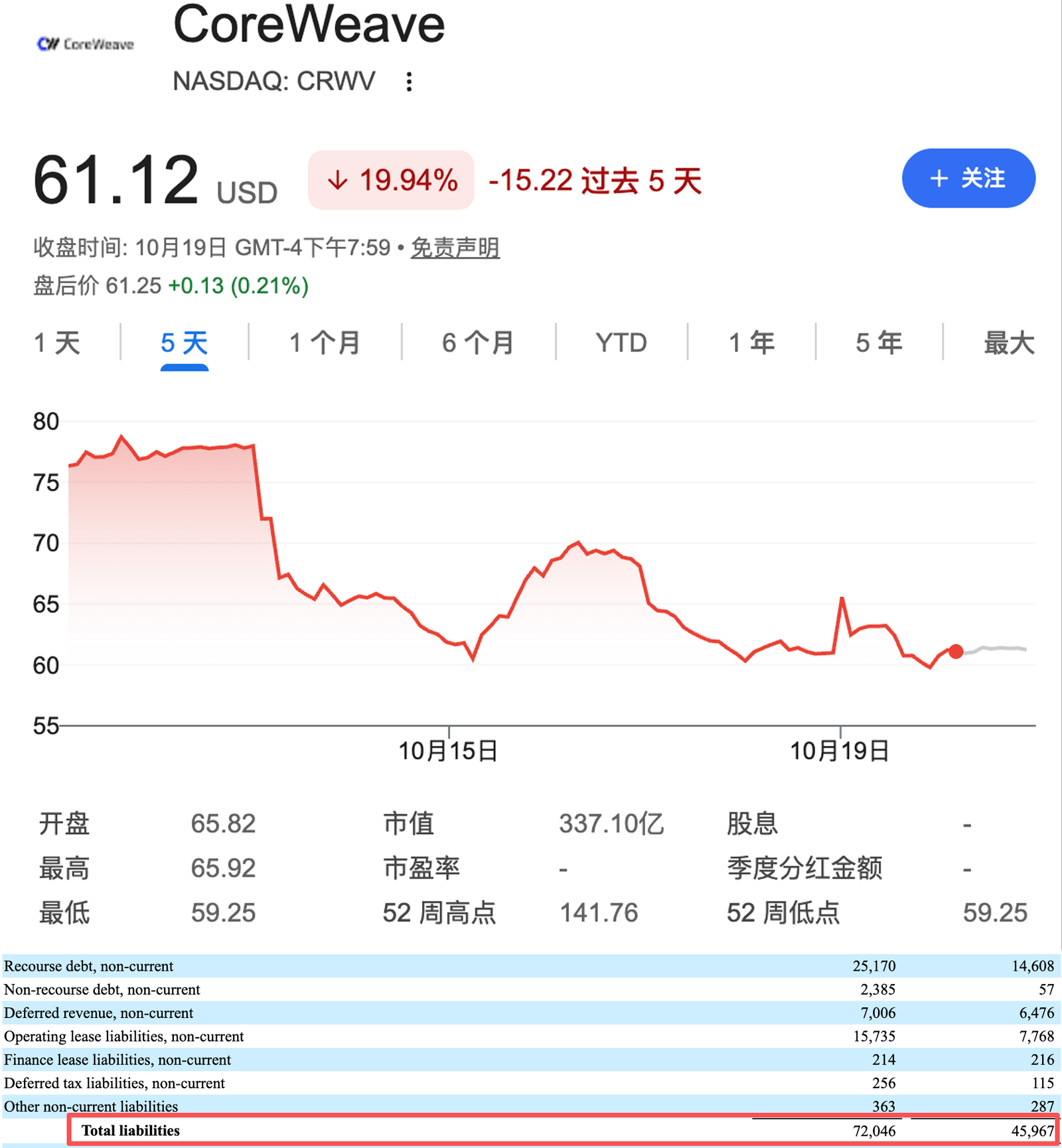
CoreWeave, the neocloud that borrows against GPU fleets and contracted compute orders, has been hit on both sides of its capital structure. Its shares fell more than 23 per cent in eight trading days and sit 55.7 per cent below this year’s peak. Its disclosed total liabilities reached USD 72.05 billion, or roughly RMB 481.2 billion, at the end of June 2026.
The debt trajectory is the part that reads badly. Total liabilities were USD 5.109 billion in 2023, USD 45.967 billion at the end of 2025, and USD 72.046 billion by mid-2026. Revenue grew about 112 per cent year on year to USD 2.575 billion in the second quarter, but the company still posted a net loss of USD 626 million, or USD 1.14 per share.
The credit market moved first
Equity weakness is survivable. What turned this into a sector event was the credit signal.
According to S&P Global Market Intelligence data cited by Reuters, CoreWeave’s five-year credit default swap spread briefly widened beyond 1,100 basis points, implying a 64 per cent probability of default over five years. Its 2032 notes, issued with a 9.625 per cent coupon, traded at an intraday yield of 15.1 per cent.
That is not a company being repriced for slower growth. That is lenders asking to be paid for the risk they think they are carrying.
The IPO queue is breaking in public
Two listings have already been damaged. Firmus withdrew a USD 5 billion IPO on 9 October after failing to attract enough subscribers. Nscale, a British neocloud, saw its listing plan stumble after the Daily Telegraph reported on 18 October that Microsoft would cancel a cooperation agreement, with no reason given.
Bloomberg then reported that Nscale is in talks with Anthropic on a USD 45 billion compute deal, a contract that would be the strongest argument yet for restarting the listing.
The selloff spread across the listed complex between 12 and 19 October: CoreWeave down 23.91 per cent, Nebius down 18.96 per cent, Core Scientific down 8.59 per cent. Even Oracle was caught in the move, because the concern is now about data-centre expansion economics rather than one balance sheet.
The business model being stress tested
The neocloud model is simple and unforgiving. Sign long-term compute framework agreements with model companies, pledge those contracts and the GPUs as collateral, borrow from private credit, lock Nvidia allocation, build the data centre, then collect monthly rent that must cover interest, operations, hardware depreciation and principal.
It works while GPU supply is scarce and rental rates hold. It fails if any link slips, and every link is now under simultaneous pressure.
Nvidia chief executive Jensen Huang and several Wall Street institutions have stepped in to argue the market has overreacted. They may be right about the quarter. The structural question is separate: whether trillions of dollars of AI infrastructure capex can generate enough revenue to service the debt taken on to build it.
CoreWeave is not the answer to that question. It is the first place the question gets priced.
Editor’s note: This is an adapted translation of the original Zhidx report. It has been trimmed and restructured for readability for an international business audience. The full original (in Chinese) is at https://www.zhidx.com/p/602553.html.