A drone the size of a hand and about as heavy as a smartphone has now flown faster than a Formula One car, and the margin over the previous record is not close.
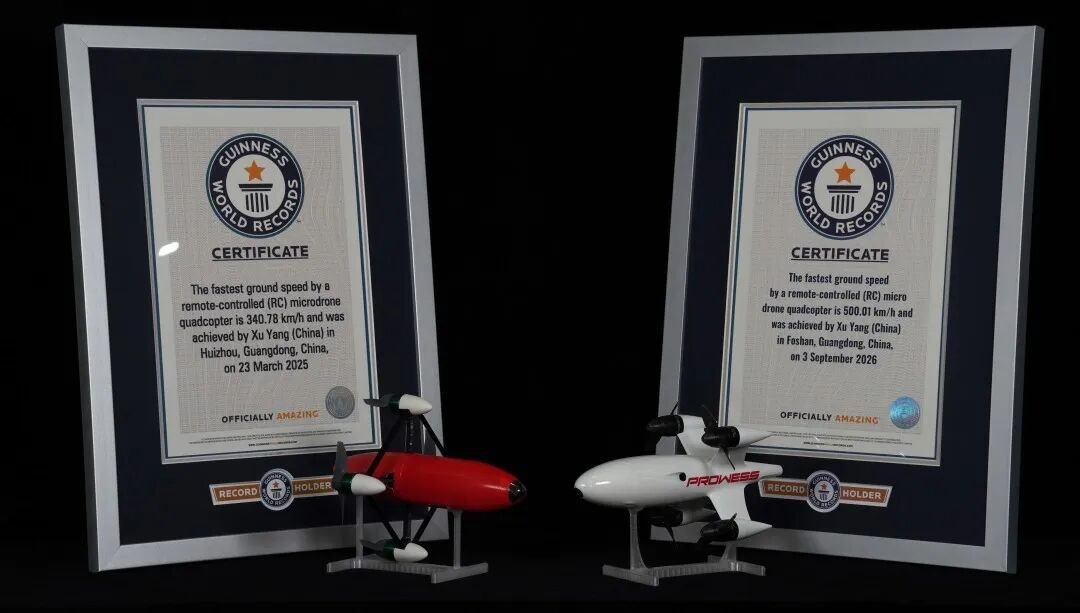
Xu Yang, an undergraduate at the School of Science and Engineering and Morningside College at CUHK-Shenzhen, set a new Guinness World Record with his self-designed micro quadcopter PROWESS-V3 at 500.01 km/h. The previous record, 358.36 km/h, was set by a student team in Tianjin. The new mark is 141 km/h faster.
At that speed the aircraft covers close to 140 metres every second, with a total mass under 250 grams.
Why 250 grams is the hard part
The engineering constraint is not speed. It is speed inside a mass budget.
Xu describes the problem as solving drag, power delivery and structural rigidity simultaneously under a 250 gram limit, where every gain in one area eats margin from the others, and the space and mass available to fix it keep shrinking as velocity rises.
The official attempt took place on 3 September 2026. The last test flight before it had already reached 488 km/h, which would have broken the record on its own, but Xu wanted to clear the 500 km/h round number. Surface preparation, including airframe polishing and painting, was optimised in the final days, and the run landed at exactly 500.01 km/h. He received the physical certificate at the end of September.
An open blueprint, then a counter-attack
In March 2025 Xu first broke the record at 340.78 km/h and then open-sourced the drawings of that aircraft. In December 2025 a student team in Tianjin improved on the open design and took the record at 358.36 km/h.
That is what triggered the second attempt. Xu said he wanted to retake the record by a decisive margin rather than by a fraction, and that he wanted to find out how fast a sub-250 gram airframe could actually go with current technology.
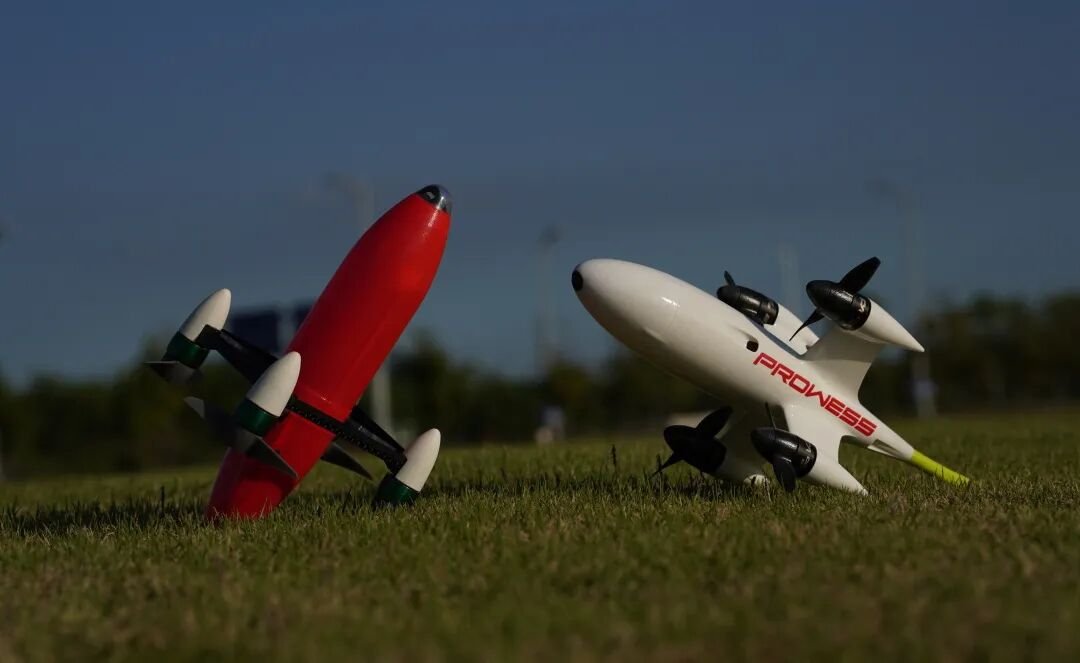
PROWESS-V3 is an accumulation of incremental work rather than one breakthrough. The motor uses custom windings, the propellers are 3D printed rather than injection moulded specifically so design parameters could be revised repeatedly, and as late as the end of August he was still testing propeller variants.
The project also spent months stalled. Power testing produced no meaningful speed gain for a long stretch until late July, when he found a workable power system combination that pushed the test rig past 400 km/h.
Why this belongs in a robotics feed
Xu has been building model aircraft for over a decade and accepted a role as head of drone research and development at a technology company in July 2025.
His argument for the record is the transferable part. Aerodynamic optimisation, lightweight structural design and power system matching learned on this airframe apply to other classes of aircraft, so the value is not the number itself but the design vocabulary the project generated.
Shenzhen’s drone industry is usually discussed in terms of delivery volumes and export share. The other half of that ecosystem is a supply chain dense enough that an undergraduate can source custom motor windings and iterate 3D-printed propellers until a record falls, then publish the drawings and let a rival in another city cut in front.
Records are cheap to break when the parts are close by.
Editor’s note: This is an adapted translation of the original Shenzhen News report. It has been trimmed and restructured for readability for an international business audience. The full original (in Chinese) is at https://www.sznews.com/news/content/2026-10/23/content_32198846.htm.