At GTC Berlin, Nvidia and Agile Robots jointly launched Agile ONE SN, a humanoid built for research rather than for a factory floor. The significance is not the machine. It is who is standing next to it.
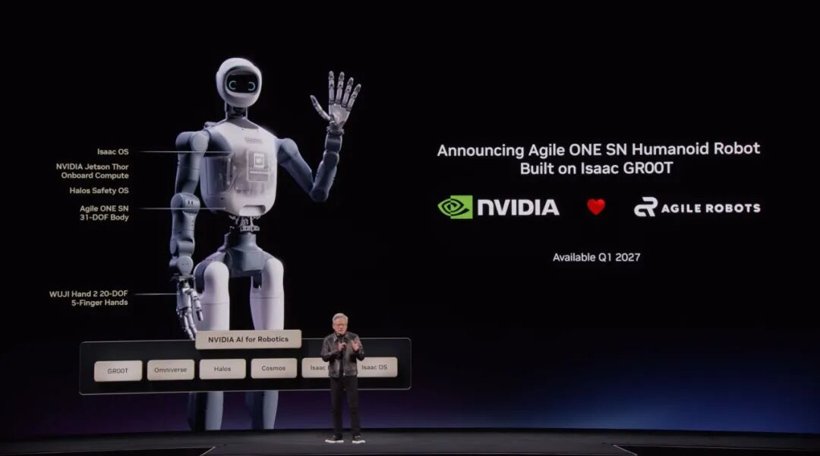
Nvidia has spent three years building Isaac into the default development stack for physical AI. Choosing a Chinese-headquartered robotics company to produce the reference humanoid that ships with that stack is a statement about where the hardware competence now sits.
The specification, briefly
Agile ONE SN stands 1.4 metres tall and weighs 43 kilograms, with 31 degrees of freedom. It carries Nvidia’s Jetson Thor compute platform on board for real-time sensor processing and robot inference.
Joint torque reaches 140 newton metres and each arm carries up to 3 kilograms. The sensing set includes a head-mounted RGB-D camera, wrist cameras, 3D lidar and an inertial measurement unit, with Wi-Fi 7 and Bluetooth connectivity.
Those numbers describe a machine designed for manipulation research in a laboratory, not for payload work on a line. The 3 kilogram arm limit in particular signals the intent: this is a platform for learning and benchmarking, not for material handling.
Why the software bundle matters more
The unit ships with Isaac GR00T preinstalled, including GR00T 1.7, an open vision-language-action model, plus whole-body control and an end-to-end reference workflow. That workflow covers demonstration data capture, data generation, simulation, training, evaluation, deployment and real-world testing.
URDF and USD assets are provided so the model can be imported directly into Isaac Sim and Isaac Lab for simulation and learning research. Agile Robots says this cuts the initial setup period from weeks to days.
For a university lab, that is the difference between spending a semester on integration and spending it on the research question. For a corporate research group, it is the difference between a two-quarter procurement and a two-week one.
Agile Robots is also exploring integration with Nvidia’s Halos safety platform, covering design, verification and software. Safety certification is the gate that separates a research humanoid from a commercially deployable one, and no Chinese humanoid maker has yet cleared a Western functional safety standard at scale.
The 2027 product ladder
The Agile ONE S and SN series are scheduled for launch in early 2027, where they will sit alongside the full-size Agile ONE aimed at industrial applications. That gives the company a two-rung ladder: a research platform that seeds the developer base now, and an industrial machine that monetises it later.
Interest has already come from Stanford and ETH Zurich, according to the company. Both are exactly the institutions whose graduates populate robotics teams at car makers, warehouse operators and defence contractors, which is the point of seeding them.
At the same conference Nvidia expanded the Isaac open robotics platform with new learning tools, datasets and workflows. The pattern is familiar from CUDA: give the tooling away, make the hardware cheap to start with, and let the ecosystem standardise on your abstractions.
What this means for the Chinese humanoid field
There are dozens of Chinese companies building humanoids and very few whose machines run on a stack that a Western research lab is willing to adopt by default. Being the reference platform is a position that compounds, because every paper, dataset and benchmark produced on the hardware strengthens the moat around it.
It also creates dependency. A company whose research platform is co-branded with Nvidia’s stack inherits Nvidia’s roadmap, its release cadence and its geopolitical exposure. That trade is worth making while the alternative is obscurity.
The strategic read is that Nvidia has concluded it does not need to build a humanoid. It needs one good one, from a partner, that everyone else measures against.
Editor’s note: This is an adapted translation of the original Gasgoo report. It has been trimmed and restructured for readability for an international business audience. The full original (in Chinese) is at https://www.gasgoo.com/apps/e060bad9eca91db7f01403fc7120041f/robot/news/70475823.