Most Chinese robotics money is chasing legs, arms and payload. A company in Kunshan is chasing something smaller and, on the evidence of its investor list, more investable: the monitor on your desk.
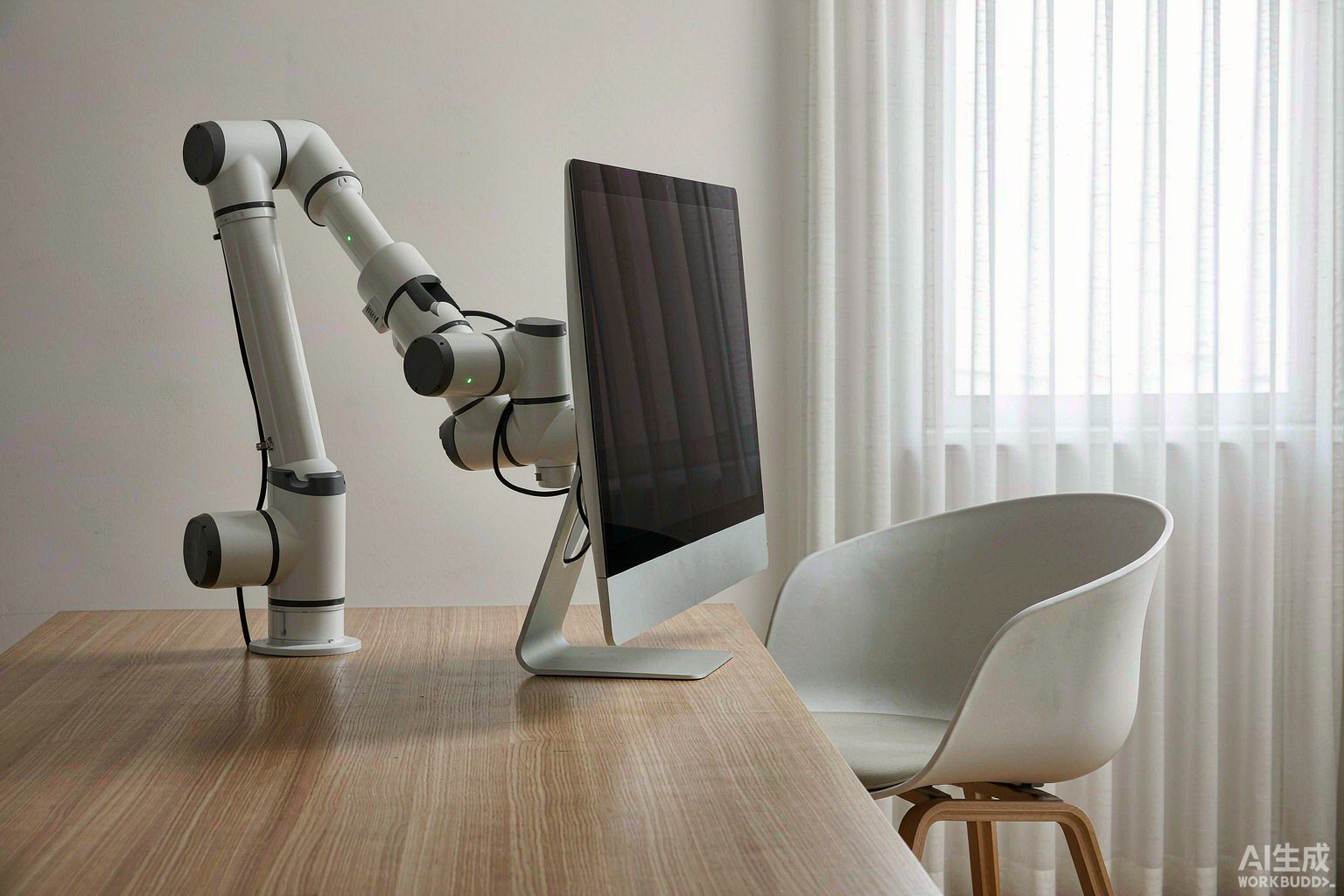
CyboPal, registered in March 2023 and spun out of Tsinghua-linked research, has completed a strategic funding round from TCL Industries’ strategic investment arm and Shenzhen Capital Group, with Xinhui Capital acting as long-term exclusive financial adviser. The company operates under the legal name Jiangsu CyboPal Intelligent Technology.
Three rounds in eighteen months
The pace is the signal. The strategic round arrived less than three months after a round in the hundreds of millions of RMB led by Oriental Fortune Capital, with Legend Star and Tianqi Capital participating. Before that came an angel round.
For a company whose first product has not yet shipped at volume, going from angel to strategic in about eighteen months is not simply a fundraising achievement. In the current market it means the company was selected by the category rather than by a single fund’s thesis.
What the strategic round changes is the investor mix. A financial round validates a team and a story. A strategic round from an industrial player validates whether a company is allowed onto a supply chain and into a retail channel.
The product is a reversal, not a robot
CyboPal ONE contains three things: a 27-inch 4K 160Hz display, a six-axis silent robotic arm with 747 millimetres of reach, and an AI compute base built on a Rockchip RK3588 running an on-board assistant called Pauli.
The behaviour follows from that hardware. Lean back and the screen tilts to face you. Turn sideways to pick up a cup and it recentres itself. Gesture push and pull, voice scheduling and window splitting are handled in natural language. Vision and voice perception close locally, and a single physical button cuts the camera and microphone.
The framing the company uses is that the display industry has ignored a problem for a decade: people move to find the screen, when the screen should move to find the person. Once a large model makes natural-language control reliable, the object you sit opposite for eight hours a day stops being furniture and becomes the most convenient physical entry point for an agent.
Presales are the strongest argument
CyboPal ONE raised USD 400,000 on its first day on Kickstarter. Over the past month it has taken more than 1,000 units and over RMB 10 million across crowdfunding and offline channels, with early-bird pricing starting at USD 1,499.
For a hardware investor, that single data point is worth more than a business plan, for three reasons. It shows overseas early adopters will pay a premium for active perception. It gives the production line a real yield and lead-time problem to solve, which becomes negotiating leverage in the next round. And it tells a strategic investor that this is not a motorised monitor but a consumer-facing agent endpoint.
Funds are earmarked for volume delivery, AI interaction development and the launch of WhisPrompt, a handheld AI work device with voice input, buttons and a dial for laptops and mobile working.
The twelve-month window
The category is only now attracting giants. Apple’s rumoured J595 pairs a display of roughly 9 inches with a motorised arm that can identify who is speaking and turn toward them, and is not expected before 2027 or 2028. Alibaba’s Qwen office line launched a desktop robot called QwenNote Eva at RMB 899 during this year’s Yunqi conference.
That leaves roughly twelve months in which an early company can define the category before the incumbents arrive with distribution. CyboPal has chosen to spend part of that window buying legitimacy from a panel maker and a state fund rather than buying reach with advertising.
Where the thesis can break
The product costs more than RMB 10,000, depends on the PC ecosystem and sells an agent capability that has no standard. Presales are not repeat purchases.
The most dangerous moment is not the next funding round. It is the reception of the first thousand deliveries. If the arm is noisy, if privacy mode is unreliable, or if Pauli fails to work across applications, the valuation logic collapses back to high-end monitor, which is a much smaller business.
Editor’s note: This is an adapted translation of the original OFweek report. It has been trimmed and restructured for readability for an international business audience. The full original (in Chinese) is at https://robot.ofweek.com/2026-10/ART-8321204-8420-30709030.html.