Axera Semiconductor used an industry forum in Shanghai to lay out a strategy that runs in the opposite direction to most Chinese semiconductor narratives. It is not chasing the most powerful chip. It is chasing the chip that European law requires every new car to carry.
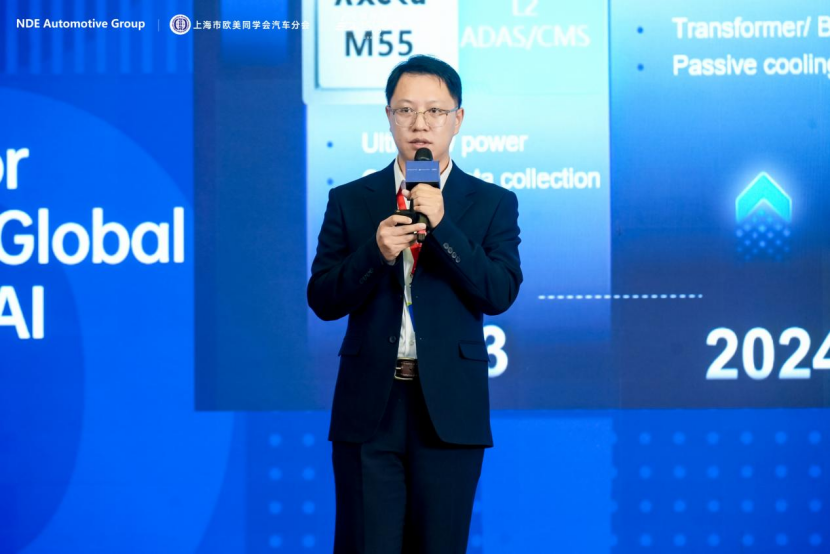
The company listed on the Hong Kong main board in February 2026. By August its cumulative automotive chip shipments had passed 1.6 million units, spread across more than 50 mainstream models since its first automotive part entered production in 2023. The M57, launched in 2025 and in mass production since March, reached a European launch in October on a leading new energy brand’s battery-electric model.
Regulation is the demand curve
The European market for entry-level driver assistance has been manufactured by statute. Since 2022 the EU has phased in mandatory requirements covering driver fatigue and distraction monitoring and automatic emergency braking, with the R171 regulation extending obligations toward higher-level assistance. China is on a similar path, with AEB expected to become standard on light vehicles by 2028.
The volumes involved are large and predictable. Axera estimates that regulation-driven AEB and related systems will account for about 50 million vehicle installations a year globally within three to five years, roughly 12 million of them in China. Above that tier, higher-level assisted driving reached 10 million units worldwide in 2025, 6.5 million in China, with compound growth of about 28 per cent globally and 29 per cent in China over the next three years.
Stacking the roadmap underneath the law
The product plan maps onto those tiers. The M55, in production since 2023, has shipped on more than a million vehicles as an L2 entry part. The M57 is aimed at regulated entry-level and information security requirements, typically in a single front camera unit or a five-camera five-radar parking and driving domain controller.
Above that, the M97 taped out in February with 720 TOPS and 460GB/s of memory bandwidth, sized for vision-language-action models and world models. The M95 offers 360 TOPS for single-stage end-to-end urban navigation on autopilot, with the M9x family scheduled for production in the second quarter of 2027. A separate X6 part, taped out in September, is the company’s first cockpit-adjacent AI box co-processor, supporting dense models up to 14 billion parameters and mixture-of-experts models up to 70 billion.
Axera is positioning itself strictly as a tier two supplier, selling silicon, low-level software and tooling while leaving integration to tier one partners. It also leans on two in-house technologies: an AI image signal processor first proposed around 2020, which improves imaging in tunnels and very low light, and a neural processing architecture now in its sixth generation.
The strategic point is not that a Chinese company can build a competitive automotive chip. It is that the compliance tier of the market, the least glamorous and most predictable tier, is where Chinese suppliers can enter Europe without needing a European badge of approval. The regulation does the qualifying.
Editor’s note: This is an adapted translation of the original Gasgoo report. It has been trimmed and restructured for readability for an international business audience. The full original (in Chinese) is at https://auto.gasgoo.com/news/202610/27I70476021C106.shtml.