Automotive software developers spend an average of 35 per cent of their time on base software integration: connecting operating systems to middleware, adapting systems and handling configuration. That is the central finding of the 2026 Driving the Future SDV developer report published by QNX, the BlackBerry-owned real-time operating system supplier, on 22 October.
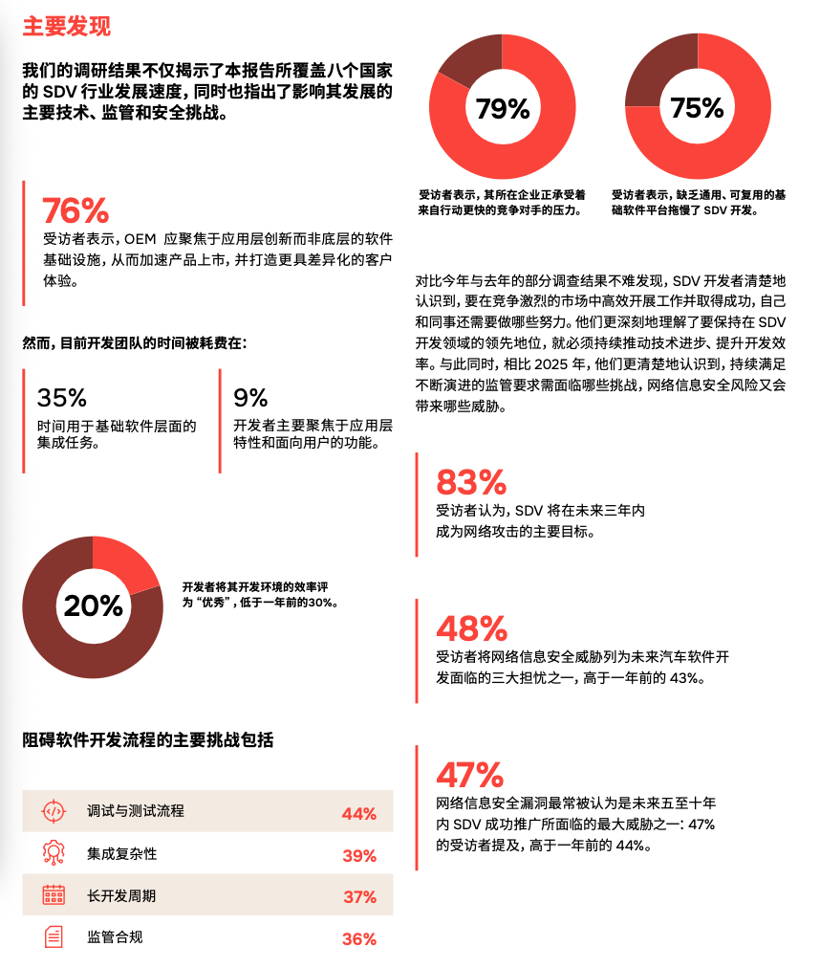
The survey covered 1,100 automotive software developers in eight major markets including China, the United States, Germany and Japan. Seventy-nine per cent said pressure from faster competitor iteration is increasing, and 75 per cent said the absence of a common, reusable base software platform is slowing software-defined vehicle development.
The allocation of effort is lopsided. Only 9 per cent said their teams focus mainly on application layer features and user-facing functions. Sixty-three per cent split their work roughly evenly between base software and application development, and 28 per cent concentrate mainly on base software.
Reuse is the missing layer
Only 22 per cent of respondents said their company can reuse one base software platform widely across most vehicle programmes or ECU domains. Sixty-eight per cent reuse it in some projects while other projects still require custom development.
China is the outlier. Just 12 per cent of Chinese respondents reported wide reuse, below the global average of 22 per cent and below the United States at 28 per cent and Korea at 27 per cent. Eighty-two per cent described a mixed model in which some projects share a platform and others are built to order.
That is not a statement about engineering capability. It reflects a product rhythm in which brands launch many models quickly, each with different feature sets and architecture versions, which multiplies the integration work every time a new electronic architecture arrives.
The strain shows in the tool chain. Debugging and testing was named the biggest challenge by 44 per cent of respondents, up from 36 per cent in 2025. Integration complexity rose from 36 to 39 per cent, and long development cycles were cited by 37 per cent. The share who rated their development environment excellent fell from 30 per cent to 20 per cent, and those rating it excellent or good fell from 86 to 81 per cent.
The security bill arrives next
Forty-eight per cent named cybersecurity threats as a leading concern for future automotive software development, up from 43 per cent. Eighty-three per cent expect software-defined vehicles to become a primary target for cyber attack within three years. In China the concern is sharper still at 54 per cent, up 15 points year on year.
Regulation is adding to the load. More than 700 new regulations or legislative proposals directly affecting in-vehicle technology development appeared globally in 2025, up from about 500 the year before, and 33 per cent of respondents said new requirements had delayed software schedules. Ninety-five per cent rated functional safety as important.
Seventy-six per cent said carmakers should shift more resources into application layer innovation rather than rebuilding base software. The interesting question is why, after a decade of the software-defined vehicle pitch, that shift has still not happened at scale.
Editor’s note: This is an adapted translation of the original Gasgoo report. It has been trimmed and restructured for readability for an international business audience. The full original (in Chinese) is at https://auto.gasgoo.com/news/202610/27I70475970C108.shtml.