Five executives from Renault, Mann+Hummel, FORVIA Hella, Gentherm and Haiwei were asked the same question at a forum in Shanghai on 23 October: how does a car technology still earn a return when the advantage it creates lasts less than a model cycle?
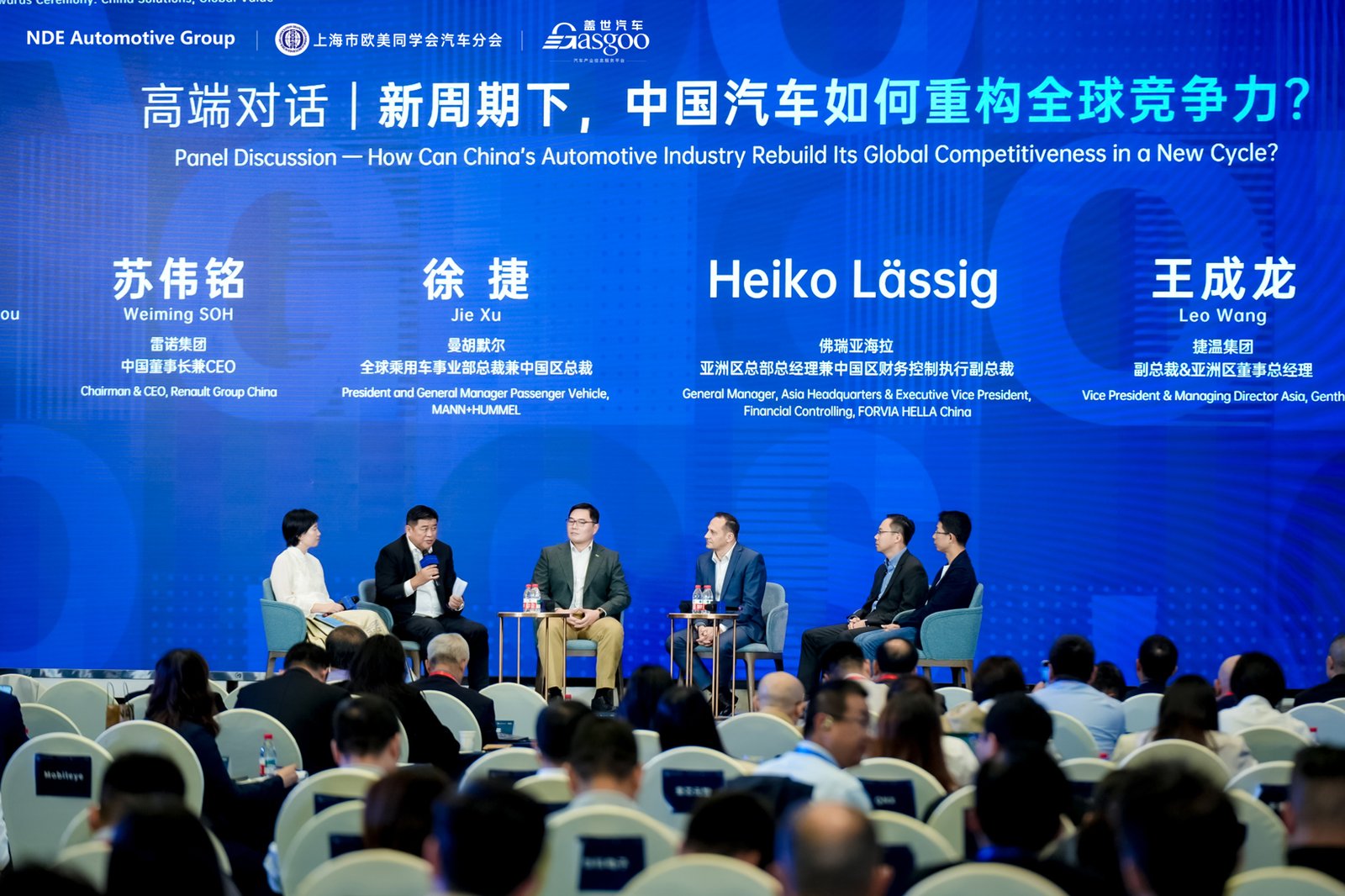
Su Weiming, chairman and chief executive of Renault Group China, described a market where the cost gap between new energy and combustion technology has narrowed to almost nothing across electric drive systems and electrical architecture during 2026. That is good news for adoption and bad news for pricing power, because a technology everybody has is a commodity.
He also questioned where the money is going. Buyers in South America and Singapore, he said, ask about range, price, colour and charging time. They do not ask about battery capacity or motor output. On smart cockpits, he argued that rising investment in features that produce similar experiences across brands will not generate a durable advantage.
The data agrees with him
JD Power’s China smart vehicle experience study, published in May 2026, found the industry innovation index up 70 points to 658, while the function performance index declined for the first time in four years. More features stopped translating into better experience.
Xu Jie, president of Mann+Hummel’s global passenger car division and its China head, described the practical version of the problem: a technology can be superior and still lose, because arriving a year late means the market and the competing technology have moved on. Speed to market now matters more than the innovation itself.
Wang Chenglong, vice president and Asia managing director at Gentherm, defended the opposite bet in narrow terms. The company still funds zero-to-one development where the result is something no competitor offers, because that is where premium pricing and a genuine window exist.
What customers will actually pay for
Deciding which features deserve funding is harder than it sounds. In a Gasgoo survey of 390 respondents after August storms, 46 per cent said rarely used capabilities are still valuable if they matter at the critical moment, and 44 per cent said such features should exist but should not add noticeable cost. On willingness to pay, 34 per cent refused any premium and 36 per cent capped it at RMB 3,000.
Li Linfeng, founder of Haiwei, offered the counter-example. When his company took on Nio’s NOMI interactive assistant, the client expected an option take rate of about 30 per cent. It settled above 80 per cent for years. The project took 18 months to deliver from a company then turning over tens of millions of renminbi.
The sourcing environment is tightening from the other direction. Li said PCB, MLCC and some chips have seen price rises and supply volatility this year, which he attributes largely to AI demand and expects to persist for three to five years. TrendForce has separately noted MLCC capacity shifting toward high-end applications, squeezing some automotive grades.
Tier one suppliers are responding by moving up the chain into materials, processes and equipment, and by consolidating development. Mann+Hummel now runs its global new energy technology centre in Shanghai across more than 80 branches worldwide, and Gentherm has made China its global incubation centre, with ventilation products developed by the Shanghai team for worldwide use.
The old bargain was that innovation bought a price premium for a few years. That window is now shorter than the payback period on the tooling.
Editor’s note: This is an adapted translation of the original Gasgoo report. It has been trimmed and restructured for readability for an international business audience. The full original (in Chinese) is at https://auto.gasgoo.com/news/202610/27I70475928C108.shtml.