At the 2026 World Intelligent Connected Vehicle Conference, the most consequential announcements were not about cars. A new edition of the national framework for vehicle networking standards opened for public consultation, and seven national standardisation technical committees signed a cooperation framework covering automotive, intelligent transport, communications, traffic management, geographic information, smart cities and road transport.
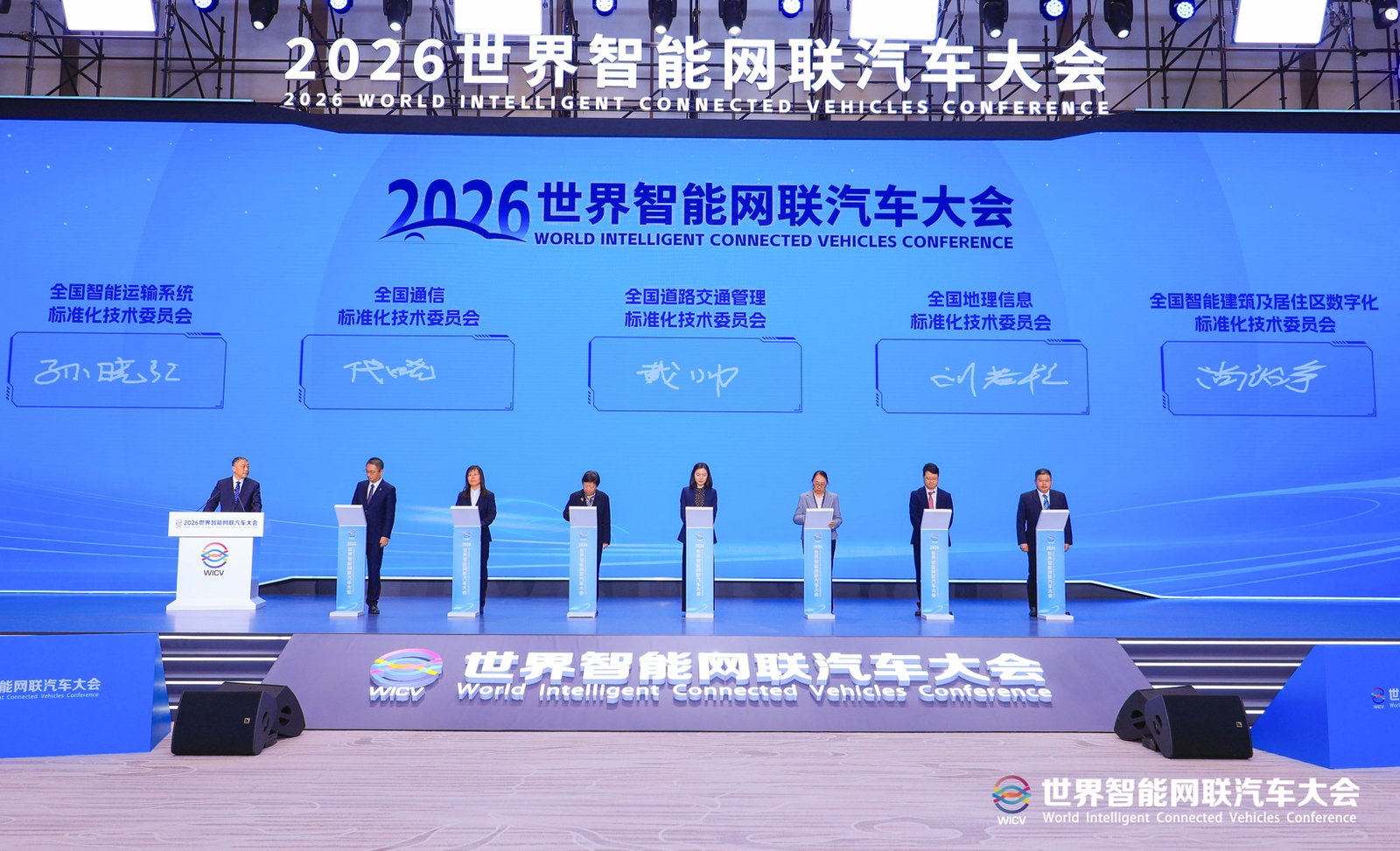
The scale of the effort is unusual. Guo Shougang, director of the equipment industry department at the Ministry of Industry and Information Technology, said China has run more than 400 standards research projects across connected vehicle fields. Sun Hang, chief engineer at the China Automotive Standardisation Research Institute, gave a more precise ledger: 90 national and industry standards already published, 62 in the pipeline, 24 awaiting project approval.
The fleet outran the rulebook
The industry moved faster than the standards process. L2 combined driver assistance now fits 70 per cent of new cars sold in China, and assistance functions of some kind appear on close to 100 per cent. As of August, about 61 million passenger cars carried L2 functions, 16 million had 5G terminals and 2 million had C-V2X.
Safety standards are already binding. Two mandatory national standards on automotive information security and software updates, GB 44495 and GB 44496, took effect this year, and a mandatory standard on automated driving safety, GB 44721-2026, has been published.
From participant to author
The international dimension is the part European and American regulators should watch. MIIT has served as vice-chair of the United Nations working group on automated driving for seven consecutive years, China has led the drafting of about 20 international standards, and Chinese experts took part in completing the first UN global technical regulation on automated driving.
The domestic roadmap sets targets of more than 140 standards by 2030, covering cooperative development of single-vehicle intelligence and networked assistance, and more than 200 by 2035. The intelligent connected vehicle section of the new framework uses a three-level, four-dimension structure of 4 parts, 19 sections and 40 sub-fields, running from terminology and general requirements down to architecture and components.
Adjacent domains are moving at the same pace. The communications standardisation committee plans more than 150 revised or new standards by 2030, covering NR-V2X, 5G-Advanced, 6G and in-vehicle satellite internet. Twenty cities or consortia have entered vehicle-road-cloud pilot programmes, with traffic light data reaching vehicles among the first commercial uses.
Standards are the least visible form of industrial policy and the most durable. A car built to a Chinese test procedure, with Chinese communication protocols and Chinese data definitions, is easier to sell in markets that adopt those standards and harder to sell in markets that do not.
Editor’s note: This is an adapted translation of the original Gasgoo report. It has been trimmed and restructured for readability for an international business audience. The full original (in Chinese) is at https://auto.gasgoo.com/news/202610/27I70475985C601.shtml.