China’s automotive industry sold more vehicles than ever and kept less of the money. Data published by Cui Dongshu of the China Passenger Car Association shows industry profit of RMB 267.5 billion in the first nine months of 2026, down 23 per cent year on year, on revenue of RMB 8.0435 trillion, which rose 2.6 per cent.
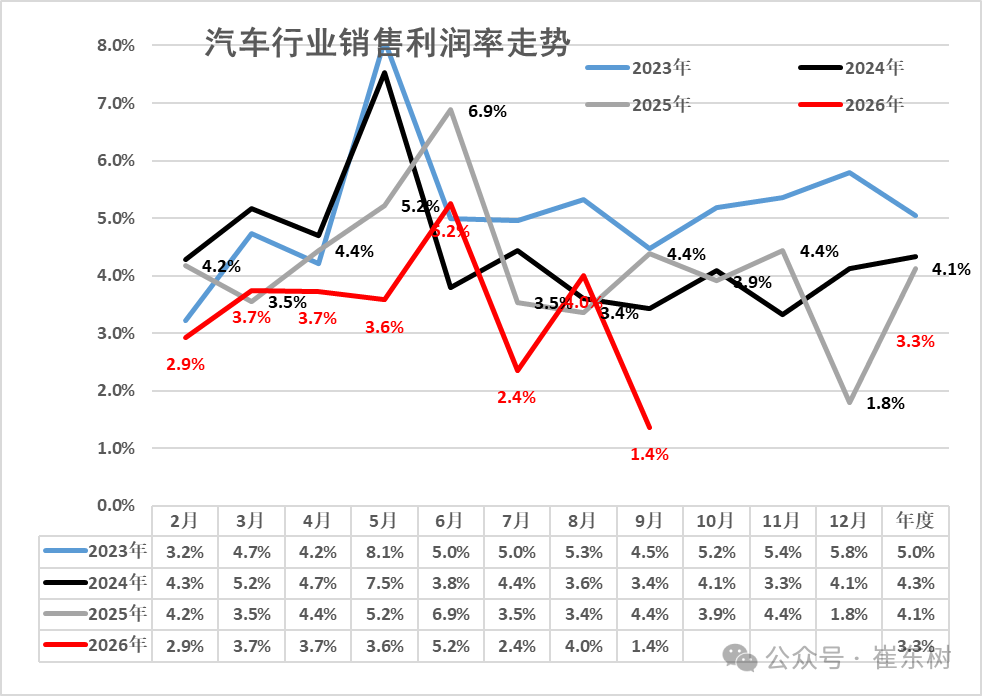
Costs grew faster than revenue at RMB 7.1627 trillion, up 3.8 per cent. Output reached 23.37 million vehicles, down 4 per cent, which means the industry produced less and earned less while still collecting more revenue.
September was the worst month. Output was 3.06 million vehicles, revenue RMB 1.0374 trillion, up 0.6 per cent, and costs RMB 925.7 billion, up 2.5 per cent. Profit fell 68 per cent to RMB 14.2 billion, a sales margin of 1.4 per cent, the lowest in about four years and below the previous monthly low of 1.8 per cent set in December 2025. For comparison, the industry margin was 4.3 per cent in 2024 and 4.1 per cent in 2025.
The squeeze is upstream
On a per-vehicle basis, measured on the statistics bureau output basis and including double counting, revenue came to RMB 344,000 per unit, up 5.8 per cent. Cost per unit reached RMB 306,000, up 7 per cent, and taxes and fees per unit RMB 26,000, up 7.2 per cent. Gross profit per unit fell 21 per cent to RMB 11,000.
The cost pressure is not coming from labour. Memory prices have risen sharply, lithium carbonate has doubled, and commodity prices remain elevated. Non-ferrous metals and semiconductor companies have booked large profit gains over the same period, which is the other half of the same transfer: margin moved out of vehicle assembly and into the components and materials that go into a vehicle.
Demand-side policy has been easing domestic consumption, but the industry’s profitability has lagged other consumer goods sectors. September was also hit by pressure on combustion vehicle production and sales, compounded by the timing of the mid-autumn holiday.
The structural read is simple. An industry adding volume while losing margin is buying share with cash, and the balance sheet of the average Chinese carmaker is now the binding constraint on how long that strategy can run.
Editor’s note: This is an adapted translation of the original Gasgoo report. It has been trimmed and restructured for readability for an international business audience. The full original (in Chinese) is at https://auto.gasgoo.com/news/202610/27I70476007C108.shtml.