In early October four Chinese ministries, led by the Ministry of Industry and Information Technology, published a draft for public comment on strengthening the management of automotive product innovation design and R&D test validation. The comment period closes on 10 November.
The draft adds 51 main technical parameters to the vehicle filing process. Forty-one of them concern innovative design. Ten concern R&D test validation.

For an industry that has spent five years treating cabin hardware as a design competition, this is the moment the competition acquires a compliance department.
The filing form was never built for these parts
Ten days after the draft appeared, MIIT chief engineer Wang Weiming explained the background at a State Council Information Office briefing. Domestic model iteration has kept accelerating and market innovation is active, but launching derivative products by following the crowd, and validating them insufficiently, have appeared alongside it. Those two problems are the stated reason the four ministries acted.
Under the previous announcement framework there was no separate filing column for this class of structure. When an automaker filed a new model, the questions concerned dimensions, powertrain, emissions and basic safety equipment. The design and validation status of door handles, screens and cabins was not on the form. Regulators saw the configuration that reached the market, could not fully trace the design process, and could not systematically check whether a new structure had ever been failure-tested.
The draft pulls that content out into its own section. Most of the questions take the form of whether a feature is fitted at all: a fully concealed door handle, an electronic-mirror-only configuration, a folding or flexible display, a roof-raising cabin function usable while driving.
Asking first whether something exists, then whether it complies, looks like a small procedural change. It relocates the regulatory entry point from post-launch investigation to the filing stage.
The prohibited list is short and specific
Fully concealed door handles must not be fitted at all.
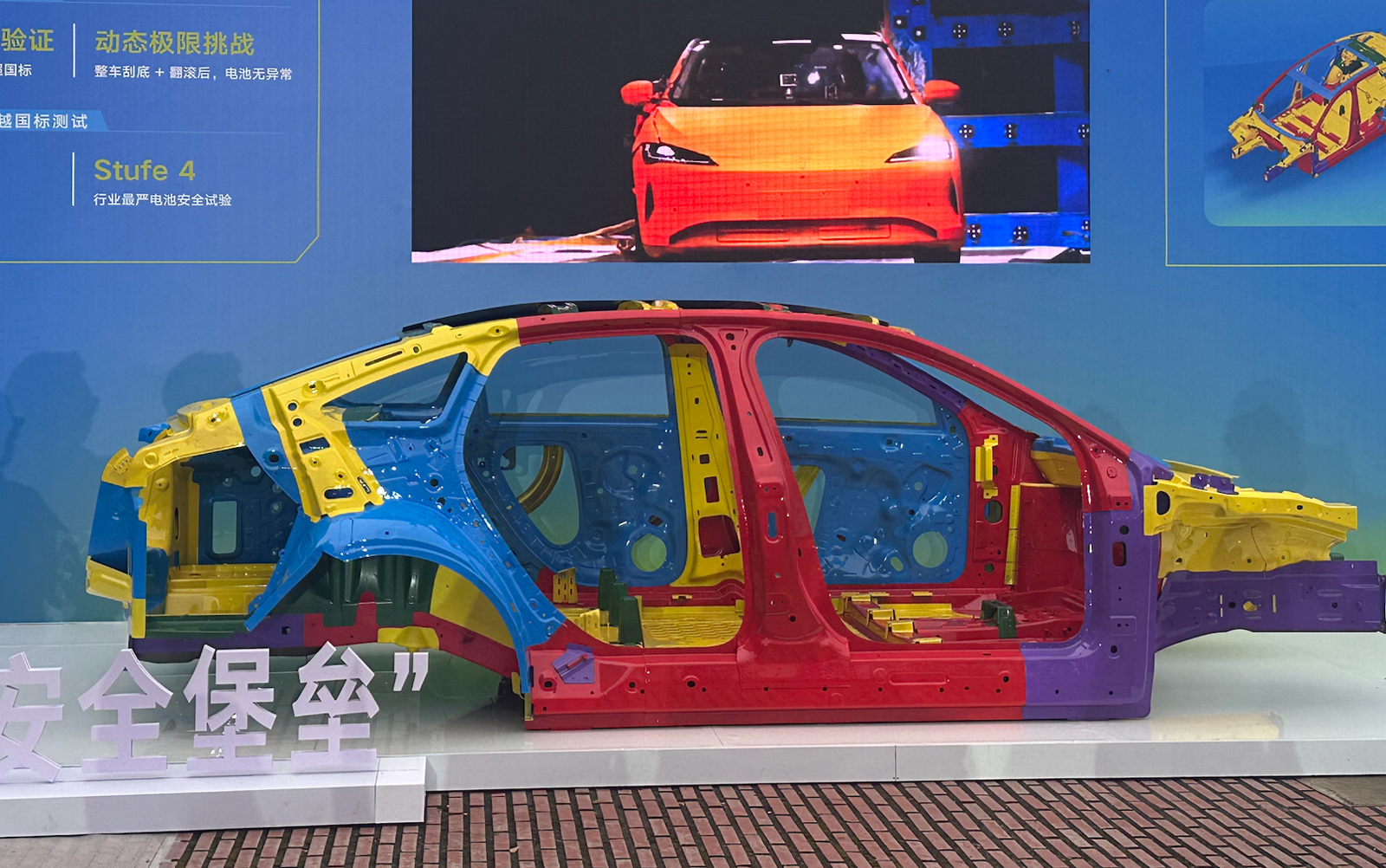
Zero-gravity seats, rotating seats, seats that fold flat into a bed, and roof-raising cabins may be installed, but must not be usable while the vehicle is moving, and manufacturers must lock the function out by technical means.
Emergency escape, emergency braking and power cut-off controls must retain a physical structure and clear marking. Soft-close doors must support manual opening when unpowered or faulty. Any innovative structure that fails risk assessment must not enter mass production.
The test applied to each item is whether a reliable fallback exists after failure. Electronic mirrors illustrate the logic. Their legal basis is GB 15084, revised in 2022, and from July 2023 automakers could legally file production models with them. Three years on, few models carry them, held back by procurement cost and user habit. The draft now requires an additional assessment of mud and water occlusion and extreme weather for electronic-mirror-only vehicles.
Folding displays went the other way and landed on the prohibited list. The dividing line is whether occupants retain a second reliable safety path when the structure fails.
Validation becomes something you have to hand over
Two technical annexes accompany the draft. One sets out risk assessment methodology for innovative design. The other specifies test requirements across six areas: comprehensive reliability and durability, structural reliability, software functional reliability, environmental adaptability, heating and cooling, and protection and sealing.
The uniform scale is where the cost sits. Reliability validation mileage must be no less than 30,000 kilometres. Environmental adaptability validation must run for at least one year and complete a cold, hot, cold sequence, known in the industry as two winters and one summer.
Validation must rest on real vehicle testing with fully traceable data. Simulation reports cannot serve as the validation basis on their own. Innovative design parts must map item by item to the list entries, with the full validation file retained. Records must be kept for at least six years, and problems exposed by testing must be fixed and re-validated. Filing with a known defect is explicitly out.
Off-season testing and indoor environmental chamber simulation are permitted as substitutes, provided their validating effect is not lower than real road testing. Multi-factor coupled environments that cannot be reproduced in a laboratory must be road tested.
The consequence clause is the enforcement mechanism. Models that are not tested as required, are insufficiently validated, or submit false materials will not be granted an announcement. Without an announcement a vehicle cannot be sold, which is a harder instrument than an administrative interview.
Qualified third-party institutions may issue formal inspection documents. In-house laboratories can handle most test items, but the automaker must give a written commitment on the authenticity of all material, and any item tied to a mandatory national standard must come from a licensed body.
Automakers also cannot simply accept component supplier reports. They must run vehicle-level incoming inspection on parts such as door handles and in-car screens, and reconcile component versions and software configurations against the filed model.
The evidence behind the door handle ban
C-IASI data shows that in side-impact collisions, models fitted with purely electronic concealed door handles achieved successful door release 67 per cent of the time, against 98 per cent for traditional mechanical handles. Complaints about release mechanisms freezing shut in northern winters have stayed persistently high, which indicates the failure envelope of electronic structures runs well beyond what automakers covered in early testing.
On 21 August nine automakers issued recall notices simultaneously, covering more than 4 million new energy vehicles. The root cause was insufficient identification of interior emergency release handles, which blocked escape after a collision cut the power. China has since issued a mandatory national standard specifically for door handle safety, requiring mechanical opening to work reliably after power loss and handle markings to be clearly visible.
Folding screens carry their own physics. A hinge and flexible substrate create new hard impact surfaces at the screen edge and mounting bracket during a collision. A passenger display playing video while the car is moving is a distraction risk that software locking alone cannot verify externally. The passenger screen position also frequently overlaps the passenger airbag deployment path, which changes the airbag trajectory and makes crash calculation considerably harder.
Roof-raising cabins follow the same logic. Raising the cabin while moving changes the centre of gravity and vehicle height and substantially raises rollover risk, so the function is permitted only when stationary.
What it costs, and who it costs most
The validation obligation lands on the vehicle manufacturer, and it reshapes supplier relationships. Door handles, screen hinges and cabin actuators come through multi-tier supply chains where test report formats and test conditions are not standardised. An automaker cannot simply collect the paperwork. It has to re-check component test conditions against real vehicle conditions and confirm that hardware versions, software iteration records and final installed state all match.
That forces vehicle-level management down through tier two and tier three suppliers. It also arrives at a capacity constraint: the number of domestic testing institutions qualified to support announcement filing is limited, and once a large batch of new projects files at the same time, test scheduling stretches and eats the development buffer.
The divergence between companies will be sharp. Automakers with mature platform architectures can reuse part of the validation work inside an adaptation envelope and spread compliance cost across several models. Companies built around a single model, without a complete internal test system, must build the institution, the test capability and the archive from scratch.
New filing models comply from 1 January 2027. Models that already hold an announcement get a six-month supplementary filing window running to 1 July 2027. A new model normally takes 36 to 48 months from programme approval to production, with validation consuming 8 to 12 of those months, so the real target is not next year’s launches. It is the cars still on the drawing board.
Editor’s note: This is an adapted translation of the original Gasgoo report. It has been trimmed and restructured for readability for an international business audience. The full original (in Chinese) is at https://auto.gasgoo.com/news/202610/27I70476017C601.shtml.