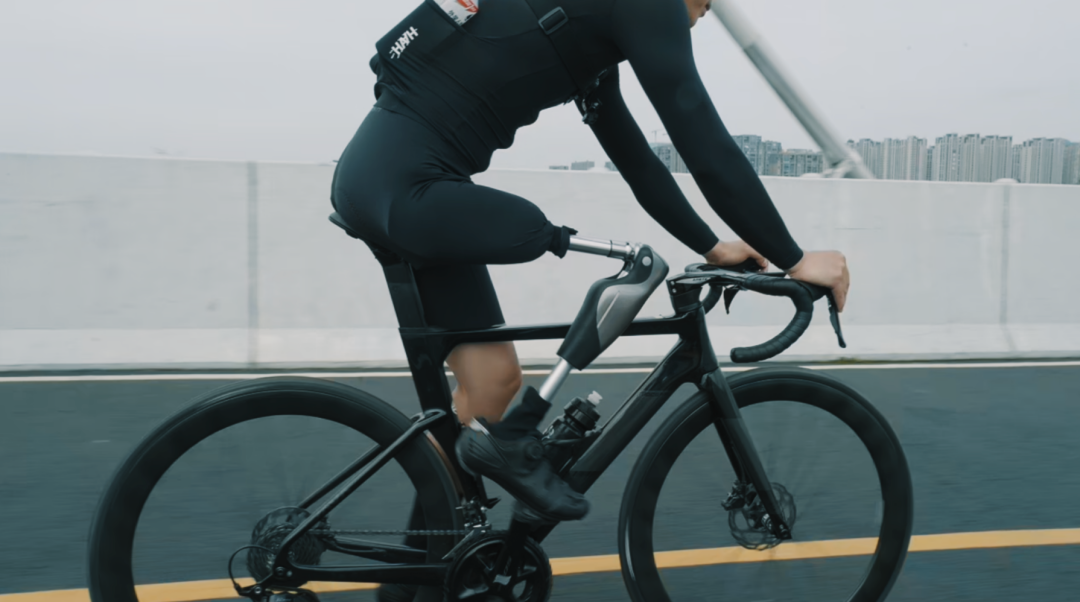
On 27 October, Synrise closed a Pre-A round in the tens of millions of yuan, invested solely by Yunqi Partners. The angel round before it had brought in Vertex Ventures and K2VC. The company makes bionic prosthetic limbs, which is not where the capital in embodied AI has been going.
That is the point. While the sector crowded into dexterous hands and humanoid bodies, two engineers from Tsinghua’s elite programmes chose a narrower field with a harder technical bar and a much clearer payer.
Where the founders came from
Liu Derui grew up in Chengdu. In 2008, as a teenager, he watched television coverage of the Wenchuan earthquake and saw people carried out of the ruins having lost their lower limbs. He went on to study robotics engineering at the University of Toronto, returned to China, and joined Tsinghua’s Institute for Interdisciplinary Information Sciences.
His co-founder and chief technology officer, Gao Jie, won a gold medal at the national olympiad in informatics and graduated from Tsinghua’s Yao Class. The two had started a company together in 2020, attempting to apply AI in the energy sector. It failed after a little over two years.
What followed was not another dash at a hot sector. They reviewed where their skills actually landed, weighed dexterous hands, prosthetics and exoskeletons, and picked the option capital liked least.
The asset that cannot be simulated
Synrise’s first product, the Synrise S5 bionic hydraulic knee, is in mass production. It has been validated with users in Europe, and the company holds more than RMB 10 million of orders from customers in China and abroad.
The more valuable output is the data. Every unit shipped returns gait data from a real user walking on real ground, and the cumulative total has passed 40 million steps. Yunqi’s assessment of that dataset was restrained and, in context, pointed: it is a barrier that is difficult to replicate.
This is the argument the prosthetics business makes against the humanoid business. A simulation can run a walking policy ten thousand times and still not encounter the specific way a real person stumbles on a particular step, with a particular limb length, at a particular body weight. The data that teaches a device to catch that fall has to come from someone falling, or almost falling. Few companies in embodied AI have access to that kind of signal, and none of them can generate it artificially at volume.
Why the price is the story
The high-end prosthetic market has been held for decades by established European manufacturers. Products routinely cost hundreds of thousands of yuan, which puts them out of reach for most of the people who need them and turns the category into something purchased by institutions rather than by users.
Synrise built the S5 on China’s consumer electronics and precision hardware supply chain and priced it below RMB 100,000, with a design life of at least five years and intelligent hydraulic control. That is still a significant sum. It is also the difference between a device a family can consider and one it cannot.
The cost reduction is not cosmetic. It changes who buys, and therefore how many units ship, and therefore how much gait data returns, and therefore how good the next control model is. Price, volume and data quality form a loop here in a way they do not in humanoids, where price cuts mostly buy market share from a competitor with the same cost structure.
What comes next
The next product is a knee that actively outputs power rather than only managing resistance. Over three to five years, the company plans to extend from prosthetics into active assistance, exoskeletons and eventually consumer devices for movement and endurance.
That roadmap is where the strategic risk sits. Prosthetics is a defined medical device market with reimbursement rules, clinical validation and a limited customer base. Active assistance for healthy people is a consumer market with none of those constraints and no proven willingness to pay. Companies have failed trying to cross that gap, and the funding raised in a Pre-A round will not carry a company across it alone.
Liu’s own framing keeps the two apart. Prosthetics, he has said, are the starting point and not the destination. For now the starting point is the more interesting business, because it is the one where a robot has already been fitted to a person, priced against a budget, and asked to work every day.
Editor’s note: This is an adapted translation of the original OFweek report. It has been trimmed and restructured for readability for an international business audience. The full original (in Chinese) is at https://robot.ofweek.com/2026-10/ART-8321204-12005-30709318.html.