Juqiao Industrial has closed a RMB 100 million Series A led by Ant Group, with existing shareholders Zero-One Ventures, Weihai Gangrong and Qingdao Hexin increasing their positions. Multi-Dimension Capital acted as sole financial adviser. The money goes into production capacity for electronic skin, into tactile and multimodal research, and into applications in robotics, home products and elder care.
The company was founded in Weihai, Shandong, in November 2023. What it makes sounds simple and is not: a sensor woven directly into cloth.
The problem a glove solves
When a person grips a paper cup, the fingers adjust force as the wall deforms. When inserting a part into a hole, the hand corrects direction from the resistance it feels. When lifting something awkward, the changing contact patch tells the body to redistribute weight.
A robot has none of that. It crushes the egg or drops the object, and the failure is not in the planning but in the absence of feeling.
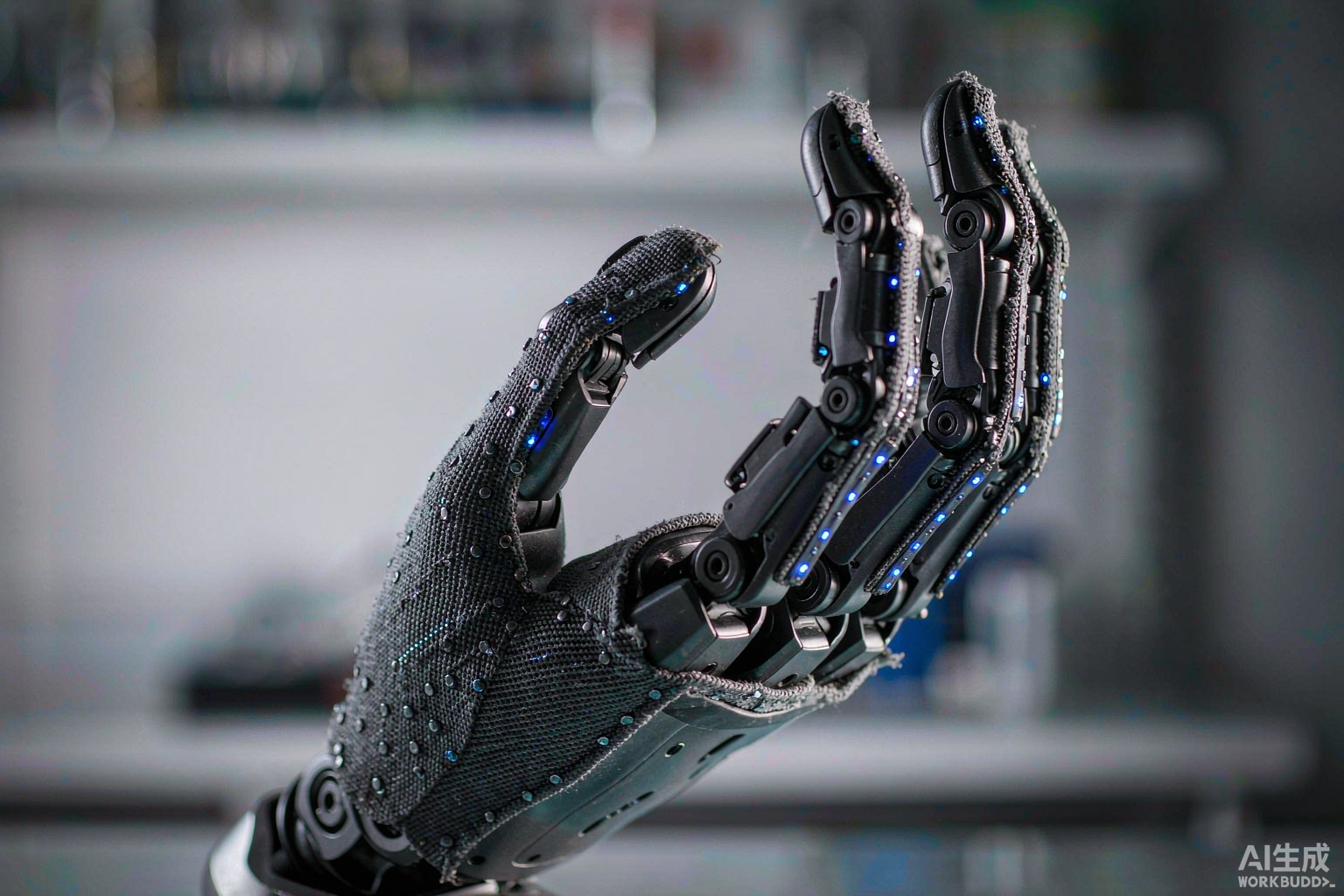
The glove exists to restore the signal and, just as importantly, to record it. When a person wears it to perform a task, the contact areas, force changes and motion details are captured alongside first-person video. The tacit knowledge of how much pressure a task needs becomes data a model can consume. Juqiao’s gloves are already being used in several research programmes at home and abroad, including large-scale training that fuses touch with vision.
The constraint that makes this hard is what the industry calls the impossible triangle: a glove must not obstruct natural movement, must record rich detail, and must survive repeated use. Optimising for any two degrades the third.
Moving the sensor into the fibre
Juqiao’s answer was to go back to materials and structure. Conductive, piezoresistive and load-bearing functions are distributed across different fibres, and a sensing network is formed during weaving. Contact produces local deformation, the conductive path changes, and the circuit reads that change and converts it into tactile information after calibration.
The difference is architectural. The sensor is not a film laminated into a glove. The fabric is the sensor.
On the current full-palm glove, each hand carries several hundred sensing points with a minimum spacing of two millimetres, and the array responds to trigger forces as low as 0.01 newtons. It is compatible with motion capture and teleoperation, which matters because most manipulation training pipelines already depend on one or both.
The second-generation skin adds direction of force, tangential force and slip tendency. The multilayer sensor is under 0.8 millimetres thick, and a single flexible layer is under 0.3 millimetres. Each measurement point is mapped to a mechanical value with consistency of plus or minus 5 per cent, which moves touch from having a signal to having a number.
Manufacturing is the actual moat
Weaving a sensor into cloth in a laboratory is a demonstration. Producing it at a yield that supports a customer’s production schedule is a business.
Juqiao built its own line in Weihai and modified spinning, dyeing and weaving equipment to do it, iterating through thousands of samples. The company reports production yields above 95 per cent and same-day prototyping.
That capability is harder to copy than the design. Textile processes are tuned by experience rather than specified in a datasheet, and a competitor can license a similar architecture without inheriting the process knowledge that makes it manufacturable. It is also the reason a strategic investor from outside the robotics sector found the company legible. Ant Group understands scaled hardware and unit economics, and the question of whether a sensing fabric can be produced reliably is the question that decides the category.
Beyond the hand
Alongside the glove, the company has released an arm skin and is extending into torso and foot coverage so that a robot can sense contact across the body during carrying and collaboration. It has also pushed the fabric into products people touch daily: work with bedding and sleep technology companies on movement, posture and breathing monitoring, with ergonomic chair brands on comfort assessment and support adjustment, and with automotive suppliers on occupant state, adaptive seating and pressure detection.
The spread is a strength and a hedge. Embodied AI is where the growth story sits, but a customer base of 400 companies across home, health and vehicles means the company is not dependent on humanoid volumes arriving on schedule. The A round buys capacity and delivery credibility. What it does not settle is whether a sensing cloth becomes a standard component or remains a specialised material for a handful of programmes.
Editor’s note: This is an adapted translation of the original Gasgoo report. It has been trimmed and restructured for readability for an international business audience. The full original (in Chinese) is at https://www.gasgoo.com/apps/e060bad9eca91db7f01403fc7120041f/robot/news/70476241-seeds.