On 26 October Jia Yueting published the 78th special edition of his weekly investor note, and the US small-cap corner of Chinese social media lit up: FFR had completed an asset merger and listed on Nasdaq. Many readers assumed a new company had rung the bell and went to watch. Anyone who looked at the filings saw something else. This was not an IPO. It was an asset shuffle inside the founder’s own shell.
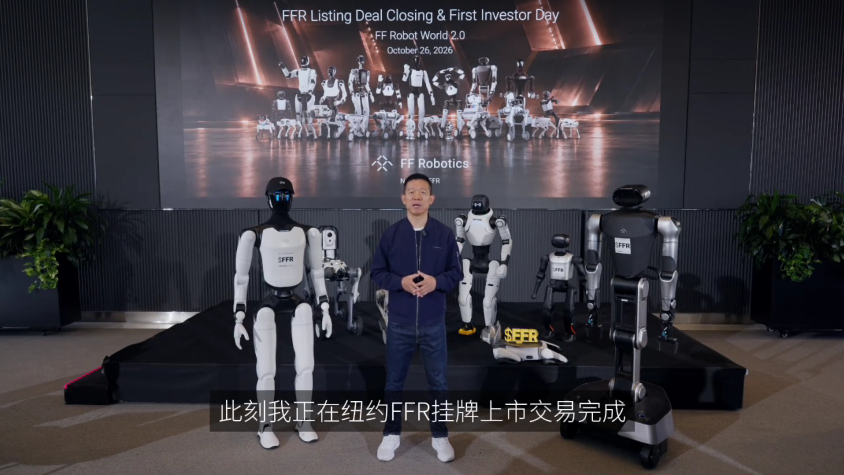
FFR is not a new listing. It is the same Nasdaq entity that was called AIxC, ticker AIXC, and before that QLGN. From 30 September 2026 it changed its name and its ticker to FFR. The transformation was accomplished by injecting assets and swapping a name and a symbol. With the transaction closed, Jia took the chief executive role and said the company would be number one in education robots in the United States and top three in physical AI overall.
Jia has spent enough years in US small caps to know exactly how the traffic works. Whatever theme is hot, tell that story. Cars, then crypto, and now humanoid robots, with a fresh narrative parked on Nasdaq. The story has been replaced several times. The shareholders who bought the original Faraday Future electric car thesis have less and less to show for it.
From crypto shell to robot rental
On 18 August a filing in Los Angeles moved the small-cap crowd. AIxC announced it was clearing out its crypto assets, abandoning the narrative it had bet on for years, and going all in on physical AI and robot sharing and rental. The stock rose nearly 300 per cent and single-day turnover broke USD 100 million.
Insiders were not surprised. AIxC had been a shell acquired during the crypto boom, valued on an AI plus crypto concept. Once crypto cooled and the old story stopped carrying the valuation, a pivot was inevitable.
Its robot rental platform RoboShare took its first paid order on 15 August. The dispatchable fleet is over 80 units, and the platform has moved out of testing and started charging. The first city is Los Angeles, the first of a ten-city plan. The launch partner was a local rapper with several million followers, DU$TY, and six machines were on site: Master humanoids performing alongside four Aegis Pro quadruped robots, with a Navi robot dog handling warm-up and photographs.
The model is easy enough to follow. Humanoids carry too high a unit price for most buyers, so the platform brokers and dispatches, using rental to lower the entry barrier. Further out it can extend into rent-to-own, resale of used units and maintenance, taking a slice of the whole robot lifecycle.
Reaction split. Some called Jia a talent who simply refuses to quit. Others noted that his eye for a trend has always been long while his execution has not. The more cynical read was that he changes tailwinds faster than clothes and has the shell playbook down cold.
The FCC as a design constraint
Facing new FCC equipment rules, FF moved quickly to a built-in-USA manufacturing banner. It announced an in-house over-the-horizon teleoperation and swarm control platform, tied itself to the Nvidia technology stack, and stacked the hot vocabulary of the season, from a four-core intelligence architecture to an AI data factory. Skepticism followed in the same volume: is this not the same robot as that Huawei prodigy’s company, with a different badge? Is this not all Agibot units with a new logo?
Long-suffering shareholders were left with mixed feelings. The most promising business finally arrived, and it was carved out and listed separately, leaving them the car wreckage and the outstanding debt.
The robots do ship
The fair criticism of Jia has always been slides first, product never. This time FFR is shipping hardware and collecting money for it.
In the month before the listing, FF put nine robot models on sale in Los Angeles, humanoid and quadruped, with function packages from USD 10,000 to USD 150,000 depending on configuration, aimed at education, research, security and industrial inspection. Distribution is live through its own site, Amazon and RobotShop.
The reported numbers are the strongest hand the company holds. Revenue recognised in the first half reached USD 1.141 million, with second-quarter gross profit of USD 209,000. By the end of September it had shipped 817 units and booked more than USD 1.52 million of cumulative revenue, at a second-quarter gross margin of roughly 30.9 per cent.
The forward targets are aggressive. October was supposed to break 300 units, a monthly record, taking the cumulative total past 1,100, with every delivery batch holding positive gross margin. The full-year target is 2,000 units, which requires roughly 900 units in the final two months. The five-year plan sets 2027 revenue at USD 45.2 million on 7,400 units, and cumulative revenue of USD 1.98 billion on 133,000 units over five years.
One condition underwrites all of it. The financing has to keep arriving. The company said as much.

To feed growth FFR announced three partnerships covering institutional, education and household markets. The heaviest is KYA, a service provider holding US federal GSA procurement access, which would open the government channel. On education it is building robot laboratories with CSTU and BIBS. On the household side it is working with Pinnacle, a leading Southern California brokerage, on home security. The technology pitch rests on a four-core intelligence ecosystem, a one-brain-many-bodies approach and a unified robot brain called FF OmniMind.
What the market will watch is not the model count. It is whether the units reaching 817 by September keep moving once the listing event stops generating free attention.
Editor’s note: This is an adapted translation of the original OFweek report. It has been trimmed and restructured for readability for an international business audience. The full original (in Chinese) is at https://robot.ofweek.com/2026-10/ART-898890-12001-30709451.html.