Maxinsights, a physical AI company headquartered in Silicon Valley whose Chinese entity is registered as Haiyu Shuwei, has closed a USD 30 million seed round. Peak XV led the round, with Tola Capital, South Park Commons, Woyin Capital and Alumni Ventures participating.
The money did not go into compute infrastructure. It did not go into robot hardware prototypes either. All of it went into the least glamorous lane in the robotics stack: capturing real-world training data.
Two founders, one gap
The two founders are both Chinese-trained engineers. CEO Yuan Yuguang graduated from Shanghai Jiao Tong University, co-founded an industrial robot company and later held a management post at Eaton. CTO Wang Kun graduated from Peking University, worked as an engineer on Google’s self-driving programme and, after returning to China, co-founded the autonomous driving company QCraft, where he worked through the full cycle of getting autonomous driving onto vehicles at the million-unit scale.
Between them they had lived through both hardware iteration and algorithm breakthroughs, and both kept running into the same wall. The internet gave language models a bottomless supply of text. The physical actions of washing a dish, prepping a meal or tidying a room had never been captured at scale or at quality.
A robot that wants to understand the real world has no ready-made textbook to read. Somebody has to write it.
Filming ordinary work
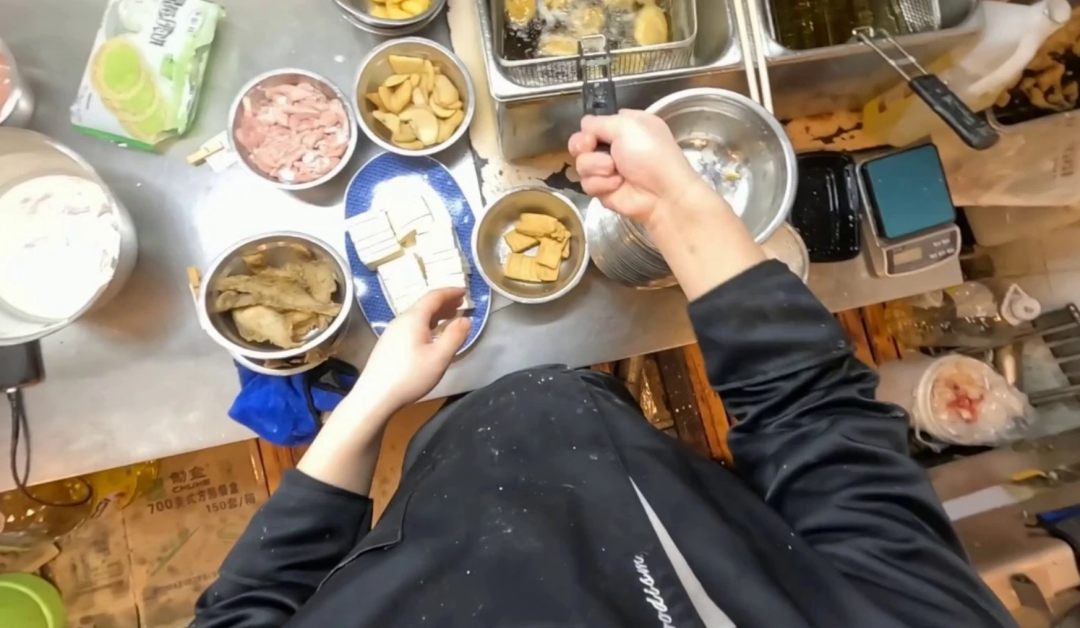
Maxinsights went straight into ordinary people’s lives to get the samples. It recruited more than 5,000 contract workers across six countries. Each participant wears three cameras, on the head, the wrist and the chest, and simply does their normal job: home kitchens, restaurant back kitchens and hotel rooms. The first-person footage is recorded end to end.
To date the company has collected more than two million hours of video, of which 1.5 million hours are clean enough to be used directly for AI model training. More than thirty frontier AI labs and robotics companies are already paying customers.

The quality problem nobody prices
Most of the sector is still competing on hours logged and headcount stacked. Many teams advertise total collected hours as their core metric, while the footage contains a large share of staged and unusable segments. The genuinely usable proportion is low, and a large human review team has to go back through it afterwards.
Maxinsights tries to separate itself on quality control treated as an engineering problem rather than a labour problem. Its in-house MaxLoop agent-in-the-loop inspection system evaluates and feeds back as soon as data comes back from the field. A review cycle that used to take one to two weeks is compressed to under a day. The human review team shrinks by 90 per cent and review costs fall by 80 per cent.
Vision alone still has an obvious hole. A camera cannot capture grip force, or the deformation and slip at a contact surface. Those mechanical signals are exactly what a dexterous hand needs in order to perform fine manipulation.
To fill that hole the company worked with Genesis AI on MaxGlove, a sensing glove, and plans to collect one million hours of force data by 2027, closing the physical interaction gap that vision leaves open.
The strategic logic is straightforward. Compute can be rented and models can be copied. Field data captured by a human being in their own kitchen cannot.
Editor’s note: This is an adapted translation of the original OFweek report. It has been trimmed and restructured for readability for an international business audience. The full original (in Chinese) is at https://robot.ofweek.com/2026-10/ART-8321205-12005-30709479.html.