Walk through any Chinese technology trade show and the crowd is around the full-size humanoids. The units that are actually reaching consumers, however, are small enough to sit next to a monitor.
Desktop robots have become a quiet side line for embodied AI companies, and the category is defined loosely: an embodied system, a desk or table as the operating environment, active perception from an on-device or cloud model, and a mechanical structure. A smart speaker or a security camera does not qualify because it cannot move.
Why the desk is easier than the floor
Cost is the obvious answer. A full-size humanoid carries an expensive compute package, a model-plus-agent brain that depends on training data, dexterous hands and a structural frame that has to survive being switched on. The stack is expensive at every layer.
A desk removes most of it. The physical boundary is defined, the environment is nearly static, the space is small. There is no bipedal balance problem and no global navigation, only the need to avoid falling off an edge. Compute, battery and sensor budget can go into interaction rather than locomotion.
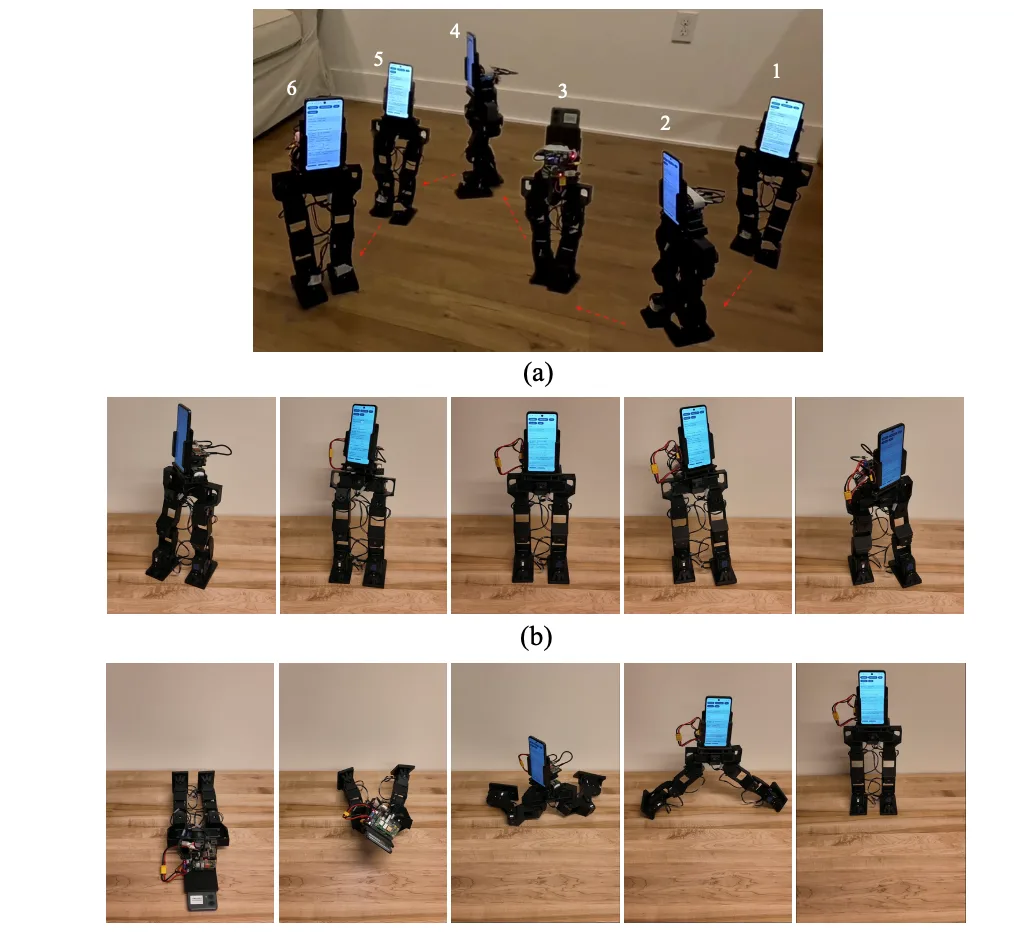
Supply chain is the second advantage. A desktop robot runs on a system-on-chip, a display, microphones, camera modules and a battery, all of which are commodity parts from the smartphone and IoT industry. A research group at UCLA demonstrated the limit case with a small biped driven by a second-hand phone: camera for vision, SoC for inference, WiFi for connectivity, phone battery for runtime, at under RMB 3,000 in components.
There is a commercial motive too. Full-size humanoids are where the strongest teams compete and where most of the cash is still being burnt. Desktop robots are a shorter path to a product that can be sold to a consumer, generate revenue and fund the next iteration.
Two product theses, one price point
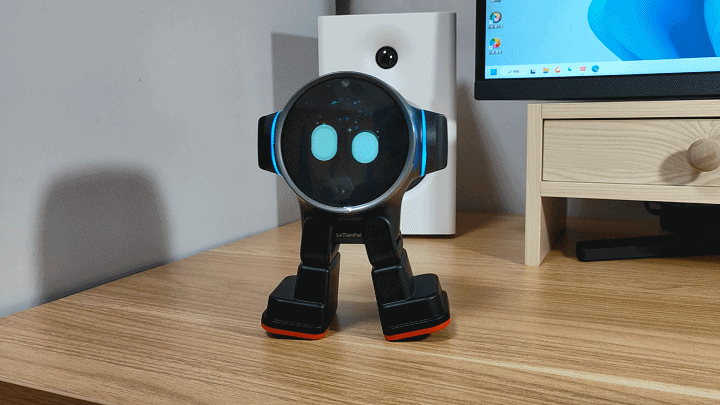
The first thesis is companionship. Lotianpai’s unit is a two-legged robot whose head is a circular screen showing a pair of animated eyes, sold at RMB 1,799 and running Android with support for custom models. Lingtong’s NIA-F01 is closer to a figurine with a camera, a micro frame and sensors, able to act on commands and hold a spoken conversation, with user-editable persona and voice.
The second thesis is utility, and it is thinner. Elephant Robotics sells the myCobot series, a small arm that is not a consumer product out of the box and needs development work: fit a gripper or a suction pump and it tidies a desk, or connect keyboard and mouse and it automates repetitive screen work. Useful, but only for people who can program it.
Overseas, crowdfunding is the main channel. Looi built a robot that treats a customer’s phone as both brain and face, with a base that only provides motion, at USD 129. Hugging Face ships Reachy Mini for developers. Chinese brands currently outnumber foreign ones in the category by a wide margin.
The honest read is that companionship is carrying the category and it has a ceiling. A device with a screen that walks two steps is a smart speaker with a higher price and a shorter useful life. Even entry-level units cost more than a good speaker.
What would change the trajectory is a shift in form and function. On form, modularity: a desktop robot that merges into a monitor stand, a desk lamp or a wireless charging pad, and disappears when it is not needed. On function, physical agency: the ability to drive a computer, move objects and adjust the environment, rather than run a scripted routine.
Until then the desktops are a supply chain rehearsal. They teach companies to build at consumer price points and at consumer volumes, which is the capability the humanoid industry has not yet demonstrated.
Editor’s note: This is an adapted translation of the original OFweek report. It has been trimmed and restructured for readability for an international business audience. The full original (in Chinese) is at https://robot.ofweek.com/2026-11/ART-8321204-8420-30709647.html.