The robotics company that has raised the most money in Chinese food service this year does not make a humanoid. It makes a coffee kiosk. XBOT has closed two consecutive rounds, an A round above RMB 200 million and a B round near RMB 400 million, a record for vertical food-service robotics in China.
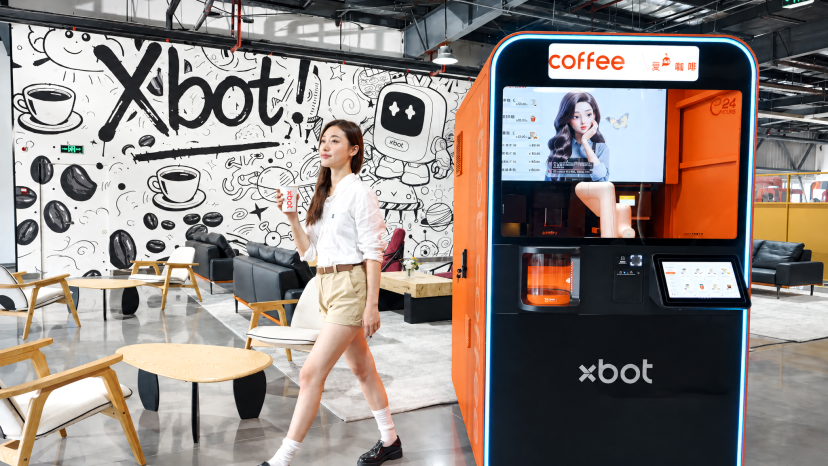
The product is an enclosed unit under two square metres holding a coffee machine, an ice maker and a milk frother, with a six-axis arm handling cups, extraction, texturing and latte art. It produces a milk coffee in 46 seconds. A customer pays a bit over RMB 100,000 and gets something close to a coffee shop without a barista.
Four years after founding, XBOT has more than 1,600 such stores worldwide and has served over 5 million cups. Confirmed orders for 2026 exceed RMB 300 million, and monthly deliveries recently passed 100 units.
Why a coffee robot and not a humanoid
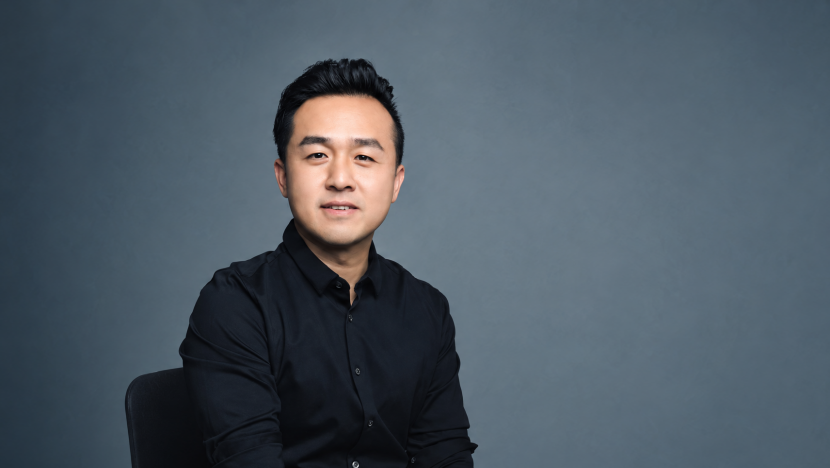
Founder Tang Mu arrived from consumer electronics with an unusually specific CV: born in 1977, he studied international accounting at South China University of Technology with a minor in industrial design, built Tencent’s QQ penguin mascot and its star, moon and sun account-level iconography, then served as Xiaomi’s ecosystem vice president running the Mi Router and Xiaoai speaker lines, both billion-unit categories.
He founded XBOT in late 2022, at 45. The angel round brought in Zhang Xiaolong, Lin Bin, Li Wanqiang, Huang Jiangji and Hong Feng, a roster that reads as a Tencent and Xiaomi reunion.
His reasoning is subtraction rather than inspiration. Home was ruled out on safety and privacy: a humanoid needs a large battery, and if an electric scooter’s pack is not allowed into a residential tower, a robot’s pack has a harder argument. Kitchens contain knives and plant pots, and any product has bugs. Privacy fails too, because a sensor-covered machine that follows a person into a bedroom or a bathroom creates a problem no warranty covers.
Industry was ruled out on economics. Large articulated arms already run lights-out factories, and a humanoid on a factory floor is a liability: one fall can stop a line costing millions of yuan an hour. The remaining option was commercial service, and among commercial services he picked the one that survives cycles. Hotels, cleaning and pool robots already had incumbents. Food and drink has demand in every era.
The arithmetic behind the pitch
Most embodied intelligence founders are still searching for a commercial scenario and burn capital while they search. Tang Mu’s pitch is a payback calculation: 46 seconds per cup, dozens of cups a day, and the site is in profit.
That framing matters for the wider sector. The capital going into humanoids assumes a future general-purpose machine. The capital going into XBOT assumes a present-day machine with a narrow task that already has a market, a price and a queue of customers. The second kind is easier to underwrite and much less exciting to talk about, which is precisely why it keeps closing rounds.
The constraint is not the robot. It is site selection, coffee quality consistency across 1,600 locations, and whether a franchisee can survive on the throughput a single kiosk can produce in a low-footfall location.
Editor’s note: This is an adapted translation of the original OFweek report. It has been trimmed and restructured for readability for an international business audience. The full original (in Chinese) is at https://robot.ofweek.com/2026-11/ART-8321203-12005-30709796.html.