The Oversupply of AI Talent: How China turned mathematical conditioning into a grassroots industrial workforce
Those poor Chinese kids are building the most advanced AI in the world.
If you look at the CVs of the researchers and entrepreneurs catching up to Anthropic and ChatGPT at a fraction of the token cost, the old playbook is gone. The majority of them never studied or conducted research in the US.
The internet and e-commerce booms of the last thirty years were built by a different class. Ma Yun was backed by his Aussie godfather. Joe Tsai was a Wall Street lawyer. Ma Huateng’s father was a director of a Hong Kong port company. Today’s frontier models are being built by people who quietly came from lower socio-economic backgrounds. The talent pipeline has shifted completely.
A Different Pedigree
Look at the architects of China’s current LLM frontier. Liang Wenfeng, the founder of DeepSeek, is the son of rural primary school teachers in Guangdong. No Stanford connection, no Sequoia backing. He armed his AI ambitions by running a domestic quant trading fund, eventually delivering a GPT-4-level model using roughly 1% of the compute typically demanded by Western labs.

Or look at Yan Junjie, who founded MiniMax. Raised by a teacher and a civil servant in a small Henan county town, he preferred playing DOTA and browsing Bilibili over polishing an elite resume. He walked away from a lucrative VP seat at SenseTime to build his own foundation models when the market was entirely dormant.
Then there’s Tang Jie, the founder of Zhipu AI. He didn’t start at an Ivy League school; his undergraduate degree came from Yanshan University, an unknown school by international standards, before he fought his way to a Tsinghua professorship.
The Closing Door
The grassroots shift is not an anomaly: it is the baseline of an entire generation. The stacked bar chart from The Economist lays bare the demographic tide. China’s active AI workforce is expanding through an explosion of students, the red bars, who now outnumber mid- and late-career researchers combined. The US shows a flat, mature line where students remain a minority.
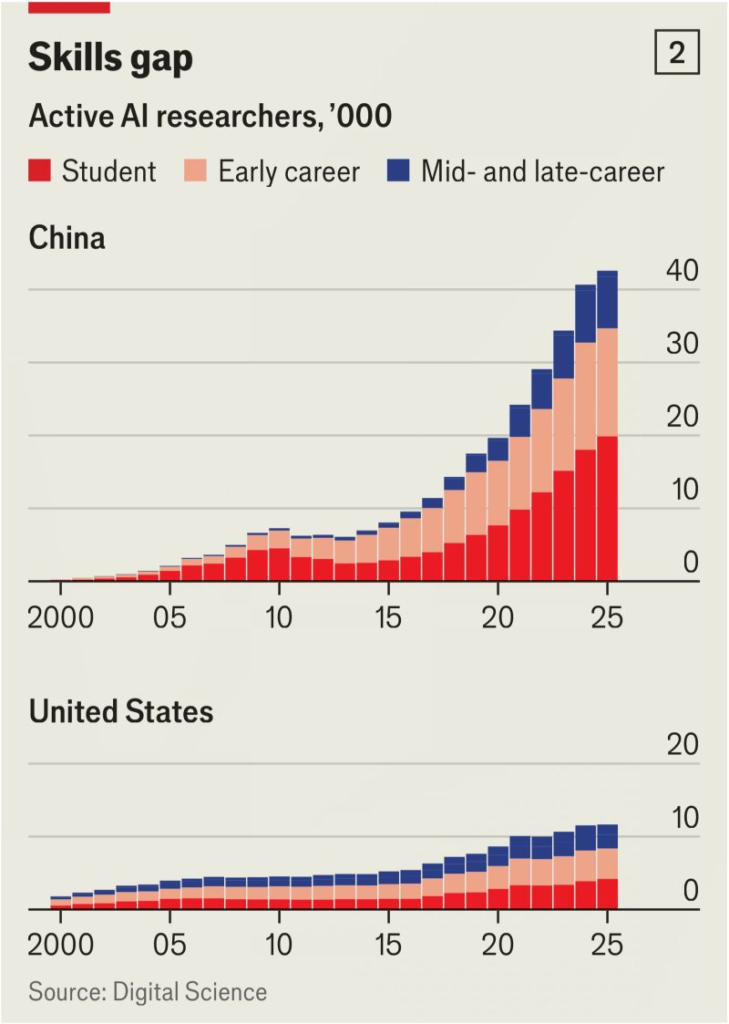
The macro numbers back this up. At NeurIPS 2025, 51 per cent of leading authors started their careers in China, while America’s share shrivelled to 12 per cent. Crucially, the talent is staying home. Nearly 70 per cent of Chinese undergraduate alumni now choose to remain in China, double the rate from 2019.
Washington is accelerating this decoupling. Visa frictions and political suspicion mean elite US universities are closing their doors, maximised by Purdue University rescinding over 100 graduate offers to Chinese applicants last year. Fed by a university system where two-fifths of students major in STEM, China is on track to outnumber US-based top researchers two to one by 2028. The old American playbook of importing global brains has cracked.
The Pure Score
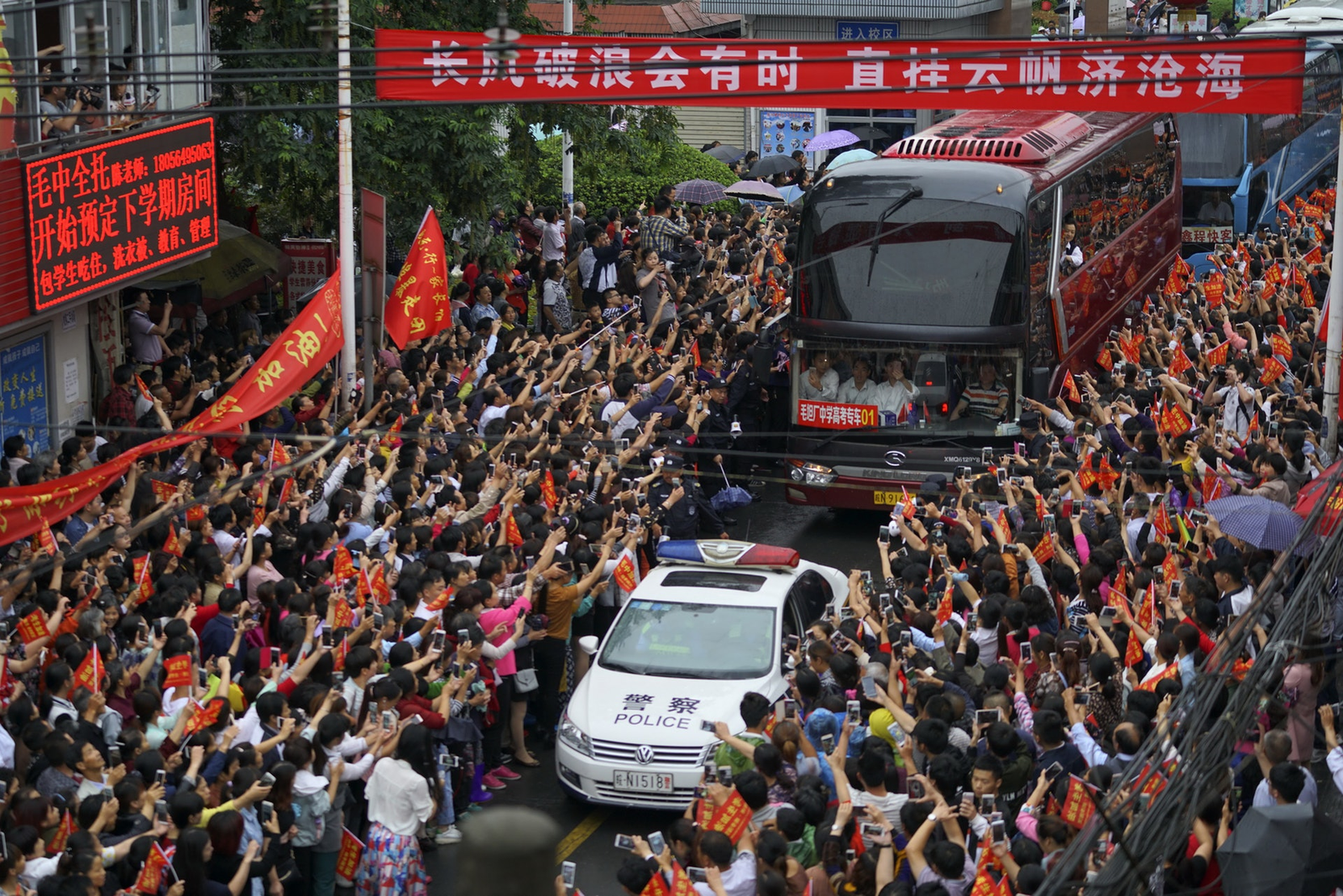
Behind this demographic shift lies a brutally deterministic selection mechanism: the Gaokao, China’s national college entrance examination. Unlike the American “holistic review” system, which evaluates candidates based on a blend of academics, extracurriculars, and personal essays, China’s university admissions are almost purely score-driven.
The American holistic approach, despite its egalitarian rhetoric, is heavily polluted by non-academic factors that serve as proxies for family wealth and social capital. Embarking on a polar expedition to demonstrate ‘resilience’ requires a family wealthy enough to hire a professional logistics and safety team. Launching a charity fund to provide education for impoverished children in Africa requires a network elite enough to persuade your parents’ wealthy friends to write checks.
These feats of self-actualisation and world-changing ambition might craft a perfect narrative for an Ivy-Plus admissions officer, but they guarantee absolutely nothing in Beijing. They cannot buy a single point on the Gaokao. To secure admission to Tsinghua or Peking University, you must sit with hundreds of thousands of peers in your home province and rank in the top two or three hundred, sometimes the top one hundred, based solely on a standardised test.
The only meaningful deviation from this pure score-based meritocracy is the state’s institutionalised fast-track for STEM prodigies: exceptional performance in the five major Olympiads (Mathematics, Physics, Chemistry, Biology, and Informatics). But even this pathway is rooted in raw, verifiable intellectual dominance rather than polished resumes. By stripping away the soft power of wealth and connections, this examination-centric system acts as a ruthless sieve for raw cognitive ability. While the American system often confuses privilege with potential, the Chinese system mathematically forces the smartest kids from rural villages into the same lecture halls as the urban wealthy.
The Arithmetic of the Funnel
But the undergraduate filter is only the first layer. The real sorting happens at the graduate level through the Kaoyan, the national postgraduate entrance exam taken by 1.5 million students annually. Terence Tao once observed that the mathematical foundation of modern AI is surprisingly mundane, relying primarily on linear algebra, multivariate calculus, and basic probability. The syllabus of the Kaoyan mathematics paper covers exactly this portfolio, mapping onto the core mathematical prerequisites of artificial intelligence research with absolute precision. If you can score well on the Kaoyan mathematics paper, you have already mastered that bedrock.
In this testing apparatus, mathematics is the only filter that cannot be gamed. The other compulsory subjects, languages and politics, are simply questions of volume. A disciplined student can grind out a near-perfect score on a multiple-choice and formatted written paper through pure rote labour. But mathematics refuses brute force. It is a hard ceiling where effort eventually hits a wall. In a system built entirely on repetition, it remains the single variable mapping strictly to raw cognitive processing power.
The funnel scales ruthlessly. Out of this massive annual pool, the absolute apex, students scoring above 125 out of 150, represents less than 2.5 per cent. This yields a fresh cohort of thirty thousand raw mathematical minds every single year, a premier tier primed for advanced algorithmic retraining. Drop slightly lower to the 110 threshold, and you find another hundred thousand graduates with the analytical foundation required to anchor deep technical research. Below them sits a vanguard of three hundred thousand students scoring above 90, a massive reservoir of cognitive capital fully capable of translating mathematical logic into industrial code.
Of course, not all of these four hundred thousand math high-scorers end up in frontier research pipelines. The point is that the volume alone gives tech founders an inexhaustible talent pool to draw from. Driven by starting salaries that routinely dwarf the national average for ordinary graduates ten times over, these students have every incentive to pivot. For a mind that has already survived the gruelling selection funnel of national examinations, the effort required to retrain as a competent engineer is negligible compared to the protracted physical and psychological grind of the entire preparation and testing cycle.
From Assembly Line to Data Centre
The sheer scale of this talent reservoir reveals itself in global academic metrics. In the latest US News standings for AI, Chinese institutions claim nearly half the top spots worldwide. Alongside expected elite pillars like Tsinghua, the list includes a dense layer of normal universities, regional teachers’ colleges such as Qufu Normal and Zhejiang Normal.
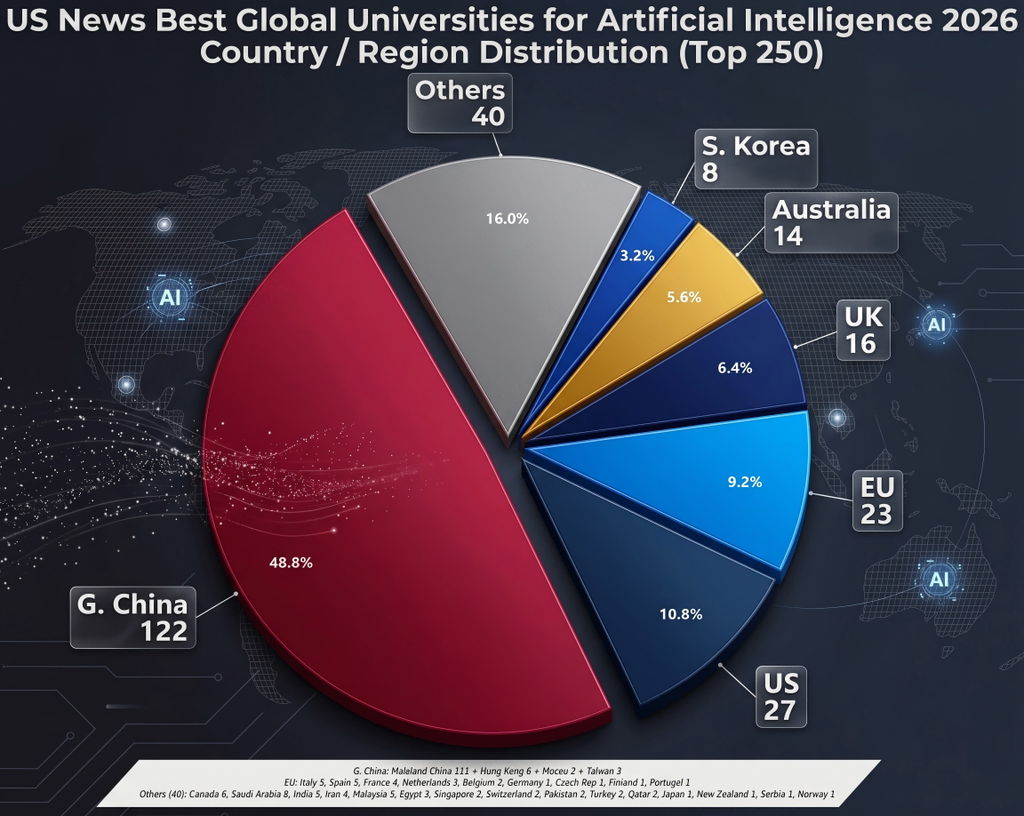
Historically, these pedagogical institutions functioned as a quiet socio-economic safety net. For brilliant but impoverished students, a tuition-free education paired with a guaranteed state placement as a middle school maths teacher was the ultimate iron rice bowl. They chose these schools solely to study mathematics, securing a stable, low-risk life at the blackboard.
Then the AI gold rush hit. The systemic incentives to pivot are overwhelming. Financially, the friction to change course is non-existent. Breaking the state teaching bond requires repaying the subsidised tuition, a penalty easily covered by less than a single month’s salary in a commercial AI lab.
Yet this institutional safety net is not exclusive to pedagogical tracks. Across the entire university system, regardless of the discipline, any impoverished student who secures admission through pure academic merit can register and complete their degree without paying upfront fees. The state facilitates this via an interest-free ledger. The university temporarily retains the physical graduation certificate, releasing it the moment the student clears the outstanding tuition balance from their post-graduation wages. Unlike the compounding burden of American student loans, this is a clean, interest-free institutional line of credit.
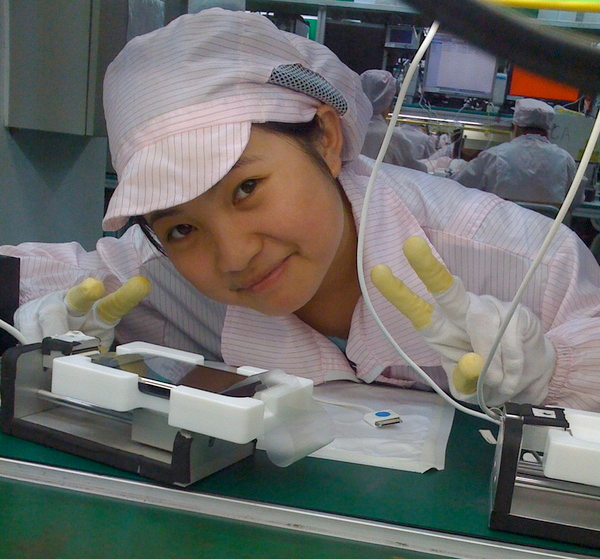
Consequently, a high school graduate from a remote village in Guizhou can ascend through elite undergraduate and postgraduate AI programmes entirely on test scores. The resulting career trajectory is immense, offering earning potential that can match the income levels of same-age peers at major Silicon Valley firms. This extreme socio-economic mobility is the precise engine driving the demographic explosion captured in The Economist’s chart. The young Chinese engineers training frontier models today are quite literally the sons and daughters of the assembly line workers who built your iPhone 4.
The academic transition is equally seamless. The effort required to re-skill is trivial compared to the competitive grind of the examinations these students already survived. For a mind trained on pure, proof-based algebra, classical Transformer architecture reads like a basic set of classroom exercises. Every year, a quiet exodus of maths teachers and rural prodigies is siphoned out of provincial schools and dropped straight into data centres.
This data funnel is not a statistical abstraction. It plays out on the ground. I watched this commodity market work firsthand at a Physical AI startup in the Yangtze River Delta. Operating out of an incubator in a second-tier city with exactly one public university, the founder needed an intake of engineers to train a crucial SLM. His hiring instructions to his staff were bluntly utilitarian: “Go to the campus down the road and bring back some bodies. Computer Science, Double E, automation, whatever. Kids in other majors? If they have high scores in maths and coding, bring them in for a trial.”
It sounded less like high-tech headhunting and more like a construction foreman hiring day labourers off a street corner. But that is the reality of Chinese tech oversupply. The strategy worked. Two years later, that startup has cleared its Series B funding. Those temporary campus kids are now the seasoned engineers training the next intake.
The Industrial Refinery
Silicon Valley treats frontier artificial intelligence as an exclusive meritocratic club, curated by an elite priesthood of Ph.D.s and mythologised Ivy League dropouts. It values social capital, pedigree, and individual celebrity. The Chinese ecosystem is industrialising it into a blue-collar trade, converting human volume directly into computational efficiency. When hardware is restricted by geopolitical friction, algorithmic optimisation becomes a survival metric. Labs like DeepSeek prove that cohorts of examination survivors can wring elite performance out of legacy architecture. Even if China lags in absolute vanguard compute today, this structural refinery makes a permanent catch-up highly probable.
Ultimately, the American model bets on the outlier, the singular Ivy-Plus genius. The Chinese model bets on the mean, the collective standard deviation of thousands drilled to mathematical perfection. For third nations seeking to build sovereignty AI, this low-cost, resource-constrained blueprint offers a far more viable playbook. The strategic move for these neutral ecosystems may simply be to aggressively import this oversupply of disciplined brains. Washington can restrict the flow of silicon, but the global gatekeepers of technology are being challenged. If the old elite cannot scale, the future of advanced models will inevitably belong to the survivors of the grind.