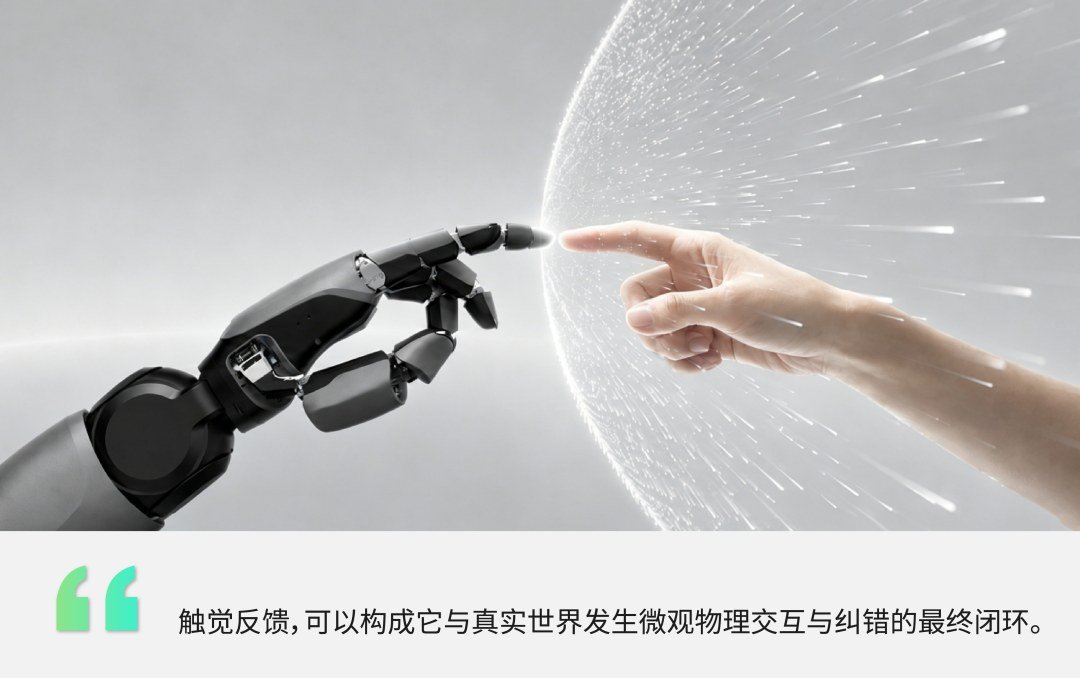
A person opening a lock in the dark does not rely on sight. The resistance felt at the moment the key touches the edge of the cylinder is what tells the hand whether the angle is off and how to correct it. Industrial robotics has struggled to reproduce that.
In high-precision manufacturing, from high-voltage harness connectors on electric vehicles to fine ribbon cables in consumer devices and chip packaging, assembly gaps can be as small as 0.02 millimetres, about one third of the diameter of a human hair.
When a robotic arm brings a part to a hole, the gripper and the workpiece block the camera completely. Vision has nothing to work with, and traditional force control has to be retuned for every part change. Any small pose error causes jamming, scratching or damage to expensive equipment.
Two stages instead of one policy
A team at the Chinese Academy of Sciences Institute of Automation, led by researcher Cheng Long with Li Houcheng, Meng Xinpan and Ma Zhenghua, published work at the IROS 2026 conference on using tactile-enhanced reinforcement learning to raise success rates and stability in sub-millimetre assembly.
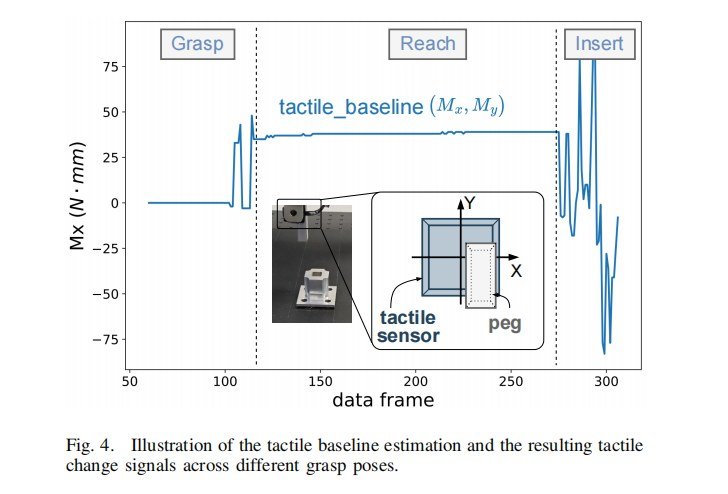
Earlier attempts to bring touch into reinforcement learning largely failed because real-world tactile signals are noisy. A slight offset in grasp position produces a large shift in raw torque output, which corrupts the training signal.
The team split the task. Imitation learning with a diffusion policy handles the approach and brings the part close to the hole. Reinforcement learning with soft actor-critic handles the insertion, learning the fine adjustments that contact requires.
Training uses an asymmetric actor-critic architecture. The actor is vision-led so that deployment stays efficient, while the critic also receives tactile feedback to guide learning.
Subtracting the grasp, then balancing the data
The first technique is tactile baseline compensation with a residual tactile critic. Once the part is gripped, the system estimates a stable baseline before contact, then computes the change relative to that baseline. Subtracting the initial offset is the equivalent of noise-cancelling headphones for the sensor, so training focuses on the force change created by insertion rather than by the grasp.
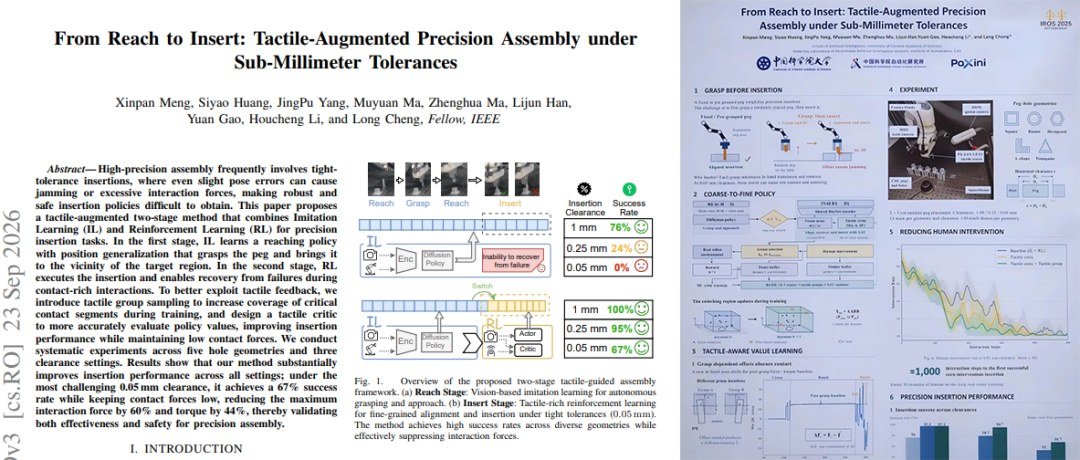
The second is grouped sampling. Offline replay buffers tend to over-represent certain grasp poses, so the team discretised grasp torque components into a grid and drew training samples evenly across groups, which improved coverage of contact conditions.
The measured result
The experiments covered five hole geometries, square, round, hexagonal, L-shaped and triangular, at varying clearance levels. At 0.05 millimetres clearance, pure imitation learning with vision and pose teaching achieved a success rate of zero. An imitation plus reinforcement learning approach without touch reached 52 per cent. With fingertip tactile feedback, success rose to 67 per cent.
The system also generalised better. Used as a vision base, it exceeded the success rate of comparison models using 75 per cent of the demonstration data while consuming only 50 per cent itself, which points to lower teaching cost and stronger performance when materials and backgrounds change.
Sensor placement is central to the result. Industrial assembly has traditionally used a six-axis force sensor at the wrist, but at sub-millimetre contact scales the wrist measures the coupled load of the entire arm, and by the time it registers a jam or a tilt the microscopic impact has already occurred.
Fingertip array data provided the time series of three-axis force and three-axis torque that the critic relied on, and the algorithm’s convergence depended on low drift, short latency and repeatable precision in that raw signal.
Editor’s note: This is an adapted translation of the original OFweek report. It has been trimmed and restructured for readability for an international business audience. The full original (in Chinese) is at https://robot.ofweek.com/2026-11/ART-8321206-8140-30709844.html.