Every large-scale advance in AI has rested on a data supply that already existed. Language models consumed two decades of web pages and code. Autonomous driving drew on shadow mode fleets, with Tesla collecting from millions of customer cars without organising a single collection session.
Embodied AI has no such supply. Two years of teleoperation and first-person wearable capture have produced only a few million hours of usable real-machine and ego data across the entire industry.
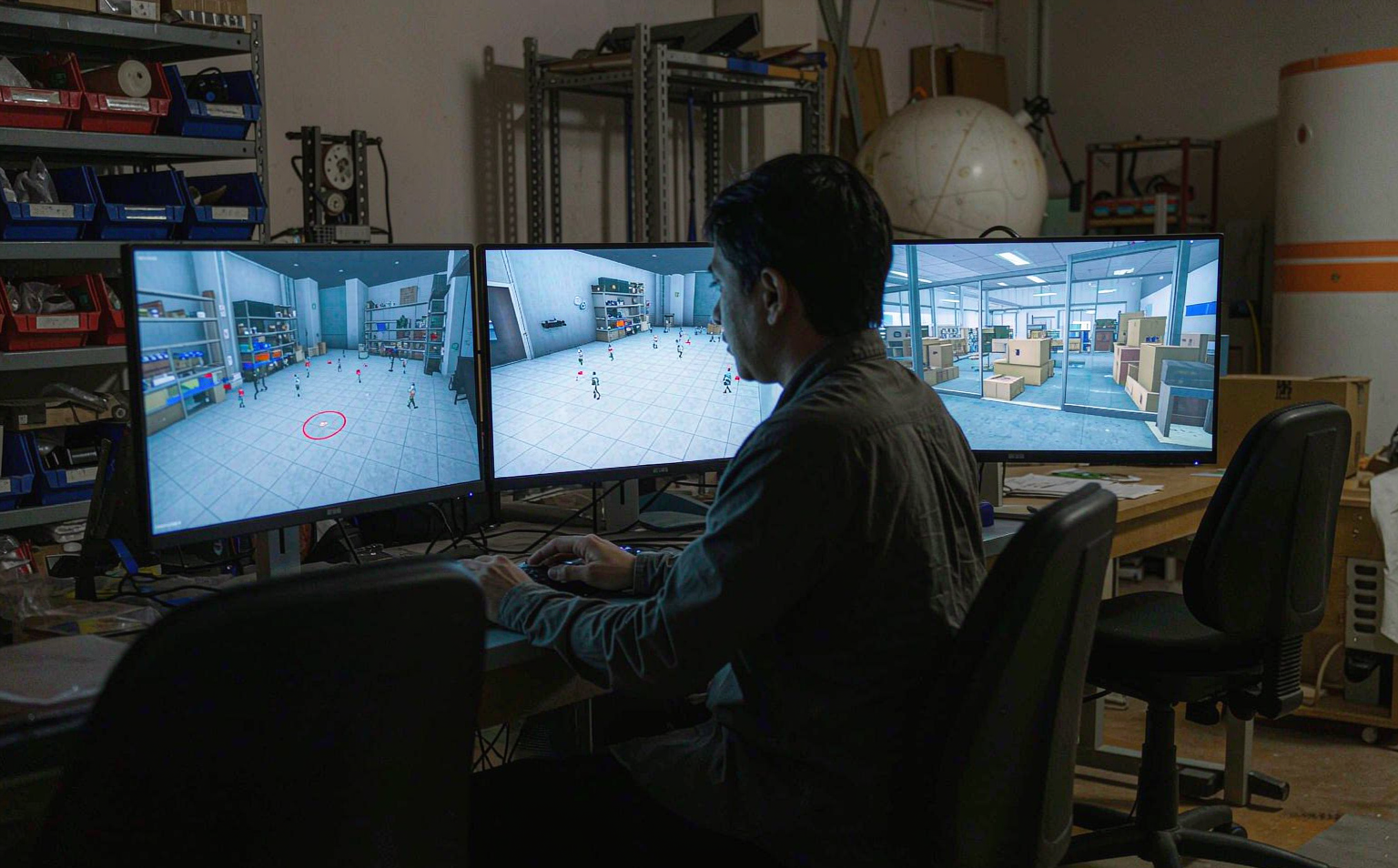
On 30 October, InSpatio, a spatial intelligence company, opened what it describes as China’s first embodied simulation data centre in Hangzhou. It expects to produce one million hours of simulated training data a month, at roughly one tenth the cost per unit of conventional teleoperation.
Why the existing pipelines stall
A usable embodied token needs three things at once. Three-dimensional spatial observation, real physical contact feedback, and an executable action sequence. It has to record not only what the robot saw, but how it interacted with the object and what changed afterwards.
Teleoperation is the main physical route and it is slow. One operator on one robot for one hour yields under thirty minutes of usable trajectory once setup, faults and task resets are removed. Scaling means more robots and more people, which is a linear problem.
Wearable ego capture removes the robot cost but inherits the site. Changing clutter, lighting or surface material means sending people back to rearrange the set. Retails, workshops and pharmacies in operation will not allow it. Hazardous areas, production lines, private homes and security sites will not admit a collection team at all.
Simulation can repeat and vary a scene cheaply, but generating the scene is the bottleneck. Parametric assembly takes hours. Reasoning and rendering rounds add cost, and procedurally stitched scenes look like computer graphics. Without real spatial measurement as a constraint, geometry, scale and physical relationships drift between viewpoints, which widens the gap between simulation and reality.
Treating a room as raw material
InSpatio borrows the logic of an AI compute centre, which turns power, chips and raw data into a continuous output of tokens. Its Topos engine turns a real space into an interactive digital scene and then into training data, across three automated stages.
Capture comes first. Portable scanning equipment covers hundreds of square metres in fifteen minutes on site, against manual modelling measured in weeks. Where access is restricted, multi-view photographs and video from on-site staff are enough, supplemented by native 3D generation.
The engine then runs three passes. Objects are decomposed, so cups, pill boxes, drawers and door handles are separated from the background rather than fused to it. Blind spots are completed, with a generative model filling the back and underside of objects and the gap left when something is moved. Physical calibration follows, assigning collision bounds, mass, friction and joint axes to doors and drawers so the scene can enter a physics simulator.
Conversion takes hours once a space is scanned. The same scene can then be reused repeatedly, with object positions, lighting and interaction patterns varied to produce different training cases.
At the compute stage, a scanned room becomes an editable template. A few real demonstrations are enough as seeds, and the system launches parallel simulation channels in the cloud, plans and executes actions, computes grasp, push and place outcomes in the physics engine, discards penetrations and dropped objects, and emits tokens carrying depth, pose, contact force and action semantics.
Output therefore depends on how often scenes can be reused and how much parallel compute is available, not on how many operators can be hired.
Counting scenes honestly
Scale invites padding, so the centre sets a counting rule. Every scene is registered as a complete house or business premises. Changing only the lighting or the camera angle in one room counts as a variant inside that scene, not as a new one. Delivery is graded by spatial geometry, physical interaction and closed-loop task evaluation.
Production also closes the loop with model testing. When a customer model fails repeatedly on transparent cups, highly reflective surfaces or densely stacked occlusion, the centre generates a batch of similar hard cases in simulation and reruns the regression in the same environment, instead of restaging the original site.
Language models scaled because the internet had already digitised text for them. The physical world is continuous, disordered and not directly trainable. Treating it as raw material, and putting a million hours a month on a production schedule, is the first serious attempt to give embodied AI a data supply that behaves like an input rather than a field campaign.
Editor’s note: This is an adapted translation of the original Zhidx report. It has been trimmed and restructured for readability for an international business audience. The full original (in Chinese) is at https://www.zhidx.com/p/606540.html.