Robot hands have become good at single movements. Picking an object, turning a screw, operating a tool. What they have not done is string those movements together into a complete workflow without swapping the end effector, which is why industrial automation still runs on purpose-built grippers.
On 29 October, at the dexterous manipulation session of AgiBot’s innovation day, Critical Point connected live to the Wolong Hill factory and showed an industrial proof of concept. One arm carrying one five-fingered hand completed a 72-step performance test sequence for a dexterous hand, covering loading and unloading, barcode scanning, grasping a screwdriver, driving and removing screws, and pressing buttons.
The test station inspects its own product
The arrangement is unusual. The hand mounted on the arm tests the hands coming off the line. It lifts the unit under test, places it on the inspection rig, scans it, picks up a screwdriver, fixes the unit to the station, presses start, waits, presses stop, removes the screws and returns the unit to the conveyor.
Three different capability classes sit inside that loop. Flexible assembly of the product under test. Fine force control and tool use with the screwdriver. And button interaction with the test equipment.
The company had tried grippers first. Reaction torque when driving a screw pulled the screwdriver out of the gripper. Fixing the tool permanently to the arm end solved that and broke everything else, because the same effector then could not pick up the product or operate the panel.
Phase one results show 98 per cent task success, 8.5 minutes for the full sequence against about 8 minutes for a person, and continuous operation for 8 to 12 hours. The 30 second gap is roughly 6.25 per cent slower than a human operator, which is close enough to matter for takt time planning.
The hard part is millimetres
The station uses reusable anti-drop screws that shift by a millimetre inside the hole, so alignment is never exactly repeatable. The screwdriver is large and heavy, its cable drags, and tightening produces recoil. A one millimetre error in how the hand holds the tool becomes a three to four millimetre offset at the tip.
Critical Point demonstrated recovery as well as execution. Staff pushed the arm mid-task, displacing the driver. The robot did not stop. It re-positioned, found the hole and finished the sequence. In another test staff moved the fixture so the screw only went in part way. The robot detected the failure from tightening torque and vision, re-aligned and drove it home.
The method is real-machine reinforcement learning combined with an agent system. Reinforcement learning lets the robot adjust from visual and tactile feedback in real time. After training, screw driving is more than four times faster than teleoperation and the approach motion is more direct.
Failed steps are handled by Omni-Maestro, an industrial deployment agent framework. It judges completion from vision, torque and station equipment signals, then either reruns the step or rolls back to the one that failed.
Touch is the missing channel
Scaling dexterous manipulation depends on data, and first-person human footage has been the cheap route. Camera-based hand pose estimation struggles with occlusion, and without tactile sensing it cannot recover what contact actually felt like.
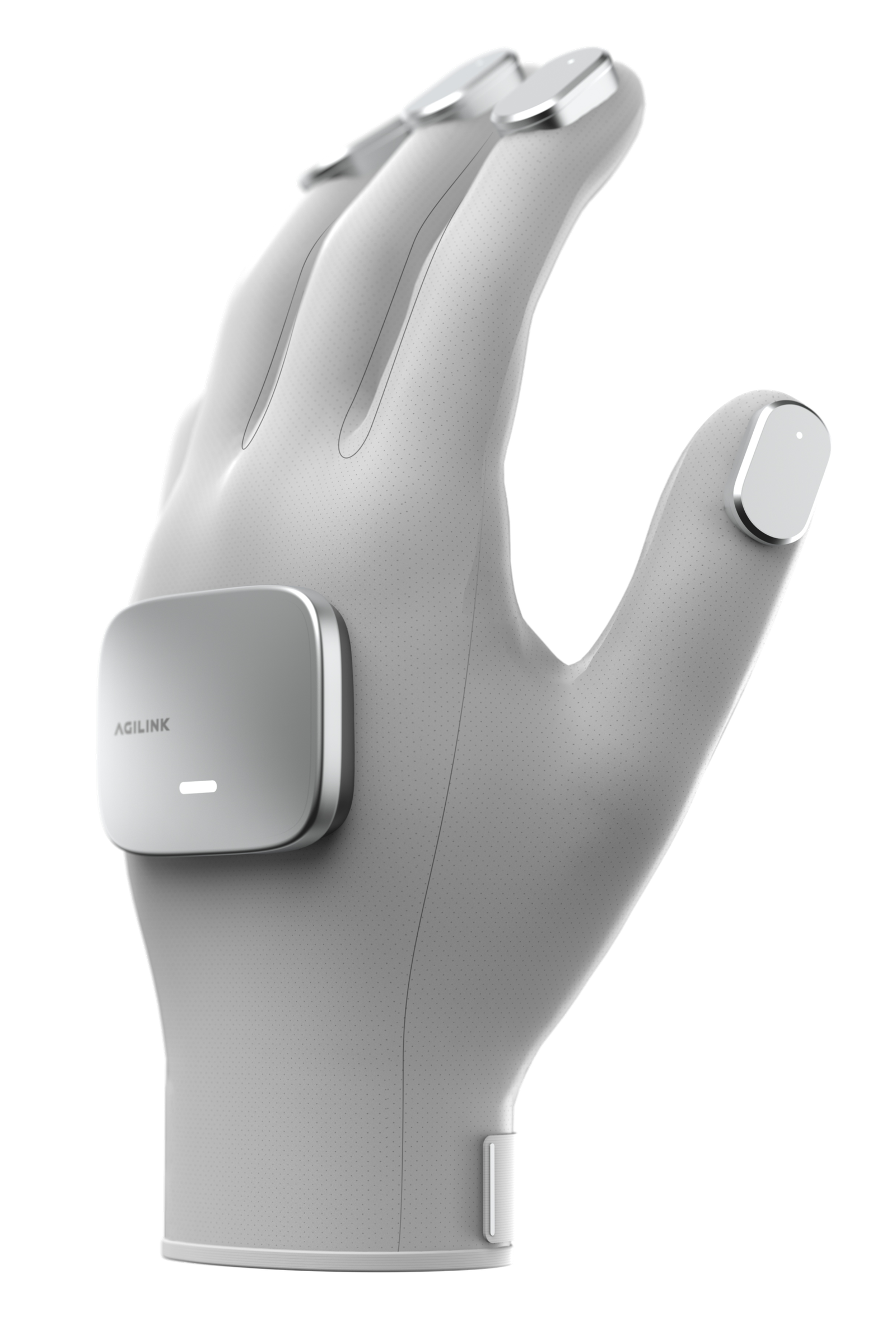
Critical Point built OmniGlove Pro to close that gap and has started volume delivery. Each fingertip combines electromagnetic field positioning with inertial measurement, giving 0.1mm positional accuracy. The glove carries 746 tactile sensing points at 3mm spatial resolution. The data is retargeted across embodiments and replayed on a real robot, which lets a human demonstration become a robot task without the robot being present during collection.
The economic case is simple. If one arm and one hand can hold a line at human pace for twelve hours without an end effector change, the cost comparison stops being about the robot and starts being about the shift.
Editor’s note: This is an adapted translation of the original Zhidx report. It has been trimmed and restructured for readability for an international business audience. The full original (in Chinese) is at https://www.zhidx.com/p/605625.html.