Jianzhi Robotics completed a USD 100 million A-plus round in the third quarter, announced on 2 November. The Beijing company was founded on 29 May 2025 and positions itself as infrastructure for data and evaluation in embodied AI and world models.
Fourteen months from incorporation to a valuation widely expected to exceed USD 1 billion, on a product that is not a robot.
The spread explains the round
Embodied and world-model training data currently sells for RMB 500 to RMB 1,000 per hour. Collection costs about RMB 30 per hour. Data carrying force and tactile feedback is rarer still, which is why 2026 is being called the year of touch.
A margin of that shape attracts capital faster than any robot hardware business, because it does not require winning a deployment contract to earn revenue.
The founder profile fits the thesis. Chief executive Chen Jianxing was a senior algorithm director at Momenta with close to a decade in autonomous driving data engineering, leading the data flywheel roadmap and taking dozens of domestic and overseas OEM programmes to production. Co-founder Zhu Yanming worked on end-to-end driving product delivery. Co-founder Li Xinglong came from Zhenji Intelligence with robot body and physical AI experience.
The argument is that autonomous driving already solved the data closed loop, and that the same discipline transfers to embodied AI. The company wants to be the supplier of picks and shovels rather than the miner.
Six rounds in fourteen months
The pace of funding is itself data. A seed round in August 2025 led by Baidu Ventures with Momenta, Galaxy General and Jiushi Intelligent. A seed extension in October 2025 led by RoboSense. An angel round in December 2025 led by Shunwei with more than RMB 200 million disclosed. A pre-A in June 2026 that brought in Ant Group and Didi. A Series A in August 2026 led by Momenta, with cumulative funding above USD 200 million.
The A-plus round added SAIC and Malaysia’s Eastworlds on the industrial side, alongside Baidu, Shougang Holdings and Galbot, with Guanghe Ventures, SUNHELM, CITIC Goldstone, CCB International and Huatai Zijin on the financial side. Cumulative funding is about USD 300 million.
The comparison investors reach for is Scale AI, which Meta paid about USD 14.3 billion for a 49 per cent stake in June 2025. Data labelling, reinforcement learning from human feedback and model evaluation were the least glamorous layers of the large-model stack, and they carried the pricing power.
Tesla showed the alternative and its cost
Tesla told its third quarter earnings call that it would build 10,000 to 20,000 Optimus units first, so they could collect data and train inside the Optimus Academy. The outlay was put at roughly RMB 14 billion. Optimus has no equivalent of the customer fleet that feeds full self-driving for free.
That is the strategic fork. A company with Tesla’s balance sheet can build its own data farm. Almost nobody else can, which is the opening for a third party.
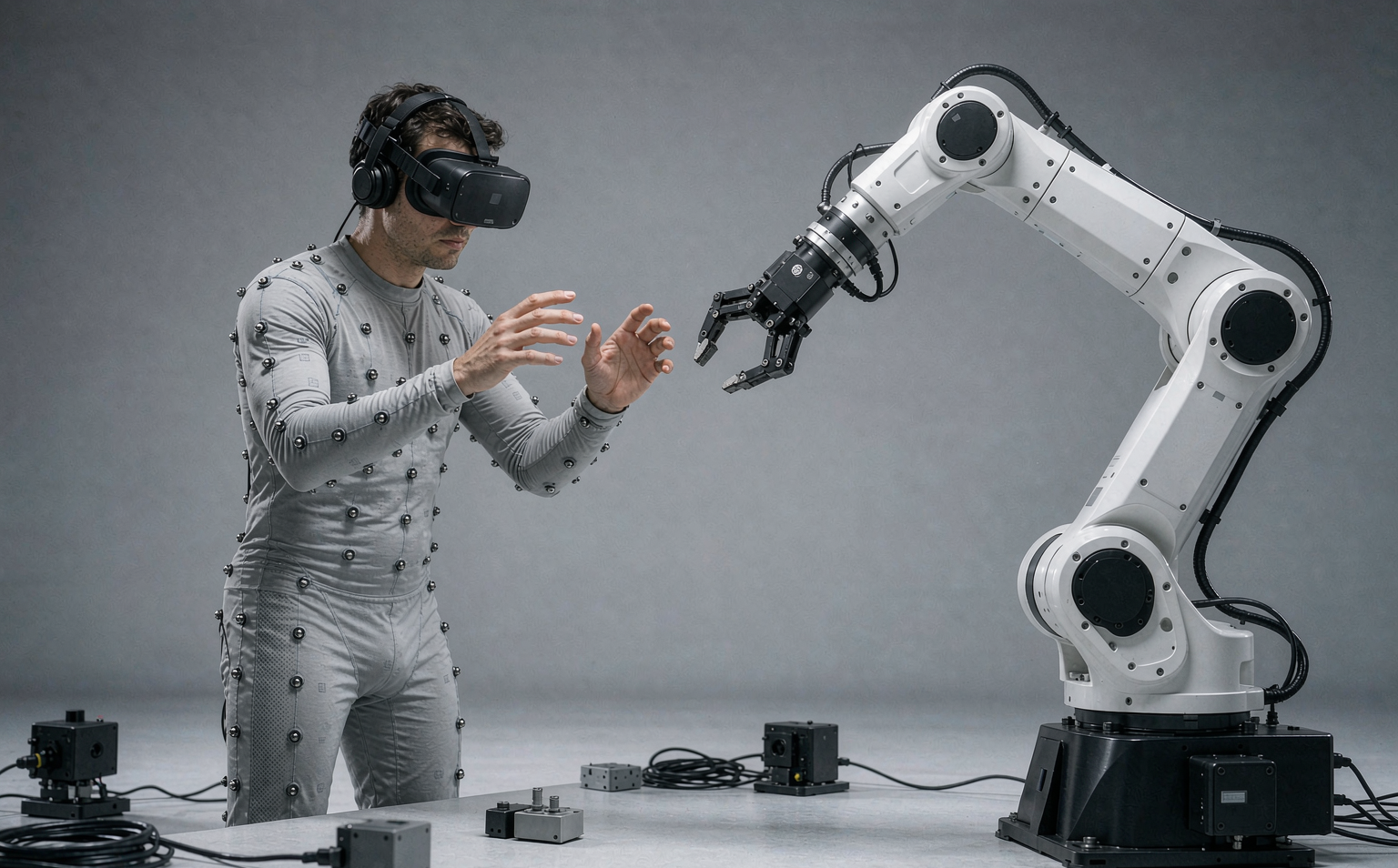
Jianzhi runs three stages. It designs its own capture hardware, Gen DAS, recording head, hand and full-body multimodal human operation at scale. A data foundation model then cleans, aligns and structures the output. Real-machine cluster evaluation closes the loop. A crowdsourced production line, Gen ADP, is meant to lift delivery to ten million hours of human skill data per quarter by 2027.
The open question nobody has priced
The industry has no standard for what embodied data must contain, so everyone is guessing at the target while collecting. If a detail that later turns out to matter is missing, such as force or tactile response, the earlier footage does not become wrong so much as insufficient.
That is a genuine risk for a company selling hours as its unit of account. Hours are easy to count and hard to value. The defensible position is not volume but knowing which hours a given model is short of, which is why the evaluation layer matters more than the collection layer.
Editor’s note: This is an adapted translation of the original OFweek report. It has been trimmed and restructured for readability for an international business audience. The full original (in Chinese) is at https://robot.ofweek.com/2026-11/ART-8321205-12005-30710032.html.