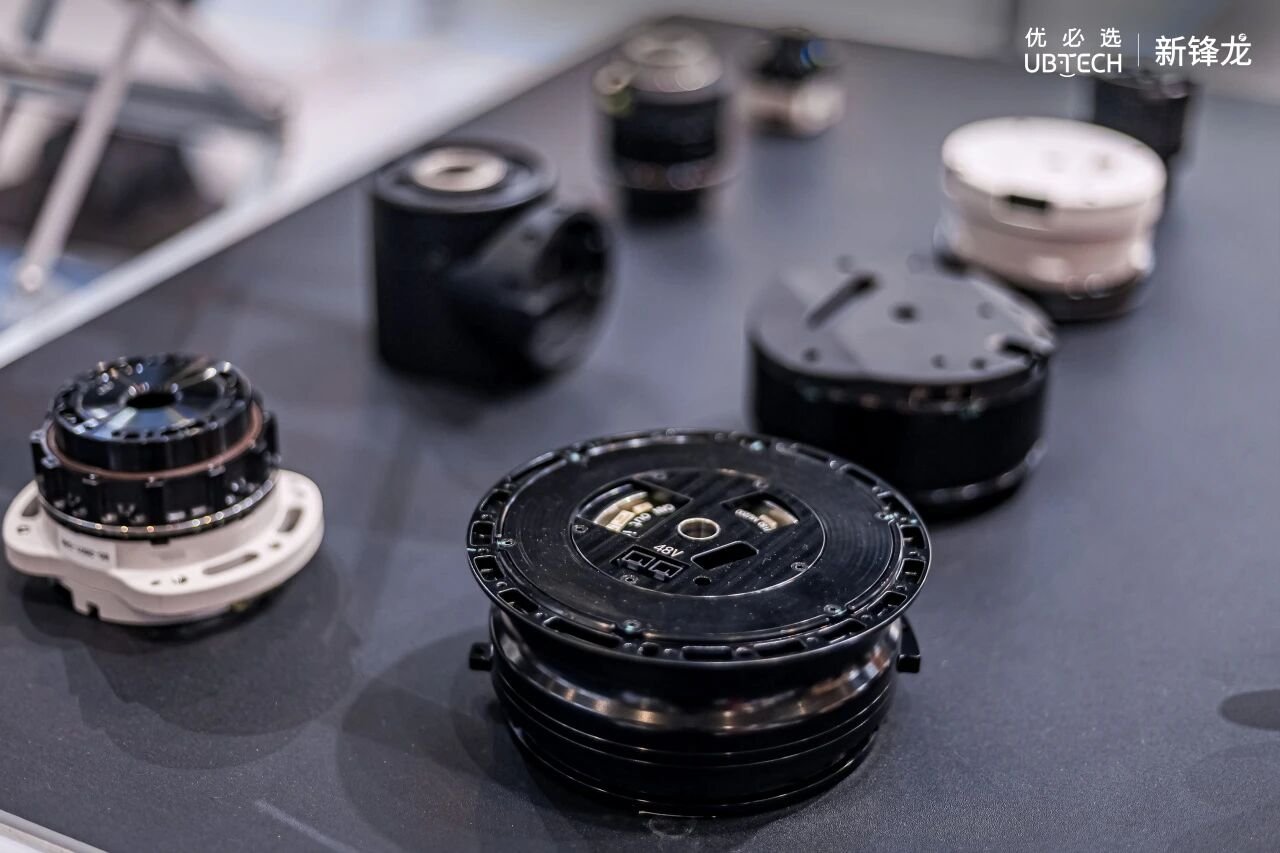
The humanoid argument has moved from whether the machine can walk to whether the parts can be bought. Xinfenglong, a joint venture that combines UBTech’s embodied AI engineering with Fenglong’s precision manufacturing, released a robot joint product matrix on 3 November covering four families aimed at humanoids, mobile robots and industrial applications.
Four families, four jobs
The planetary joint modules target high-dynamic motion, with peak torque up to 300Nm and torque density up to 200Nm per kilogram. They support hollow wiring, which lets cable runs pass through the joint rather than around it, and are aimed at commercial service humanoids and mobile robots.
The harmonic modules target precision motion control. Absolute positional accuracy reaches plus or minus 0.2 degrees, relative accuracy plus or minus 0.05 degrees, and the maximum reduction ratio is 161. These suit light-load humanoids and industrial precision work.
The linear modules integrate screw, drive and encoder in one unit, with peak push and pull force up to 100N and absolute accuracy of plus or minus 0.05mm. The intended applications are dexterous hands and dexterous arms, where the actuation has to sit inside the finger or forearm rather than at the base.
The servo nobody specs until it is missing
The fourth family is the one that reveals how far the design has moved. A bionic facial micro servo is already in mass production, weighing under 40 grams with a maximum torque of 6 kilogram-force centimetres, 360 degree rotation and CAN bus communication.
Faces are the hardest packaging problem on a humanoid. Expression requires many small actuators in a volume with almost no room, and buyers notice a stiff face before they notice a slow gait. Getting a servo to production at that weight is a manufacturing statement, not a specification sheet entry.
The company now covers rotary drive, linear drive and micro bionic drive in one portfolio. For a Shenzhen supply chain that has spent two years assembling humanoid prototypes from whatever actuators were available, a catalogue with published torque density and positional accuracy is a meaningful shift. Integration, precision and cost control at the joint level are where humanoid bill of materials is actually decided.
What the release does not settle is volume. Whether these modules reach scale application and which customers adopt them is still open, and a joint matrix is a capability claim until order books prove otherwise.
Editor’s note: This is an adapted translation of the original Gasgoo report. It has been trimmed and restructured for readability for an international business audience. The full original (in Chinese) is at https://www.gasgoo.com/apps/e060bad9eca91db7f01403fc7120041f/robot/news/70476785/.