Unitree’s share price rose more than 8 per cent intraday the day after the Wuzhen internet summit closed. The market had heard what Wang Xingxing said on the entrepreneurs panel: 2027 is very likely to be a threshold year for the robotics industry and for robot models.
Read that as a prediction of an explosion and you miss the argument. Wang defined the threshold narrowly. The GPT moment for embodied intelligence, he said, is a robot completing 80 per cent of tasks in 80 per cent of unfamiliar scenes, using voice instructions.
Not a fixed workstation repeating one motion a thousand times. An unfamiliar room, out of the box, a place the machine has never seen but roughly understands how to work in.
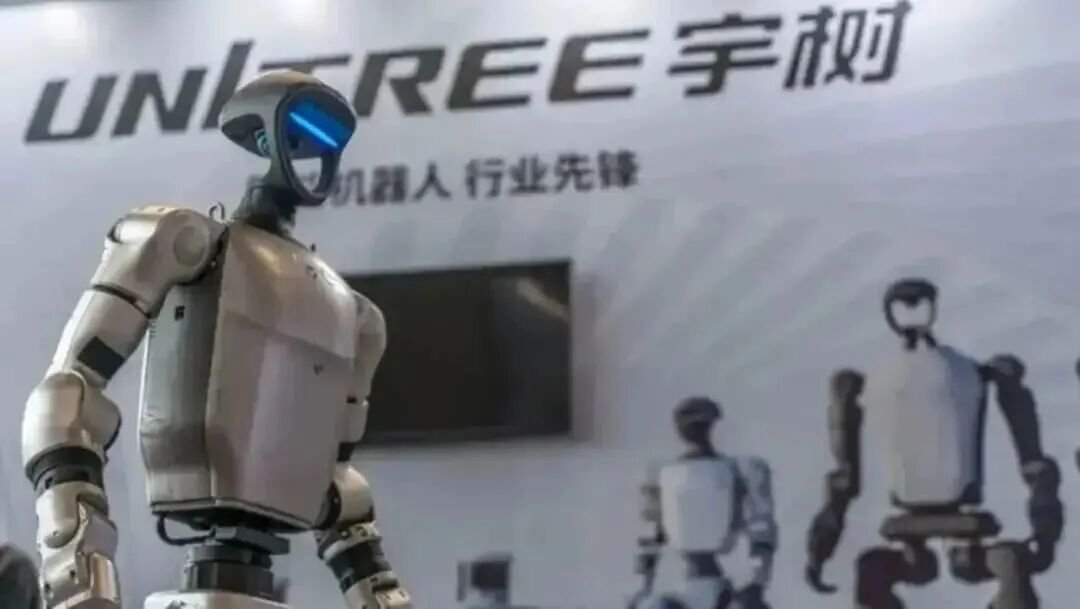
The best models in the world are, in his words, very close to that target, and stuck on the last few millimetres. Grasping and carrying have high success rates. Taking apart a phone, or threading a needle, where touch and fine force control matter, still fail often.
Wang’s own description of the gap is that the alignment between what an AI model puts in and out and what the physical world does is still slightly off.
What Unitree has, and what it does not
The case for betting on 2027 starts with a hard 2025. Unitree booked revenue of RMB 1.699 billion, up 332 per cent, and shipped 5,215 humanoids, the most in the world, at an average selling price of RMB 166,400 with gross margin above 60 per cent. More than 90 per cent of core components are designed and built in-house.
Quadrupeds, the original business, sold 23,000 units in 2025, also the global leader. First-half 2026 revenue was RMB 1.152 billion with net profit of RMB 274 million. On the narrow question of building and selling robots, Unitree is the closest pure-play robotics company in China, and probably in the world, to scale profitability.
Public markets then taught it a lesson in the second half of 2026. The stock opened at RMB 1,100 on debut for a market value of RMB 444.9 billion. A month later it was at RMB 203.6 billion, a 54 per cent retracement.

The trigger was not shipments. Non-recurring net profit fell 19.34 per cent year on year, revenue growth decelerated from 332 per cent to 48 per cent, and research and sales spending began eating the margin. The market’s pricing logic has moved from the imagination of the first robotics listing to the delivery question of whether a robot can be turned into productivity.
Wang conceded at Wuzhen that robot efficiency in factories remains below human labour, which is the core reason deployment has not scaled.
The missing piece is not hardware. Motion control, manufacturing consistency and cost control across quadrupeds and humanoids are solved. What is missing is the loop between the brain and the data. Wang was blunt that data utilisation across the industry, Unitree included, remains low, and that a large amount of data is wasted because it never gets properly fed back into a model.
Leading model companies have already closed the self-evolution loop internally, where the model collects data, trains on it, iterates, and humans only score the output. In robotics that pattern is still rare. Unitree raised RMB 4.2 billion in 2026 and is putting RMB 2.022 billion of it, close to half, into robot model research. The direction is right. The window is not generous.
100,000 units of output, 1,200 units of work
Pull back from one company and the 2026 numbers become hard to reconcile. The Ministry of Industry and Information Technology counts more than 40,000 humanoids produced in China in the first half of 2026, with the full year expected to break 100,000. GGII is more conservative, at close to 60,000 units shipped globally, over 50,000 of them in China, for a market worth more than RMB 10 billion.
On any of those measures the supply curve is steep. Frost and Sullivan decomposed the shipment mix and the picture changes. More than 60 per cent of humanoids sold worldwide in the first half of 2026 went to stages and laboratories. Sales into production work, where a machine creates direct economic value in a factory or a warehouse, amounted to 1,200 units.
AgiBot co-founder Peng Zhihui put it bluntly at his company’s innovation day. Rolling 10,000 units off the line is a manufacturing victory. Ten thousand units clocking on for a shift is the victory of physical AI.
That is why financing cooled sharply in the fourth quarter. October recorded 33 embodied AI deals worth RMB 10.1 billion, against 60 deals and RMB 11 billion in September, and 55 deals and RMB 30.8 billion at the June peak.
GGII’s forecast is direct: 2027 brings the first major shakeout in humanoids, and more than 15 per cent of companies will fail or be acquired within three years. The China Academy of Information and Communications Technology uses softer language and reaches the same conclusion, warning that bubble risk is accumulating and that a first market-driven clearance will take place over the next two to three years.
So 2027 as a threshold is not a single technical event. A generalisation breakthrough and a commercial shakeout are likely to arrive together. Companies that cross the last few millimetres will find themselves on a course with far fewer competitors. Companies that do not will find that no amount of narrative buys the next round.
The models help, just not with the final step
How far have large models actually pushed robots? The progress is real. Xiaomi’s Robotics-1 was pretrained on 100,000 hours of real manipulation trajectories and ranks first on both RoboCasa365 and RoboDojo. A humanoid has run a self-tapping nut station on an automotive line autonomously for three continuous hours at a 90.2 per cent success rate, inside a 76-second takt.
SenseTime’s open-sourced embodied execution framework cut the cost of specific tasks to one fiftieth of calling GPT-6-Astra directly. OpenAI has signalled a striking demonstration robot for 2027.
The detail most readers skipped is in SenseTime’s technical report. GPT-6-Astra reaches 81.9 per cent success on RoboDojo when given a tenfold step budget, against 27.6 per cent at the standard budget. The model is not incapable. It needs to think for a long time.
Thinking longer is free in simulation. On a real line, a 76-second takt does not wait. That is the physical version of Wang’s last few millimetres. A language model learns what the word cup means from text. A robot has to learn how much force to apply to a cup of a different material, weight and surface friction, which requires touch, force feedback and fine-grained physical interaction data.
The industry’s cumulative stock of real manipulation data is roughly 100,000 hours. That is not a rounding error away from what a language model needs. It is nowhere near the starting line.
What matters in 2027 is therefore not which company teaches a robot another backflip. It is whether the data flywheel turns. Unitree has started an internal physical AI self-evolution programme aimed at looping models between simulation and real environments to cut dependence on hand-written programming and tuning. If that loop produces verified efficiency gains in 2027, the threshold has a technical floor. If it does not, the GPT moment stays a good analogy rather than an engineering fact.
What Unitree is actually betting
Unitree carries one underrated advantage and one overrated risk into 2027. The advantage is hardware scale itself. Wang’s point is that building and deploying thousands or tens of thousands of robots to collect data is, in a sense, cheap and easy.
While competitors struggle to deliver a few hundred units, Unitree can put more than 10,000 machines into real environments. The G1 alone has rolled out between 10,000 and 20,000 units, the largest volume of any single humanoid model globally. Hardware scale is not intelligence, but it sets the marginal cost of acquiring data, and in an industry where data is the binding constraint that is a bigger chip than most people price.
The overrated asset is the first-listing halo. A large part of the RMB 444.9 billion peak was pricing the narrative that humanoids are the next trillion-dollar sector, not what Unitree’s income statement could carry. The profit decline and the growth deceleration say the company has to walk the road from selling robots to selling productivity on its own feet.
The competitive picture has already hardened. In the first half of 2026 AgiBot shipped 8,400 units against Unitree’s 5,900, taking global share of 44 per cent against 31 per cent. The domestic duopoly is formed, and neither side can coast.
The task before 2027 is not proving that a robot can do something impressive. It is proving that after the impressive thing is done, somebody keeps paying for it. A threshold does not carry everyone across. It just makes the distance between the two banks visible.
Unitree holds a ticket. The boat has not docked.
Editor’s note: This is an adapted translation of the original OFweek report. It has been trimmed and restructured for readability for an international business audience. The full original (in Chinese) is at https://robot.ofweek.com/2026-11/ART-898890-8420-30710441.html.