If assisted driving matters in a purchase decision, VLA is now difficult to avoid in China. Since the second half of last year the term has appeared in almost every intelligent driving launch, and Xpeng and Li Auto present it as the route to L4 and eventually to physical AI.
The practical question for buyers is narrower: which cars actually ship a vision-language-action stack, and how do the implementations differ once the marketing is stripped out.
What VLA is
VLA stands for vision, language, action. The system converts what it sees into natural language, reasons in that space, and then executes a driving action. It sees, thinks, then acts.
Three generations of architecture got here. The earliest modular approach split perception, prediction, planning and control into separate blocks wired together by hand-written rules, which capped performance and left long-tail scenarios unsolved.
Around 2023, end-to-end arrived, using a single neural network from perception to control and removing the rule book. It remained a black box. It could imitate a human driver without understanding why the human drove that way.
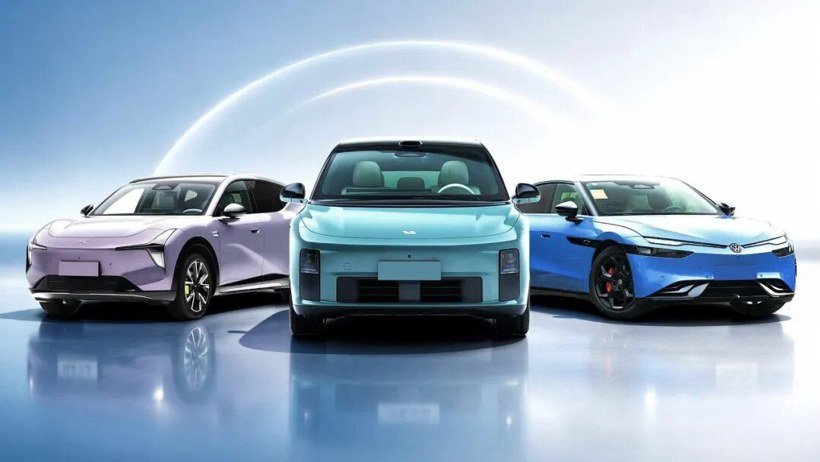
VLA attaches language as a reasoning tool. The language layer lets the system describe a scene rather than classify it, moving from a pedestrian ahead to a pedestrian carrying a child who may step into the road, and therefore to slowing early in preparation for braking. That capacity to see, explain and then act is why the industry treats VLA as the bridge to L3 and L4.
It also solves a separate experience problem. A model that understands language can be controlled by it, so an instruction to turn around at the next junction or to find a parking space becomes an executable command rather than a menu action.
Four implementations, one label
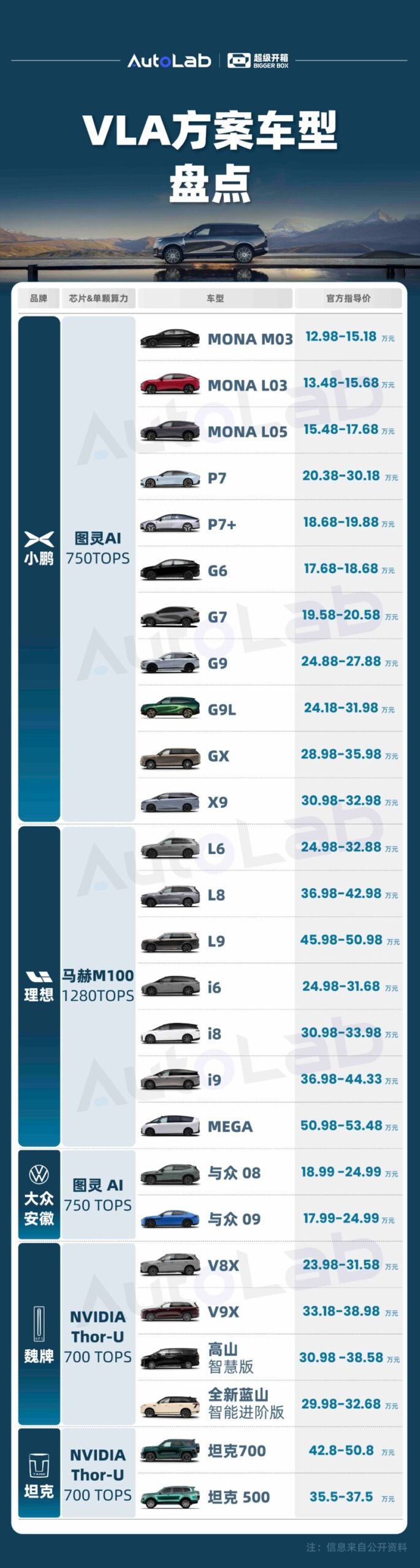
Xpeng, Li Auto, Volkswagen Anhui and Great Wall carry the VLA label in China today, covering roughly RMB 100,000 to RMB 500,000. Xpeng and Li Auto use in-house high-compute silicon. Volkswagen Anhui uses Xpeng’s architecture. Great Wall runs Yuanshi’s stack on NVIDIA hardware.
Li Auto uses a 3D vision transformer to model the world directly and keeps the language layer as what its engineers call a thinking exoskeleton, to the point where the car can narrate its own reasoning to the driver.
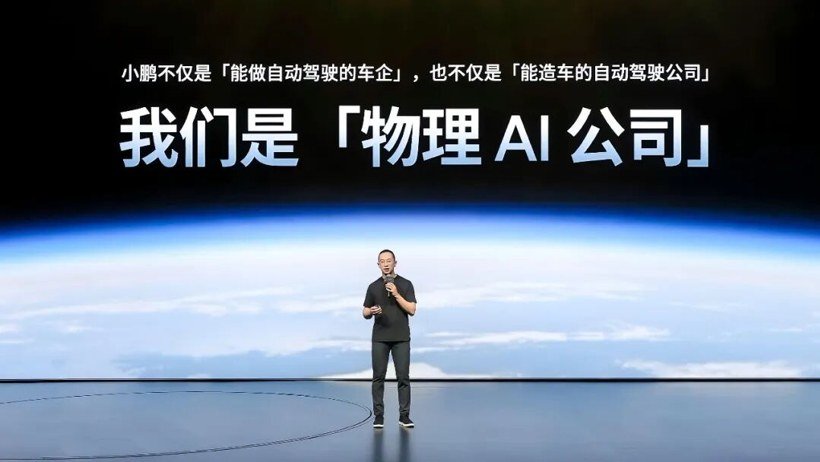
Xpeng removed the language scaffold and goes from vision to action, branding it second-generation VLA. The trade is latency and directness against explainability.
Yuanshi, supplying Great Wall, strengthens chain-of-thought reasoning in the language layer and trains defensive driving as the primary objective, which lets the system read text-based signage that requires actual comprehension rather than character detection.
What it feels like
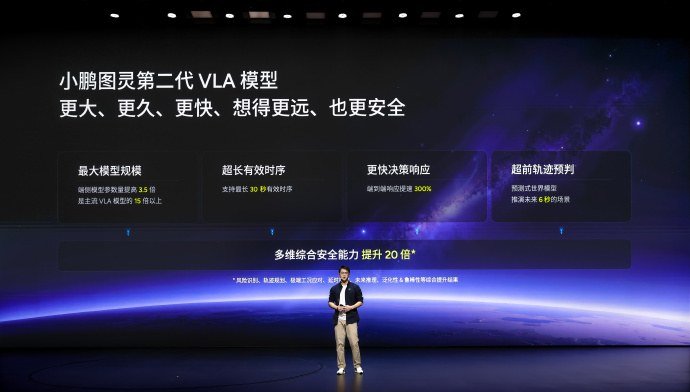
In a Guangzhou test of Xpeng’s second-generation VLA, the dominant impression was calm rather than dramatic. The version carries 30 seconds of backward memory and reasons six seconds forward, aligning time and space in a long context.
When a mother carrying a child stepped out from a blind spot, the system did not brake to a stop. It yielded while keeping the cabin from pitching passengers forward. In a dense urban village it chose to run close to a container truck, on the reasoning that a truck is a predictable obstacle while pedestrians and scooters are not. It also steered around potholes and narrow debris.
Two basic failures showed up in the same drive. The car repeatedly failed to yield at a zebra crossing and started slowly from traffic lights, which are calibration problems rather than architecture problems.
On a 2025 Li Auto MEGA updated to software 8.6.0 on Thor-U silicon, the system exited a parking space and found its way out of an unfamiliar residential compound unaided, and in a narrow meeting situation with an oncoming car and a parked two-wheeler on the right, it threaded the gap rather than retreating, judging spatial sufficiency first.
A Great Wall Wey Blue Mountain running Yuanshi’s IO4.0 handled a tight bend under a bridge with oncoming traffic by creeping through within a safe margin, and when a stopped car blocked the way ahead it reversed to create room before continuing.
Why the distinction will matter commercially
Every one of these systems covers parking-space-to-parking-space driving, so the feature list has converged before the technology has. What separates them is what happens at the edge of the operating domain and how much of the reasoning a manufacturer is willing to expose.
That has a direct consequence for export. A stack that can explain a decision is easier to certify against European functional safety and incident-reporting rules than one that cannot, and a stack that responds to natural language instruction is easier to localise than one that relies on menu-driven settings. The VLA label will not survive contact with a European type-approval process, but the architecture behind it will.
Editor’s note: This is an adapted translation of the original Gasgoo report. It has been trimmed and restructured for readability for an international business audience. The full original (in Chinese) is at https://auto.gasgoo.com/news/202611/6I70477075C601.shtml.