Samsung Electronics and Hyundai Motor Group have widened a partnership that already spans semiconductors, batteries and automotive electronics into robotics and physical AI, with a joint development programme for robot batteries as the most concrete new commitment.
The two groups met on 9 November at Samsung Electronics’ Seocheon training centre in an event titled Hyundai Motor Group Appreciation Day, under the theme Harmony Toward the Future. Attendance included 177 people, among them core executives from both groups, their spouses and officials. Samsung said it was the first time it had staged an event on this scale for a large Korean conglomerate.
Who was in the room
Samsung sent its device solutions chief and vice chairman Jun Young-hyun, DX division head Roh Tae-moon, system LSI head Park Yong-in, foundry head Han Jin-man, Samsung Display president Lee Chung, Samsung SDI president Choi Joo-sun and Samsung Electro-Mechanics president Chang Duck-hyun.
Hyundai Motor Group sent vice chairman Chang Jae-hoon, planning and coordination president Seo Gang-hyun, Hyundai and Kia R&D head Manfred Harrer, and advanced vehicle platform head Park Min-woo.
That is not a courtesy delegation. It is the complete set of people who would have to agree a cell specification, a foundry allocation and a robot platform between them.
What already ships
The commercial base is real. Samsung Electronics has agreed to supply the Exynos Auto V920 automotive infotainment semiconductor to Hyundai. In 2023 Samsung SDI signed its first long-term electric vehicle battery supply contract with Hyundai, and its high-nickel NCA prismatic cells go into Kia’s compact electric SUV and the Hyundai Ioniq 3, with the same cell family also specified for the Genesis GV90 flagship electric SUV.
Samsung SDI, Hyundai and Kia have now begun joint development of a battery dedicated to robots. That is the line to watch. Robot packs are specified differently from car packs: peak discharge matters more than energy density, thermal behaviour under repeated high-torque duty cycles matters more than fast-charge curves, and the safety case is written around a machine that operates next to people indoors rather than a vehicle crash structure.
Why the two groups need each other now
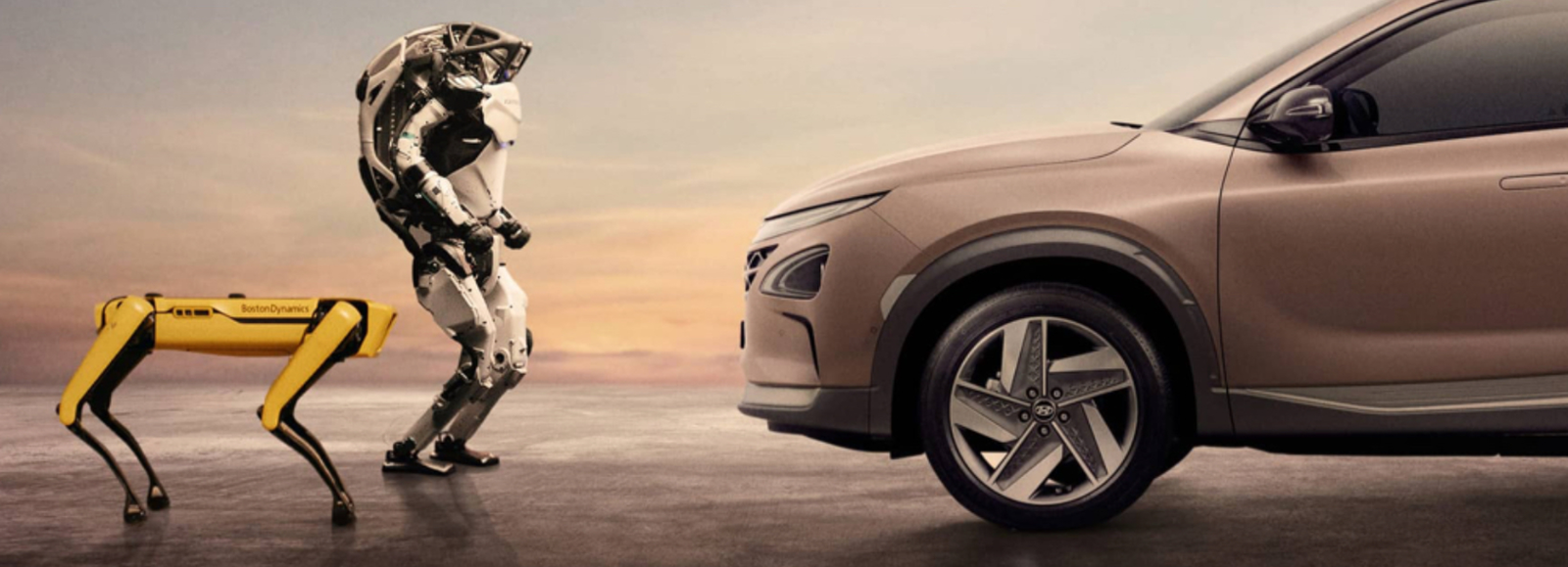
Hyundai is trying to convert a vehicle manufacturing base into a robotics platform business, with Boston Dynamics inside the group and a physical AI agenda that needs compute, sensors and power. Samsung owns the three scarcest inputs for that agenda in Korea: leading-edge foundry capacity, display and sensor technology, and cell manufacturing.
Neither company can build the full stack alone at Chinese speed. China’s humanoid supply chain has scale, iteration speed and cost that no Korean consortium matches today, and the gap is widest exactly where this partnership is aimed, which is the bill of materials for a working humanoid.
The historical framing offered at the event went back to 1985, when Samsung founder Lee Byung-chull attended the seventieth birthday of Hyundai founder Chung Ju-yung. In 2001 Lee Kun-hee met Chung Mong-koo, Samsung began buying Hyundai Equus sedans for its executives, and Hyundai partly adopted Samsung cards. In 2020 Lee Jae-yong and Euisun Chung met twice to discuss future mobility including next-generation EV batteries.
The read-across for European suppliers
Korea is building a vertically integrated robotics supply chain inside two conglomerates. That is a different competitive shape from China’s fragmented ecosystem of hundreds of specialised suppliers, and a different one again from Europe’s tier-one model, where a handful of large suppliers sell subsystems to all carmakers.
If the Samsung and Hyundai arrangement produces a qualified robot cell and a reference compute platform, it becomes the default option for every Korean and Japanese robot programme that does not want to depend on a Chinese cell maker. That is a market European battery and automation suppliers currently have no route into.
Editor’s note: This is an adapted translation of the original Gasgoo report. It has been trimmed and restructured for readability for an international business audience. The full original (in Chinese) is at https://auto.gasgoo.com/news/202611/10I70477427C108.shtml.