At the entrance to the press centre at this year’s China International Import Expo, a robot picked up a Polaroid camera, adjusted its grip, pressed the shutter and handed the photograph to a journalist. Elsewhere in the halls, robots sorted medicines, depalletised cartons, welded without teaching, and assembled components.
The demonstrations were genuine. The question the industry spent the week arguing about is what happens when the demonstration ends.
Probation, not employment
Mu Zelin, founder and chief executive of Shanghai Moushen Intelligence, gave the blunt version. Large-scale robot deployment is still uncommon and most units remain in a probationary phase, though some scenarios have already reached scale.
The distinction is not semantic. A robot on probation works one station, under supervision, with engineers nearby and a fallback plan. A robot with a job works a shift, on a line that changes product mix, without an engineer standing next to it.
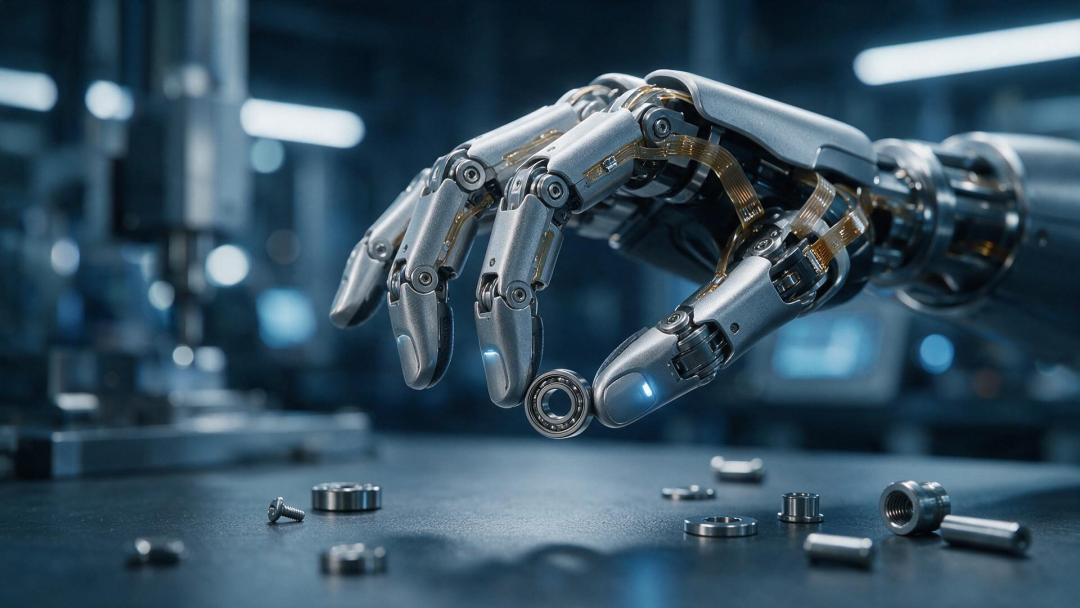
The gap between those two states is what the industry calls the last few millimetres.
What is actually deployed
Ant Group’s Lingbo unit and Guoda Pharmacy built a smart retail pharmacy on the show floor. A customer places an order, the robot takes it, picks the goods and delivers them to the counter. The system runs LingBot 2.0, an embodied-native general robot brain, and requires almost no modification to the existing store layout. It is already live in several pharmacies in Pudong.
Industrial cases were more specific. Zhejiang Humanoid Robot Innovation Centre showed NAVIAI handling depalletising, sorting, transport and component assembly as a continuous flow. Shanghai Hugong demonstrated teaching-free welding with its HGR humanoid. Siemens brought a complete end-to-end humanoid production concept covering body design, process simulation, virtual commissioning, core component machining, final assembly and industrial application. Tesla showed humanoid form factors for carrying luggage, walking dogs and childcare, and described building a humanoid academy that trains on human data before moving to simulation and real-world practice.
Precision improved too. Hexagon used high-precision coordinate measuring machines, laser trackers, industrial CT and its RoboDyn calibration system to push whole-machine motion accuracy from centimetres to below a millimetre.
The barrier moved to the model
None of that settles the commercial question. If every new shelf layout, every new product and every new line requires fresh commissioning, the robot is a custom demo rather than replicable productivity. That is the objection European manufacturers raise first, and the show floor did not answer it.
The brain side was loudest. Nvidia researchers reported that GPT-6 Astra can perform general pick-and-place tasks out of the box. Apple’s research team disclosed HALO, a humanoid autonomous control system that ran 360 individual task tests across six real environments it had not previously scanned or mapped, with an average success rate of 91 per cent.
That raised the obvious question of whether embodied companies still have a moat if a general model can drive the hardware. The practitioners were unimpressed in a specific way. Wang Qian, founder of Zibian Robotics, argued that fine motor control and high-level reasoning share an evolutionary origin and that fusion is the direction worth expecting. Gao Jiyang of Galaxea judged the impact on embodied foundation models to be limited, for a practical reason: both boxes have to run on the device, or the work cycle cannot keep up and the inference latency cannot be solved.
The test data supports the sceptics. Chen Tao, chief scientist at Moushen, said his team connected GPT-6 Astra to robots from several manufacturers and found substantial room for improvement. Tasks a native brain completed in one or two minutes took thirty to sixty minutes with GPT-6 attached. It followed a successful manipulation path well, but stalled when something went wrong or when it could not locate the instructed target or the expected contact position.
Zhiyuan partner Xiong Yan made the cost point: action generation can take minutes per simple motion and a single call can cost hundreds of dollars, which makes deployed debugging expensive.
The last few millimetres
Wang Xingxing, founder of Unitree, framed the constraint as alignment between model and physical world. Multimodal models already understand scenes reasonably well, he said. The problem is error in the mapping between input and output. The best multimodal models can grasp a large object with success approaching 100 per cent, but do markedly worse on precise work such as assembling parts. He expects that to improve within one to two years.
That distinction matters for anyone specifying automation. Hardware accuracy is now a solved problem at sub-millimetre level. What remains unsolved is whether a model’s instruction corresponds accurately to an object’s real position, its contact state and the magnitude of force applied.
Editor’s note: This is an adapted translation of the original OFweek report. It has been trimmed and restructured for readability for an international business audience. The full original (in Chinese) is at https://robot.ofweek.com/2026-11/ART-8321201-8420-30711041.html.