The component at the centre of the biggest change in steering since power assistance has gone into series production, and it is being built and shipped in China first.
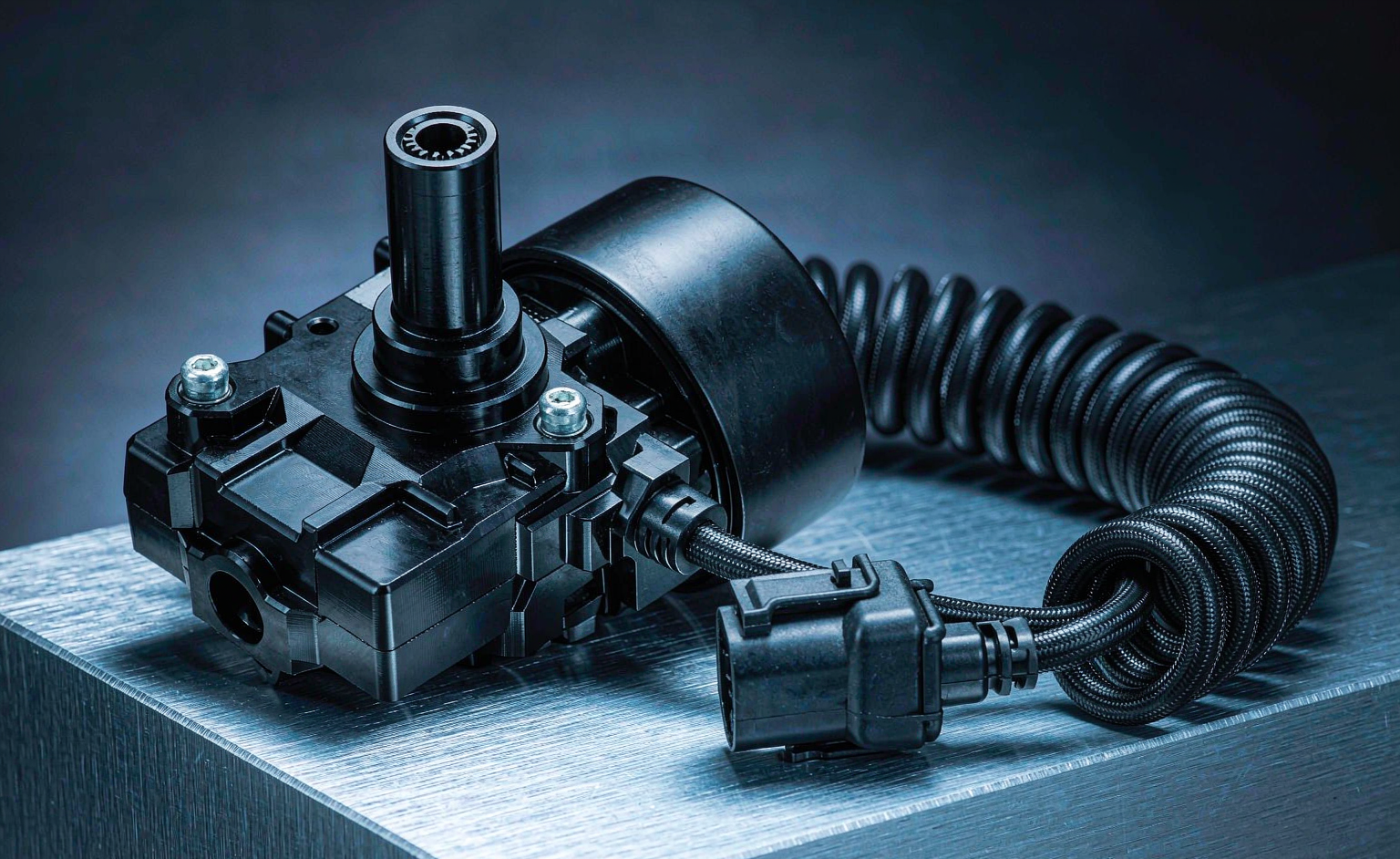
Forvia HELLA says its new-generation steering angle sensor has entered mass production in China and is now being delivered to several leading Chinese electric vehicle manufacturers, targeting steer-by-wire architectures in intelligent electric cars.
What the part does
Steer-by-wire removes the physical connection between the steering wheel and the front wheels. Everything the driver does becomes an input, and everything the road does becomes feedback generated by software and an actuator. The angle sensor is how the system knows where the actuator actually is.
It samples the rotational position of the front axle actuator in real time and converts that physical position into a precise electrical signal for the control unit, which uses it to interpret driver intent and issue the corresponding steering command.
Forvia describes three areas of improvement over earlier electronic steering systems. Response speed is higher, addressing the lag that characterised first-generation electric power steering. The sensor can be embedded in the perception modules behind lane keeping assist and emergency steering assist, feeding position information into active safety functions. And it resists low-frequency discrete magnetic field interference, which is the specific failure mode that makes a steering system behave unpredictably in a real traffic environment.
Where it was designed
The product was developed jointly by the global headquarters engineering team in Lippstadt, Germany and a Shanghai engineering team. Forvia frames it as global technology plus strengthened local engineering capability.
That framing is accurate and also understates the shift. For the last three decades, a European tier-one developed a part in Germany, homologated it, and then localised production in China to serve a market that was adopting European architectures. Here the sequence is closer to the reverse: the first series application of a new steering architecture is Chinese, and the German engineering centre contributes to a programme whose lead customers are Chinese carmakers.
Why modularity is the real product
The sensor is built as a modular hardware and software platform with a high degree of configurability. Forvia says this lets it flex on performance, cost and delivery cycle for different customers while keeping platform commonality, which in turn lowers development and manufacturing cost.
For a part that will be specified across a dozen models with different safety ratings and different cost targets, that modularity is worth more than any individual performance figure. Steer-by-wire sensors are not sold as a single specification. They are sold as a family that can be trimmed to hit a price point on a compact car and a redundancy requirement on a flagship.
The European read-across
European carmakers are moving to steer-by-wire more slowly than their Chinese competitors, largely because their current platforms were designed around a mechanical column and because the regulatory treatment of a fully electronic steering system is more conservative in Brussels than in Beijing.
That gap is now a supplier geography problem. A tier-one that has run a steer-by-wire sensor through Chinese series production has manufacturing learning, field data and cost structure that a competitor still in validation does not. When a European OEM finally launches the same architecture in 2028 or 2029, the suppliers most able to bid will be the ones that already shipped it somewhere.
The angle sensor is a small part on a bill of materials that runs to thousands of lines. It is also the point where a mechanical industry becomes a software one, and that transition is now being commissioned from Shanghai.
Editor’s note: This is an adapted translation of the original Gasgoo report. It has been trimmed and restructured for readability for an international business audience. The full original (in Chinese) is at https://auto.gasgoo.com/news/202611/10I70477473C103.shtml.