A robotics company that sells cleaning is not necessarily selling cleaning. In San Francisco this autumn, the product on offer was a humanoid that wipes surfaces for USD 30 an hour, and the valuable output was never the clean counter.
Tau Robotics is the company. A reporter from MIT Technology Review booked a session after seeing the service on social media, joined a waiting list, and deliberately did not identify herself as press so the visit would not be staged. She used her real name, which the company could have checked.
A remote-controlled car with a sponge
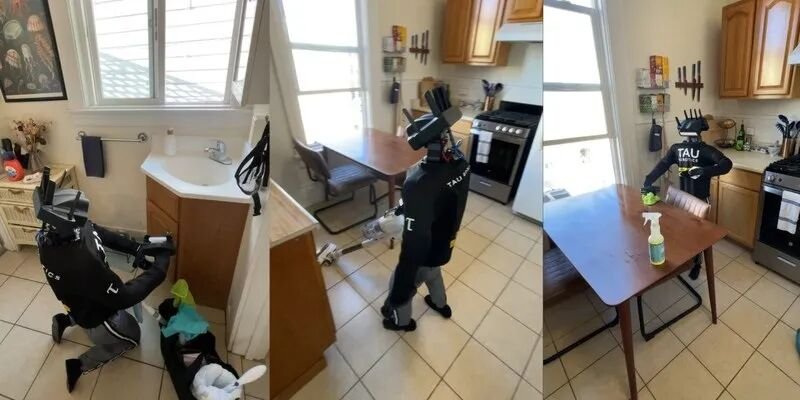
The machine that arrived was four and a half feet tall, with a 3D-printed head carrying an antenna for the link back to headquarters and two 3D-printed claw hands. The claws are not a stylistic choice. A hand closer to human anatomy was not durable enough for the work, and the claw shape turned out to be effective on most cleaning tasks.
It wore a Tau shirt and non-slip socks to avoid marking the wooden floor. Two people lifted it out of a small blue van. The first obstacle was eight steps at the entrance, which it climbed approximately like a person who has had too much to drink, losing progress on almost every step but never fully falling. The carpeted internal staircase defeated it, and it was carried up the last few steps.
Co-founder Cornelia Weinzierl later attributed the stair problem to the short but real latency in the remote link, and said that optimising timing and connectivity consumed far more engineering effort than expected.
The visit that ended early
That first session also coincided with abnormal heat. The robot shut down repeatedly. The cause turned out not to be the robot overheating but the operator’s display device being thermally shut down on the other end. Without remote assistance the machine could not continue, and the booked hour ended incomplete.
The company’s handling was competent: an apology email, a waived fee and a replacement session, all before the reporter identified herself. The second visit was smoother. Stairs still needed less help, and the gait remained visibly crooked.
Where the money actually is
Pricing started at USD 30 per hour per robot, then moved to USD 60 a week for two robots, or USD 100 for a single visit. The cleaning itself was competent in the kitchen, though the robot avoided the hob entirely. The most impressive moment was the toilet brush head, which fell off three times and was re-seated each time by feel, using the handle to find the angle.
It left the tap running repeatedly, knocked over a sealed bottle of olive oil without righting it, and could not lift the air purifier it had pushed over. Bed making and shirt folding required kinematic guidance, where a human performs the motion once and sensors transfer it to the robot to copy. That data is the most valuable the company collects.
Weinzierl said vacuuming and mopping already run without a person. The company has completed a few hundred cleanings in total. Teaching an apartment’s full range of tasks will require a considerably larger dataset.
The flywheel and the jobs question
Strip away the charm and the business is straightforward: sell a service below cost to acquire real household manipulation data, and use it to train towards autonomy. The American team’s advantage is models and capital. Its disadvantage is hardware cost at volume, where Chinese humanoid makers compress bill of materials faster.
What Chinese companies lack is the household data. Housing stock differs, door-to-door service networks are thinner, and privacy compliance has to be solved before a single visit. Whoever lowers the cost of collecting teleoperation data first is the one who can turn a home robot into an appliance.
On employment, Weinzierl’s argument is that cleaning is not work many people want, with high turnover and high injury rates, and that the long-run targets are mould remediation and home care, which are worse. The original piece also notes that if these machines become cheap and autonomous, people will lose jobs, and that the United States is nowhere near a policy for that.
Editor’s note: This is an adapted translation of the original OFweek report. It has been trimmed and restructured for readability for an international business audience. The full original (in Chinese) is at https://robot.ofweek.com/2026-11/ART-8321203-12003-30711355.html.