Huawei Cloud released CloudRobo-WM1.2 on 16 November, an embodied world model built on Ascend chips, with weights, inference code and training code published in full. There were no dancing robots at the launch, only a screen and a set of parameters.
The number Huawei repeated was 80 per cent. Wu Xiaodong, who runs the company’s embodied AI product line, used it to describe how much of China’s embodied AI industry already works on Ascend cloud infrastructure. The model is the bait. The compute pool is the point.
Why a camera angle breaks a robot
Wu opened with a familiar complaint. A robot performs delicate work in a laboratory and turns useless the moment it leaves the building. Traditional vision models learn what an object looks like from one angle rather than what the object is, so partial occlusion is enough to collapse performance. Huawei’s own figures put detection F1 at 68 per cent falling to 28 per cent under occlusion, and accuracy at 62.72 per cent falling to 7.62 per cent when the viewpoint shifts.
Data is the second constraint. Collecting real-robot trajectories costs RMB 500 to 2,000 per hour. Ten thousand hours therefore costs RMB 5 million to 20 million, and a large share of what is collected turns out unusable.
The architecture change
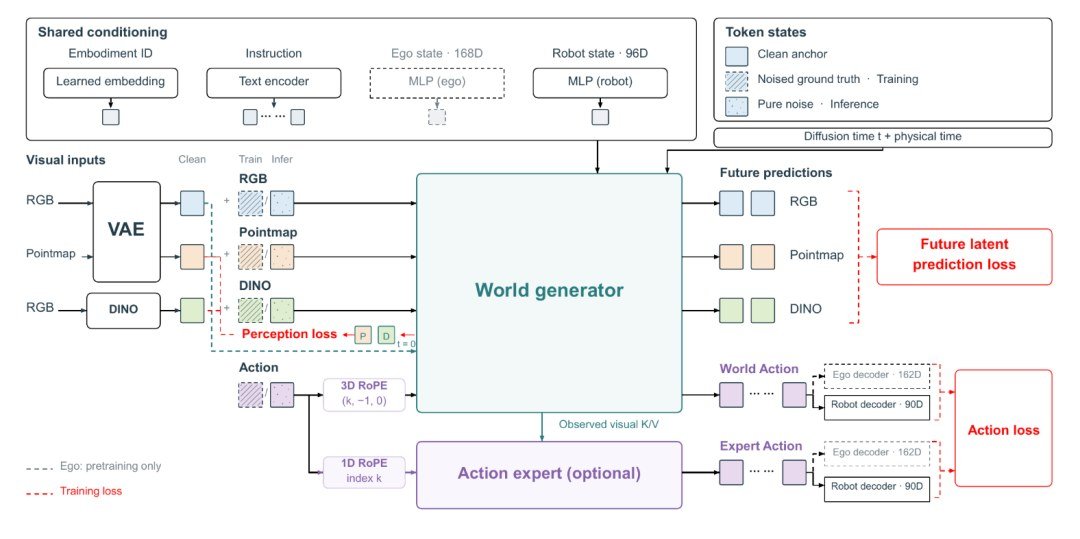
Earlier systems bolted two modules together. Tight coupling preserved physical intuition but added latency, loose coupling cut latency but lowered success rates. WM1.2 runs natively integrated, using a PPA architecture that upgrades static recognition into four-dimensional physical understanding. In Huawei’s phrasing, the model stops reading a photograph and starts reading an action film already in progress.
Action generation splits into two channels under DualAct. One outputs high-precision motion directly from the world model, the other hands off to an action expert for low latency. Training uses multi-granularity supervision, so missing depth or missing labels do not disqualify a dataset. Cross-embodiment support comes from a shared action translator covering single-arm, dual-arm and wheeled bodies.
The data footprint has grown accordingly, from roughly 8,000 hours of pre-training to 27,500 hours across 20 data sources and 33 embodiments.
Benchmarks are Huawei’s own numbers
Huawei says the model ranks first on RoboTwin 2.0 and LiberoPro 2.0. Both are public benchmarks, not production lines. Gemini Robotics 2.5 from Google and GR00T 2 from Nvidia were both trained inside the Nvidia GPU ecosystem, and domestic Chinese silicon has mostly been proven on inference rather than training. This release straightens that question a little.
The commercial sample is Fulongma, a sanitation equipment maker that signed a RMB 200 million contract with Huawei Cloud in September covering sanitation autonomous driving technology. Their next-generation sweeper is in pre-sale, with a Shanghai launch scheduled for December. Projects that clear review receive up to RMB 1 million in compute support. Huawei Cloud repeats that it will not build robot bodies, only compute, models and a development platform.
What the 80 per cent buys
If enough teams train on Ascend by default, the hardware conversation inside Chinese robotics stops being about who can obtain an export licence. The 80 per cent figure is a scorecard today. It is a starting position tomorrow.
Whether a sweeper holds a lane at four in the morning is still unanswered. That answer arrives in December.
Editor’s note: This is an adapted translation of the original OFweek report. It has been trimmed and restructured for readability for an international business audience. The full original (in Chinese) is at https://robot.ofweek.com/2026-11/ART-8321206-8420-30712131.html.