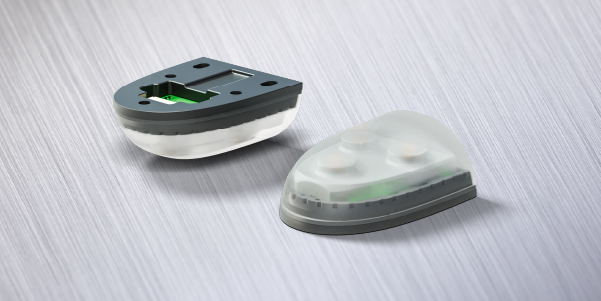
Melexis has released the MLX90901, a tactile fingertip module that gives a humanoid robot finger three-axis force sensing, covering normal force and shear in two directions. It is the Belgian supplier’s first mechatronic module, built on its Tactaxis magnetic sensing technology and shipped with the mechanical structure, materials and integration support around it.
The gap it addresses is well known to anyone building hands. Most robots carry simple grippers with no force feedback or with single-axis detection, while multimodal tactile hands that work well remain laboratory projects with high cost, heavy customisation and complex integration.
What the numbers say
The module measures up to 15 newtons of normal force and 4 newtons of shear, with 10 per cent accuracy across full scale and a typical resolution of 200 millinewtons. An I2C interface connects it to hand controllers and embedded platforms. The design integrates the sensor, magnet, elastomer, mechanical structure and circuitry, which removes material selection, assembly tuning and sensor integration from the customer’s workload.
The DVK90901 evaluation kit is available now and is intended to give hand makers a standard platform for benchmarking, prototyping and system debugging, while robot builders can collect contact data for closed-loop control and physical AI development.
Four years from a sensing principle to a part number
Melexis validated the biomimetic principle first through discrete tactile sensing units, or taxels, which engineers could evaluate individually. System-level experience from customer pilots then turned the principle into a standardised finger module, combining the research with the company’s volume manufacturing.
Julien Ghaye, product line manager at Melexis, said the Tactaxis project began when tactile sensing research was accelerating and the technology matched the company’s magnetic sensing base, and that the MLX90901 marks the move from discrete components to a complete module in which Melexis owns the materials, mechanics, electronics and integration.
The significance for the humanoid supply chain is that tactile sensing now has a catalogue part with a data sheet, which is the point at which a component stops being a research line item and starts appearing in bills of materials. Whether that raises or lowers the barrier for hand makers depends on how much of their differentiation was the sensor and how much was the control around it.
Editor’s note: This is an adapted translation of the original Gasgoo report. It has been trimmed and restructured for readability for an international business audience. The full original (in Chinese) is at https://auto.gasgoo.com/news/202611/17I70478223C601.shtml.