SMIC is now within half a percentage point of Samsung in global foundry share, and the gap is closing on the back of a factory network that has already been paid for. That is a very different position from the one China’s largest chipmaker occupied for most of the past decade.
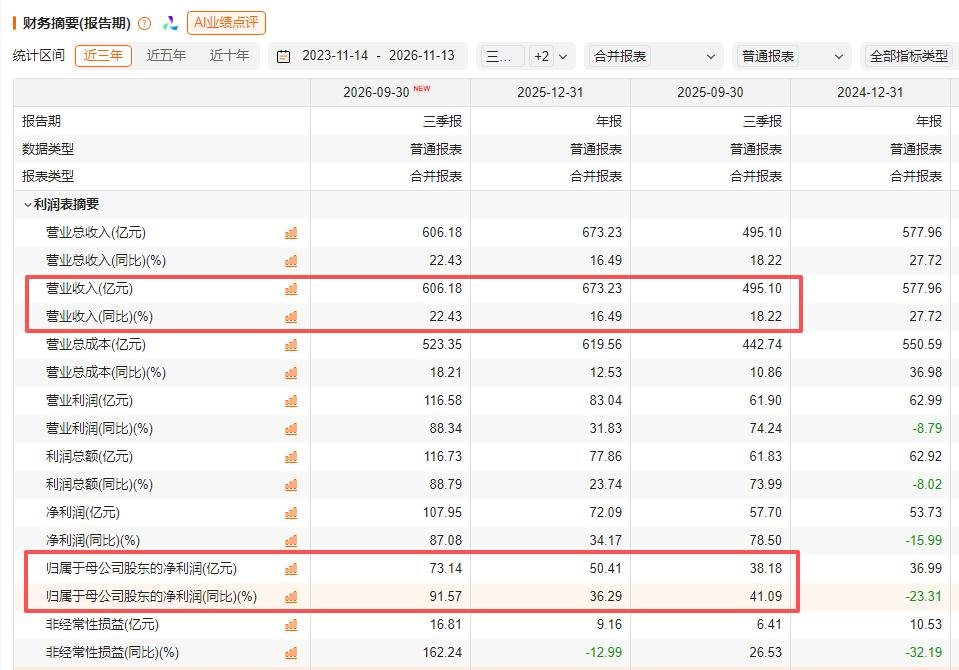
For the first three quarters of 2026, SMIC reported revenue of RMB 60.618 billion, up 22.43 per cent year on year, and net profit attributable to shareholders of RMB 7.314 billion, up 91.57 per cent. Gross margin for the period reached 25.59 per cent, a four-year high for the same window. Third-quarter revenue in US dollar terms was US$3.19 billion, up 6.1 per cent sequentially, with gross margin of 29.9 per cent, 4.6 points above the second quarter.
A 0.5-point gap to Samsung
TrendForce put second-quarter 2026 global foundry share at 72.5 per cent for TSMC, 5.9 per cent for Samsung and 5.4 per cent for SMIC. One quarter earlier the Samsung-to-SMIC gap was 1.4 points. In revenue terms Samsung’s foundry business took US$3.26 billion that quarter against SMIC’s US$3.006 billion, a difference of about US$254 million. SMIC’s own fourth-quarter guidance of 4 to 6 per cent sequential growth implies US$3.32 billion to US$3.38 billion, already above Samsung’s second-quarter level, though the comparison spans different quarters.
Samsung is not standing still. It is pushing 2nm customer qualification, 4nm NPU and HBM work, and holds a long-term supply agreement with Tesla worth roughly US$16.5 billion running to the end of 2033. Advanced nodes and contracted customers are its case for holding second place.
What is actually driving the growth
It is no longer smartphones. Their share of SMIC’s wafer revenue fell from 21.5 per cent a year earlier to 14.3 per cent in the third quarter, an estimated drop from about RMB 3.513 billion to RMB 3.015 billion. IDC data shows domestic smartphone shipments of roughly 58.06 million units in the same period, down 15.2 per cent year on year.
Industrial and automotive moved the other way, from 11.9 per cent to 19.3 per cent of wafer revenue, or an estimated RMB 1.94 billion to RMB 4.07 billion, more than doubling in a year. Computing and tablet revenue rose about 55 per cent on the same basis. Two forces sit behind this: demand for power management and analogue chips from electric vehicles and industrial automation, and continuing domestic substitution that keeps orders flowing to local fabs.
On 13 November, co-chief executive Zhao Haijun said SMIC has built out low, medium and high voltage BCD processes covering battery management, digital isolation and smart power switches, with some processes supporting Grade 0 automotive qualification. Qualification cycles for these chips are long, and once a supplier is designed into an automotive or industrial chain it is rarely swapped out.
AI demand reaches mature nodes
SMIC’s main battlefield remains mature process nodes. Power management, display drivers, image sensors and discrete power devices do not need 2nm, but they do demand reliability and specialty process control. TrendForce expects the global split between mature and advanced capacity to stay near 7:3 from 2023 to 2027.
The less obvious boost comes from AI. A server needs advanced-node GPUs, but it also needs power management chips, controllers and specialty memory, and most of those do not require the most advanced node. Semiconductor Industry Association data puts cumulative global chip sales above US$1 trillion in the first eight months of 2026, with a full-year forecast above US$1.6 trillion against about US$800 billion for 2025.
At the 13 November results briefing, Zhao said customer pull-in for BCD, specialty memory and controller chips tied to AI was growing faster than the company had expected three months earlier, which pushed third-quarter revenue above the top of its guidance. SMIC responded by trimming some engineering wafers and research lots so more capacity could go to volume orders. AI demand is now changing fab scheduling, not just the income statement.
Third-quarter shipments in 8-inch equivalent wafers passed 3 million for the first time, up 5.7 per cent sequentially, with average selling price up 1.8 per cent. Goldman Sachs raised its earnings forecasts, citing margin leverage from AI-related demand and domestic substitution.
The financial turning point
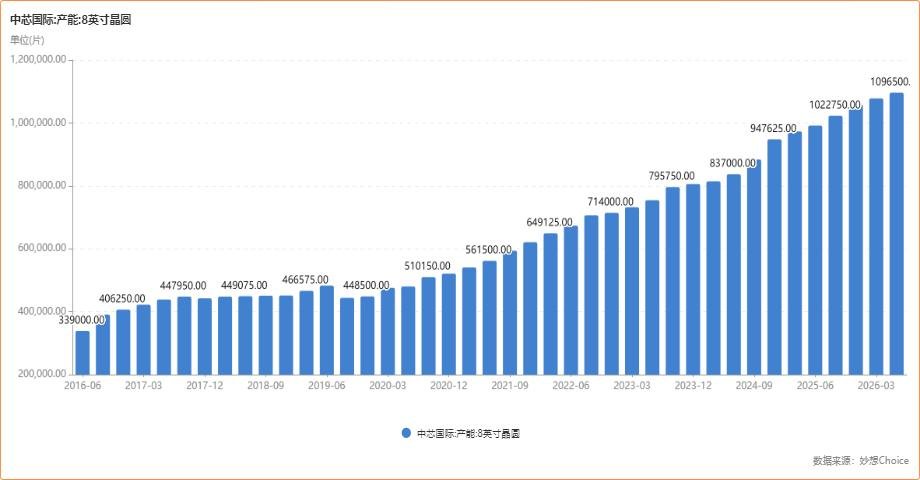
SMIC has more than tripled capacity in a decade. Monthly capacity was 339,000 8-inch equivalent wafers in mid-2016, reached 1.0965 million by mid-2026 and 1.1168 million in the third quarter. The global foundry market grew from about US$47 billion in 2016 to roughly US$175 billion in 2025, while China’s IC design sales rose from RMB 164.4 billion to about RMB 835.7 billion over the same span.
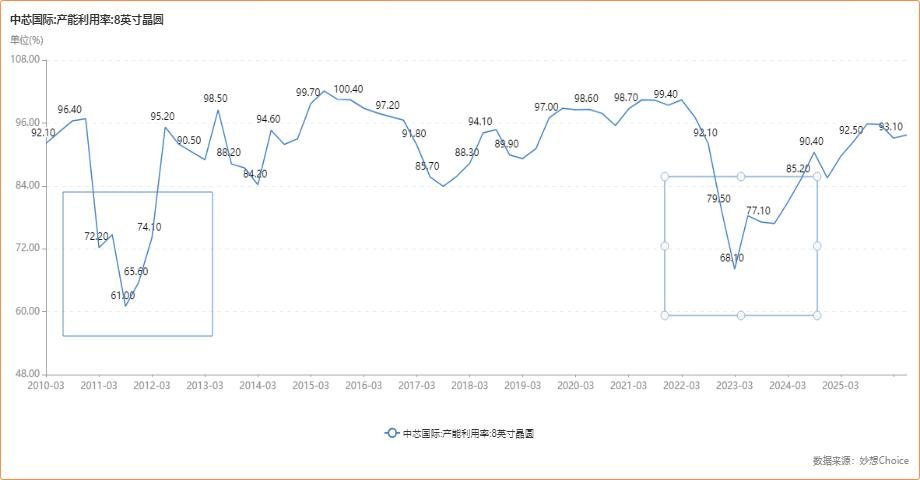
Fabs, cleanrooms and tools have to be paid for before equipment tuning, process qualification and customer onboarding produce revenue. Cyclicality has bitten twice before: the inventory correction around 2011 and the post-shortage consumer slowdown around 2023, when newly built capacity arrived just as demand softened.
Now the lines are full again, at 93.7 per cent utilisation in the second quarter and 97.3 per cent in the third. The striking change is that capital spending is falling. Third-quarter capex was RMB 7.423 billion, against RMB 12.574 billion in the second quarter and RMB 17.065 billion a year earlier, a drop of about 56.5 per cent. Cash paid for fixed assets, intangibles and other long-term assets came to RMB 29.142 billion for the first three quarters, more than 30 per cent below RMB 43.721 billion in 2024 and RMB 42.199 billion in 2025.
The build-out is winding down. Half-year reporting put the major Shanghai, Beijing, Tianjin and Shenzhen expansion projects at 95 to 98 per cent complete. Construction in progress fell from RMB 92.619 billion at the start of the year to RMB 62.652 billion by the third quarter, while fixed assets rose from RMB 136.254 billion to RMB 158.618 billion.
It would be too early to call the spending cycle finished. Management noted that longer equipment lead times can distort the timing of capex, and net cash outflow from investing has not narrowed in step. Fourth-quarter gross margin guidance of 26 to 28 per cent sits below the third quarter’s 29.9 per cent, as new capacity and research wafers add cost. Catching Samsung also still requires sustained investment in advanced processes and specialty platforms.
But the question in front of SMIC has changed. For ten years the task was to build fabs, buy tools and close a capacity gap. With four major expansions nearly complete and their output beginning to earn, the next decade is about whether the hundreds of billions of RMB already spent can keep converting into profit and cash flow. Overtaking Samsung decides the ranking. Converting sunk capital decides how long the position holds.
Editor’s note: This is an adapted translation of the original 36Kr report. It has been trimmed and restructured for readability for an international business audience. The full original (in Chinese) is at https://m.36kr.com/p/4073536943593345.