The founder of Yuanli Chuangzhi noticed something during the work-from-home years. His rescued dog would pace at his feet during conference calls, uneasy, while he kept talking to a screen. That repeated scene became the starting point for a product.
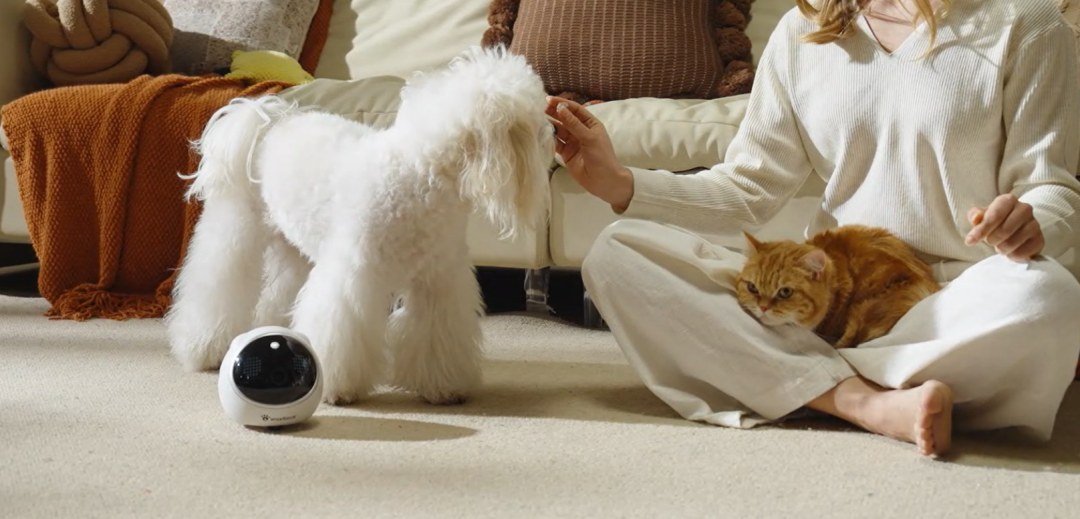
The company has launched Enor E1, an AI pet companion robot priced at RMB 999, built by a team with backgrounds at Huawei, Lenovo and Meitu. The question it tries to answer is narrow but unusual: when the owner is out, can a machine read the pet and do something on its own?
Three steps, one missing
Pet hardware has moved through three stages. A Taiwanese team put a treat-dispensing camera on a crowdfunding site in 2014, enabling remote interaction. In 2018 a Shenzhen team out of DJI put a camera in a rolling ball so the view followed the animal. After 2023, large models cut the cost of interpretation by an order of magnitude, and posture and sound could be read as states.
None of those steps crossed the same line. Most pet cameras and toys keep a human in the loop: the owner opens an app, pans the lens, presses a laser pointer. The device is an extension of the person, not a companion for the animal.
Enor E1 bets on the word active. Its in-house perception system fuses vision and audio, picking up frequent barking, agitated movement and long periods of stillness, then grading them. If the system judges the pet anxious, it starts low-noise rhythmic soothing without waiting for an instruction. If it detects no movement for a long period, it begins a search patrol, finds the animal, switches to play and takes a photograph.
Compute in the home
That autonomy runs on a local architecture. The E1 uses a 1 TOPS edge chip, a 1440P wide-angle camera with night vision, a microphone array for sound-source location and infrared sensing for navigation and obstacle avoidance. The AI layer combines visual recognition, audio emotion recognition and personalised recommendation. Keeping inference on the device speeds response and keeps camera data inside the home.
The product has gone on sale through e-commerce and entered Xiaomi’s distribution channels through a partnership.
Competitors fall into three groups. Full-range brands such as Small Pet, Hormann and Donis own the basics of feeding and litter, with supply-chain and channel strength but shallow emotion sensing. Xiaomi and Ezviz bring cost and distribution. Vertical players such as Enabot, backed by Sequoia with more than a million users across 160 countries, and Pickfun, out of a facial-recognition listed company, compete on data reliability.
The market numbers point both ways. Global companion robot shipments are forecast at about 19 million units in 2026, growth above 40 per cent, yet penetration remains below 3 per cent. In China, smart pet product penetration is roughly 10 per cent against stated purchase intent of 40 per cent. Returns on smart pet products run three to five times the ordinary rate, and the top five brands hold just 18 per cent combined.
More than 70 per cent of urban pet owners are working professionals, people living alone or frequent travellers. What they lack is not another camera. It is something that still pays attention when they are not there.
Editor’s note: This is an adapted translation of the original OFweek report. It has been trimmed and restructured for readability for an international business audience. The full original (in Chinese) is at https://robot.ofweek.com/2026-11/ART-8321203-12003-30711984.html.