During the Shenzhen APEC week on 17 and 18 November, humanoid robots appeared on a multilateral diplomatic stage as working machines rather than exhibition pieces. The global headquarters experience centre of LimX Dynamics was listed as an official visit site for business representatives from 21 economies. Most coverage stopped at the idea of Shenzhen as a technology calling card. The more interesting question is whether the way Chinese robot makers sell abroad has changed.

Three pieces of evidence
The first is in the news centre. Seven Aibao humanoid robots from AI Square Robotics formed the largest service team at the event, producing 45 coffees, 30 ice creams and 30 juices per hour in more than 20 languages, handling a tea break for 2,000 people. The company says its products are deployed in roughly half of APEC member economies. Outside the venue, it placed dozens of robots across conference, city, airport and emergency scenarios.
The second is Ziyuan Intelligence. Its Yezai unit delivered snacks and cleared tables, arranged flowers by recognising stems and coordinating two arms, and sorted on a conveyor running at 11 metres per minute. All three tasks ran on the same in-house model, WALL-B. The company is explicit that this was not scripted execution but continuous perception and dynamic planning.
The third carries the highest weight. Ten Kuafu inspection robots from Leju ran autonomously along four routes in Qianhai, accumulating more than 3,000 detections of illegal smoking, misparked two-wheelers and similar incidents over two months of routine operation. The time span matters. These machines were on duty well before the meeting began. The Longgang robot street also entered the official route, with nearly 60 humanoids greeting visitors in formation and a 6S store combining sales, spare parts, service, rental and customisation. More than 100 robots are on regular display there.
The customs numbers and what they mean for pricing
The trade figures are harder to argue with. In the first three quarters, Shenzhen exported RMB 4.86 billion worth of robots to other APEC economies, separately itemised by customs, up 7.5 times. Citywide robot exports passed RMB 13.4 billion, a rise of close to 13 times. Both multiples need a caveat because the comparison base was small. Yet one detail carries more information than the multiples. Customs listed robots as a separate category. A product line large enough to be singled out for statistical tracking has reached a scale the aggregate figures conceal.
The more consequential change is in what is being priced. Buyers from 21 economies did not watch backflips. They watched a robot hold a shift: Aibao retrieving parts in a Singapore Airlines maintenance hangar, or deploying in one day at a Lan Kwai Fong bar in Hong Kong. LimX says more than half of its several-thousand-unit order book comes from overseas, with delivery as fast as one month. When the demonstration changes from can perform to can work a shift, the negotiation moves from equipment price to service contracts and maintenance systems. The buyer is purchasing continuous uptime and the support network behind it, not a metal torso.
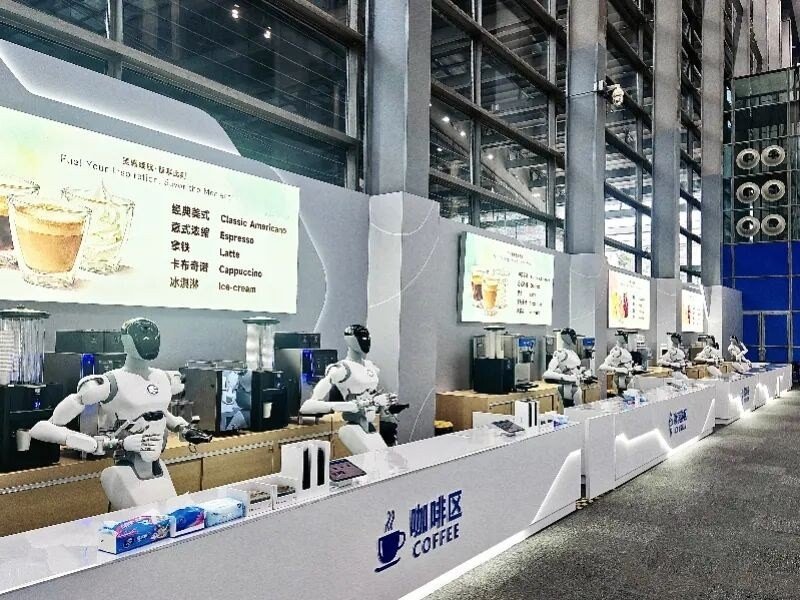
The rental module inside the 6S stores already charges by hours of use rather than ownership of the machine. Move that structure overseas and it becomes the outline of service exports. Cao Zhongxiong of the Shenzhen-based Comprehensive Development Research Institute has pointed in the same direction: going global is shifting from shipping single devices to delivering whole solutions.
Wang Xingxing’s other half
That reading fits the second half of Wang Xingxing’s recent remark at APEC. He said 90 per cent of humanoid robots are still performing, held back by weak generalisation and the need to retrain for every new scenario. Most reports stopped there. He also warned that when robot numbers eventually reach tens of millions, manufacturing, reliability and after-sales become unsolved problems, and computing demand will far exceed current assumptions. His advice was to grow the market first.
Read together, the two halves are consistent. The robots that can go overseas are the 10 per cent with enclosed scenarios, structured tasks and workable maintenance. The other 90 per cent lack deployment systems, not performance. Capital is moving the same way. Genesis AI announced a USD 500 million Series A on 17 November at a USD 3.5 billion post-money valuation, with NVIDIA and AMD venture arms in the same round for the first time, while Jianzhi Robotics raised USD 100 million in a Series A plus for physical-AI data infrastructure. Money is going into infrastructure and data, which is another way of buying deployability rather than hardware capacity.
The risks
Three cautions are in order. APEC is a state-task setting whose budget, standards and error tolerance do not follow commercial procurement logic, so replication with ordinary customers remains unproven. The 13-fold export growth includes mature categories such as cleaning robots and cannot be read as a humanoid ramp. And the barrier to service exports sits outside the machine: cross-border maintenance networks, spare-parts systems and local compliance each cost more than selling hardware. That is both the moat and the cash burn for early movers.
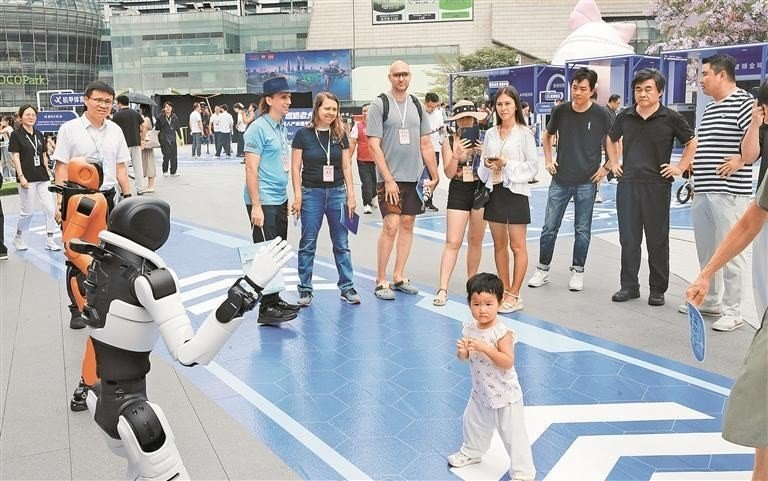
The thing priced during this week was not how strong the robots are. It was deployability itself. Hardware exports compete on price; service exports compete on systems. The first rewards the lowest quote. The second rewards whoever can keep a machine working far from home.
Editor’s note: This is an adapted translation of the original OFweek report. It has been trimmed and restructured for readability for an international business audience. The full original (in Chinese) is at https://robot.ofweek.com/2026-11/ART-898890-8420-30712429.html.