At the Conference on Robot Learning in Austin last week, OpenAI’s reserved booth number 208 stood empty. There was no company sign. Fortune then reported that OpenAI had dissolved its independent robotics research team again, and the company confirmed it.
The word again matters. In 2020 OpenAI shut down a robotics laboratory, saying there was too little physical interaction data and that progress was slow compared with language models. Six years on, the reason has inverted.
Reorganisation, not retreat
This was a break-up rather than an exit. Core algorithm researchers moved into the main model research group led by chief research officer Mark Chen. Applied and hardware staff moved into the Applied division under president Greg Brockman.
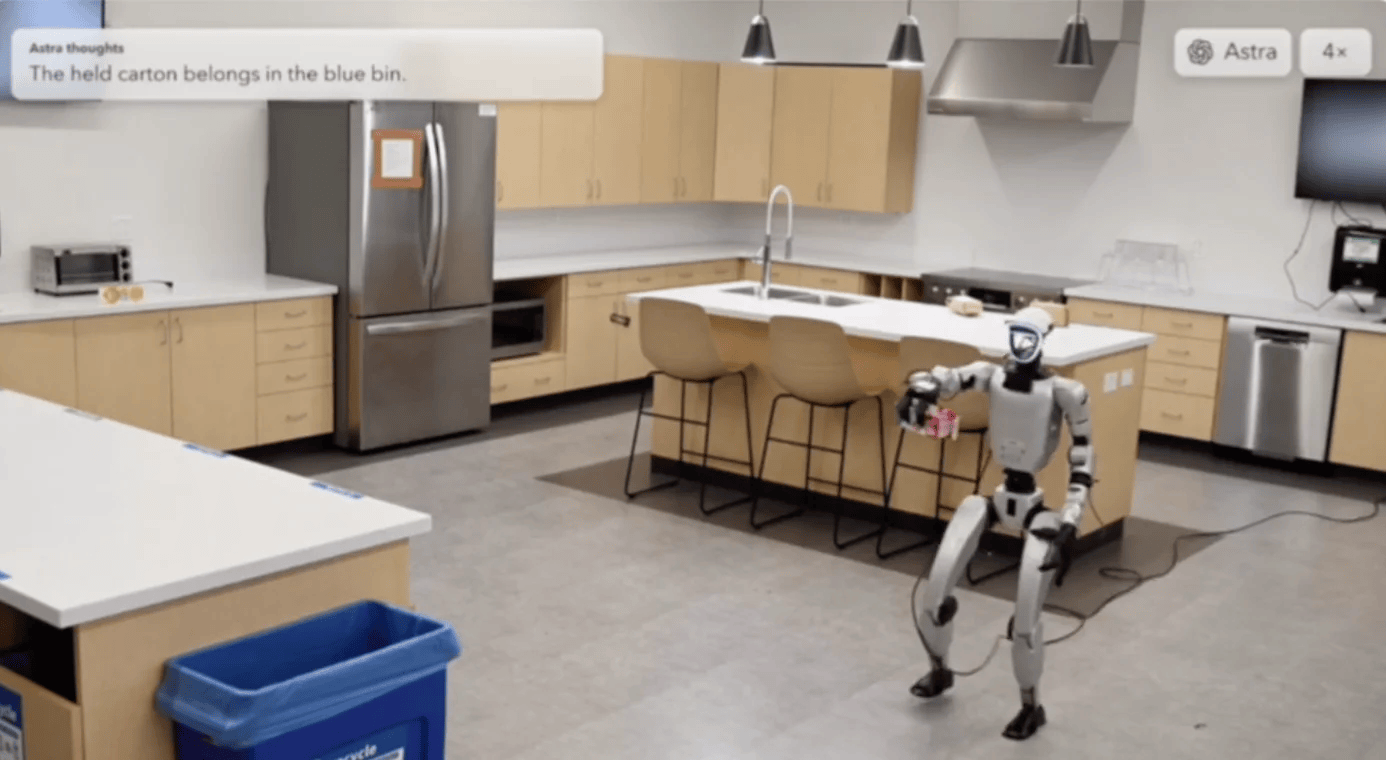
OpenAI’s logic is that the leap in general frontier models, including GPT-6 Astra, has made them strong enough to drive physical hardware directly. A separate, specialised robot foundation model has become harder to justify. Sam Altman is still preparing an in-house humanoid body, with a public appearance targeted for 2027.
Anthropic reported a similar finding in July: newer general models could observe visually, write control programs and call motion tools to complete tasks that once needed purpose-built robot policies.
The score that changed the argument
In early November Anthropic released Claude Fable 5.2. On RoboDojo Sim, a simulation benchmark for two-arm visual control of complex physical manipulation, it scored 64.9 per cent. The previous Fable 5.1 scored 27.6 per cent, Google Gemini 4 Argon 34.2 per cent and GPT-6 Astra 29.8 per cent.
Fable 5.2 was not designed for robotics. It had no millions of hours of teleoperated arm trajectories. In zero-shot real-machine tests it capped bottles, turned a Rubik’s cube and, in a third-party run, played a complete 62-step checkers game, compensating when a grip slipped by reading small visual changes. It beat most systems trained specifically for robot manipulation.
Nvidia’s GR00T 2, published in November, uses a world-action model that predicts both the action and the visual change that follows. Galbot founder Wang He also argues for merging VLA and world models. The boundaries between the approaches are blurring even as each keeps its strengths.
The industry has not agreed
Dario Amodei told the New York Times in February that controlling a real robot is more complex than a video game, but that as an intelligence problem the two are not fundamentally different. Sam Altman and Figure’s Brett Adcock represent the general-first camp. With 100,000 rented next-generation GPUs, Adcock has argued that robot learning obeys a clear scaling law.
Unitree’s Wang Xingxing is more measured, saying the physical AI inflection could arrive within one to three years. AgiBot’s Peng Zhihui sees general foundation models penetrating embodied AI as a trend, while insisting a full-stack robot company must keep developing its own decision model. Wang Qian of Self-Variable Robot cautions that intelligence lives largely in data, and that a general model controlling a robot does not prove intelligence has transferred from other domains.
Sergey Levine of Physical Intelligence takes a middle position. Language models carry broad knowledge that can compensate for scarce robot data, he argues, but that knowledge only becomes executable ability through real manipulation, video and other physical data.
The unresolved question is how much robot and physical data Fable 5.2 and GPT-6 actually saw in pretraining. A general brain has rewritten the starting line for embodied AI. It has not removed the physical gap to the finish: 64.9 per cent in simulation still leaves a failure rate above one third.
Editor’s note: This is an adapted translation of the original Sohu Tech report. It has been trimmed and restructured for readability for an international business audience. The full original (in Chinese) is at https://www.sohu.com/a/1102391504_116157.