Chen Xionghui, a researcher on embodied large models in Alibaba’s Qwen team, has changed his internal status to on leave. Multiple sources say his departure is effectively decided and that he plans to work on embodied brains and vision-language models. His next destination has not been made public, and Alibaba had not responded at the time of writing. Just over five months earlier, he had delivered the first complete embodied model suite the Qwen team had put on show.
The models can be copied. Judgement cannot
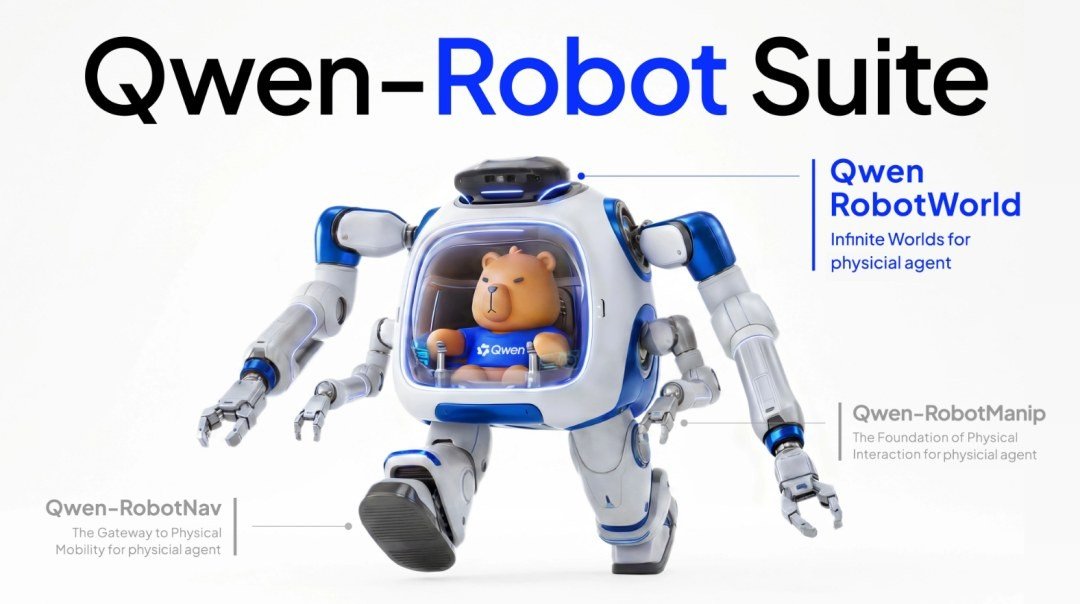
On 16 June Alibaba released three Qwen-Robot models covering manipulation, navigation and world modelling, its first complete embodied technology stack. The manipulation model was pretrained on about 38,100 hours of public operation data, with 15.6 million navigation samples and 8.6 million video-text pairs for the other two.
Robot data is fragmented by nature. Joint spaces, camera configurations and first-person demonstration videos share no common language. The team compressed them into an 80-dimensional state-action representation, converted end-effector displacement into camera coordinates so similar actions sit close in numeric space, and taught the model to read execution history as an embodiment identifier. Only after that alignment was done were 1,933 hours of human hand video synthesised into more than 20,000 hours of robot demonstrations. All of that fits in a technical report, and the weights stay on the servers. Why the team chose 80 dimensions rather than 64, or RGB rather than depth for navigation, appears in no document. That judgement lives in a few people. The real replacement cost is not the June launch but the next iteration, when someone new has to reconstruct the alignment logic between three models.
Who is putting a price on the resume
Chen’s record is not legendary, but each step landed in the right place. He studied software engineering at Southeast University, entered the LAMDA lab at Nanjing University in 2018 for a combined masters and doctorate under Professor Yu Yang, and after graduating in 2025 joined a joint Peking University and Alibaba postdoctoral programme as an Alibaba Star. He published 19 papers during his doctorate, eight as first author at CCF-A journals and conferences. He did research at Meituan where a decision system he worked on entered business operations and won a best industry-academia collaboration award. Sources say he began talking to investors earlier than outsiders assumed, before GPT-6 Astra had been released.
Astra’s subsequent performance revalued embodied work, and his resume was already circulating. The market has offered a reference price. When Hu Han, head of multimodal models at Tencent’s Hunyuan, left in July to found Winverse AI, DeepSeek was reported as leading the seed round at a post-money valuation near USD 400 million, with no product yet visible. Primary markets are now pricing embodied brains by person rather than product. Zhou Qingliang, formerly head of smart hardware at Meituan, is said to have been in long discussion with Chen. Zhou once managed rider helmets, IoT terminals and delivery robots before founding his own company. Algorithm people pairing with hardware people has become a repeated pattern.
The more of these people get priced, the harder the premium is to hold. Change at Alibaba is not isolated either. Li Xin, who led the Rynn model series at DAMO Academy, has also been reported as leaving to co-found another firm. As Hu Han, Yuan Zehuan and Wang Naiyan leave large platforms, one technical-lead resume has many comparables, and scarcity is manufactured in bulk. The premium falls accordingly.

Why the money cooled first
Money turned before people did. IT Orange counted RMB 93.5 billion in embodied AI funding in the first half of 2026, five times a year earlier, across 322 deals. Of that, RMB 59.544 billion flowed into brain-layer companies according to iiMedia. By October, the whole sector had just 33 deals and total funding barely above RMB 10 billion. One investor admitted privately that many hundred-billion valuations were never actually settled. Some financial advisers stopped taking embodied mandates in the second half because prices were too high and scenarios were absent.
Robot makers have shipments, production lines and orders. Brain companies have benchmark scores and success rates. Brains took the most money and felt the cold first. Capital has switched from backing a direction to verifying delivery, so companies whose valuation anchors were people and models were repriced fastest. The price of people, meanwhile, is still climbing. UBTech, listed in Hong Kong, is offering its chief scientist responsible for AI model development an annual salary of up to RMB 124 million, a record in Chinese robotics. The money has not disappeared. It has become more selective.
Can a leaderboard buy an order
Several reports put GPT-6 Astra’s success rate on robot control tasks at 95 per cent. Public experiments using the RoboLab-120 benchmark give a different set of numbers. Astra’s best policy succeeded 74.8 per cent of the time and took an average 18.56 seconds per inference. Different test definitions produce different conclusions, which is itself the problem. A nut-tightening station has a cycle time of a few seconds. The distance between getting an answer right on a benchmark and not failing on a production line is measured in downtime and scrap rates.
OpenAI’s behaviour points the same way. At the Conference on Robot Learning in Austin on 13 November, its booked booth 208 stood empty, and the company confirmed it had disbanded its independent robotics research team, folding the group into chief research officer Mark Chen’s organisation. Even the best-funded lab is shrinking its standalone brain team. That suggests the problem lies in the route, not the people.
The Chinese answer is written on factory floors. Lei Jun said Xiaomi’s embodied robots have been interning in its car factory, working a full eight-hour shift, charging themselves twice, and lifting the success rate at a self-tapping nut station from 90.2 to 98 per cent, within one percentage point of human work. Wang Xingxing supplied the other half: a robot retrains when it changes scenario, and whether it can keep working determines whether a company dares to expand deployment. Global humanoid shipments in 2026 are expected near 60,000 units. A benchmark proves the ceiling of something. Delivery proves the floor, and buyers today pay only for the floor.
Talent moving out of large platforms is not a bleed but a division of labour. An industry only truly has a market when individuals can be priced on their own. China’s advantage in this round is not a benchmark ranking but the density of real workstations, with 322 deals pouring into one sector in six months. Turning eight hours of stable operation into eight thousand is the task ahead.
Editor’s note: This is an adapted translation of the original OFweek report. It has been trimmed and restructured for readability for an international business audience. The full original (in Chinese) is at https://robot.ofweek.com/2026-11/ART-8321205-12003-30712437.html.