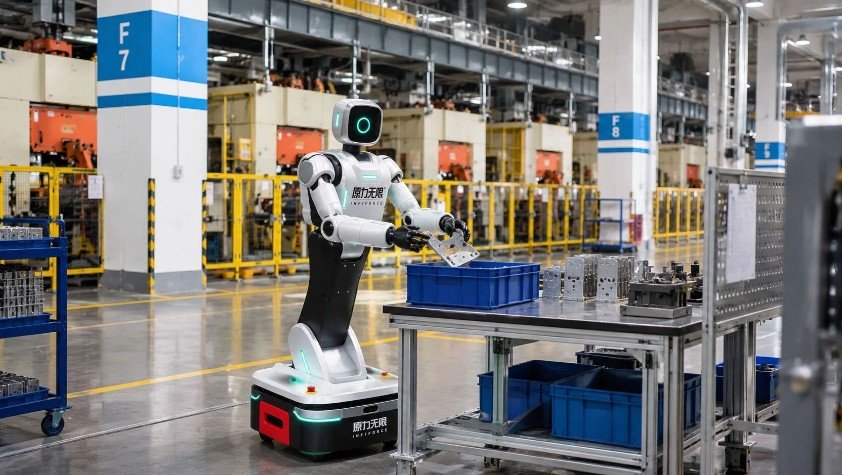
Embodied-brain company INFIFORCE has completed a Pre-B funding round of tens of millions of yuan in single investment from Hangzhou Capital, the municipal state-owned capital investment and operating platform. The company, founded in 2023, has now closed four rounds in three months and its valuation has climbed to nearly RMB 10 billion. More telling than the amount is where the money is going: into research on its AtomBrain embodied brain, deeper work in real-world scenarios, and engineering for scaled production. As capital attention shifts from robots that do backflips to the invisible brain inside them, pricing power in robotics is moving from the body to the head.
Why state capital keeps doubling down
The pacing of the rounds carries a signal. From a near-RMB 1 billion Series A and A+ in August, to close to RMB 100 million from Zhejiang provincial fund Zhejiang Chuangtou in October, to Hangzhou Capital entering alone in November, INFIFORCE has strung four financings into a single line. Hangzhou Capital, by media accounts, holds more than RMB 110 billion in assets and works with more than RMB 240 billion in funds. Its shareholder list runs through Hangzhou hard-tech names such as Unitree, BrainCo and DeepRobotics.
Repeated state backing of one direction is unusual. It reflects a repricing of the embodied-intelligence industry. Investors once paid for unit shipments. Now they are more willing to pay for the ceiling of intelligence. A robot body can be purchased or contract-manufactured. The brain that understands the physical world is hard to copy. When local state capital pours money into an embodied brain, it is effectively channelling patient capital into basic research, a form of long-termism that matters in hard-tech competition.
How a robot learns to foresee consequences
To understand why capital will pay a premium for the brain, look at the technology. Chief scientist Chen Jiayu is an assistant professor and doctoral supervisor at the University of Hong Kong. He studied at Peking University, took a doctorate at Purdue and completed postdoctoral work at Carnegie Mellon, and pioneered a latent world model based on causal emergence. Chief technology officer Wang Yizhou graduated from the University of California, Berkeley under robot-control scholar Masayoshi Tomizuka, worked at NVIDIA and Baidu’s US driving team, and brings more than a decade of million-vehicle autonomous-driving deployment experience.
Founder and chief executive Bai Huiyuan gives an example. When a robot knocks over a cup, it must understand that water will spill and the table will become slippery, and adjust its next action accordingly. That grasp of cause and effect cannot be obtained by fitting data. According to several reports, INFIFORCE’s AtomVLA leads the LIBERO benchmark at a 97.0 per cent success rate, while its SAM3D-VLA pushes the figure to 99.1 per cent. More important than the scores, the implicit causal world model sits at the base of AtomBrain, with embodied foundation models, high-level intelligence, scenario-specific post-training and a continuous-learning loop stacked above it.
From benchmark to production line
Whether the technology holds up ultimately falls to the production line. At a hotel front desk, a robot must handle an identity card, a room key and a signature slip, then complete verification, card issuance and check-out. INFIFORCE combines multimodal perception with fine contact manipulation: vision judges the orientation and position of the document, force control handles inserting and handing over, and the robot adjusts its grasp when it meets reflection, occlusion or misplacement. The same capability extends to laundry, turning a passive sequence of collection, washing, drying and returning into a schedulable, trackable workflow.
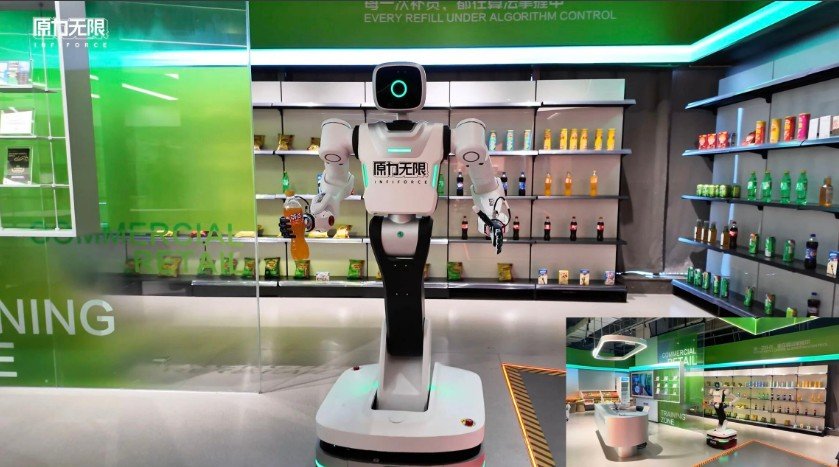
The company says its systems now cover more than 30 cities and close to 100 real-world scenarios. In Hangzhou it took part in a national embodied-intelligence pilot base, building a full-process autonomous retail training case. In September it expanded into Chongqing, planning the region’s largest embodied-brain training centre aimed at 67,200 local industrial firms. The bet is that the next margin in robotics sits not in the chassis but in how well a machine understands the world it touches.
Editor’s note: This is an adapted translation of the original OFweek report. It has been trimmed and restructured for readability for an international business audience. The full original (in Chinese) is at https://robot.ofweek.com/2026-11/ART-8321202-12005-30712928.html.