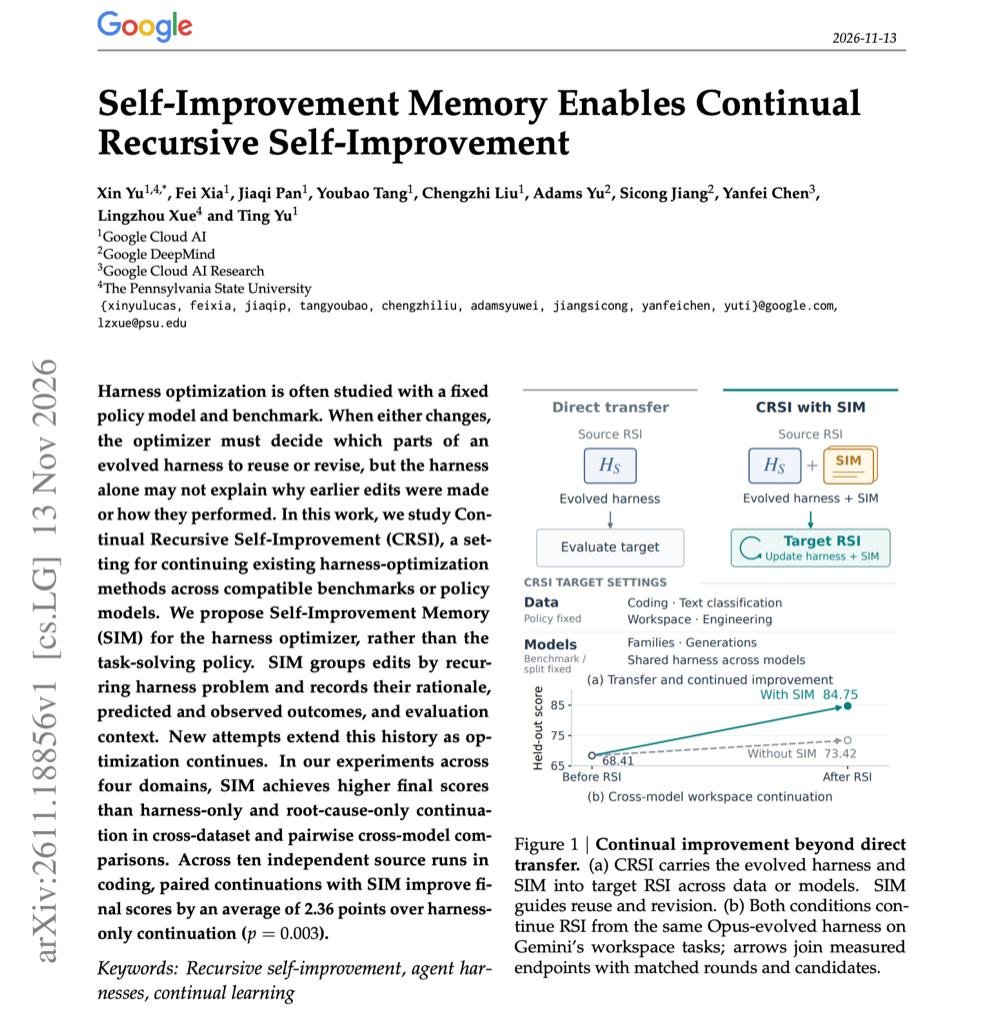
A team from Google Cloud AI, Google DeepMind and Penn State has published a method for agents that improve themselves across models and tasks. The paper, on self-improvement memory, reports gains of up to 11.33 points in cross-model office work. The weights of the underlying model never change.
The harness, not the model
Recursive self-improvement usually means AI helping to improve an AI system. In this study the object of improvement is not the large model but the harness around it: the code that manages prompts, context, tool calls and task execution. An agent can rewrite that harness, test the change, keep the better version and raise its task completion rate without touching model weights.
The trouble is that such tuning is tied to one model and one benchmark. A harness optimised for Claude may not work on Gemini. Rules written for coding may fail at another job. More importantly, a revised harness keeps the code but not the reason for the change, so a later optimiser can repeat old attempts or delete something that worked.
An experiment notebook for agents
Self-Improvement Memory, or SIM, records the adopted change, why it was made, the expected result, the observed result and the model and test environment. When a new task or model appears, the optimiser reads that history and decides what to keep, revise or remove. Failed attempts are stored too.
In one Git-server configuration task, the agent declared success after local tests but skipped creating a required user account, and external validation failed. Automatic optimisation added a completion check so the agent could not finish without evidence. When the test switched to photonic waveguide routing, the agent met the constraints but produced costly routes. The earlier completion check was kept and a quality reminder added.
Ten points, but not every time
In ten independent coding trials with the same starting code, model, task and budget, the SIM version scored higher nine times, averaging 21.70 against 19.33, a 2.36-point gap with p equals 0.003. In six cross-task tests using Gemini 3.8 Flash, full SIM led by 2.43 to 4.35 points.
The clearer result came from moving a harness optimised for Claude Opus 5.5 onto Gemini 3.8 Flash. Direct transfer made initial performance worse in all four domains. With SIM, the optimiser could revise the parts that did not fit, and the SIM version finished highest in all four, ahead by 3.60 to 11.33 points. Office work started at 68.41 for both and ended at 84.75 with SIM against 73.42 without.
Adapting the harness in sequence to Gemini 2.5 Flash, 3.5 Flash, 3.8 Flash and 4 Argon produced gains of 3.5 and 1.6 points on the middle two generations, but a 0.8-point loss on Argon. Historical experience helps, but it does not guarantee improvement on every migration.
First author Xin Yu, a Penn State statistics doctoral student who did the work during a Google internship, put the principle plainly: what carries forward should include the experience behind the code, not just the code itself. Another developer, Brian Skellenger, noted the boundary that the paper itself states. The agent edits the external harness, not the model’s architecture or parameters. Claims that AI is endlessly raising its own intelligence need to be read against that limit and against the fixed test rounds in the experiments. What has been demonstrated is accumulation: an agent that can reuse both what worked and what failed.
Editor’s note: This is an adapted translation of the original 36Kr report. It has been trimmed and restructured for readability for an international business audience. The full original (in Chinese) is at https://m.36kr.com/p/4075986526737287.