In 2015 a company called 7 Road International was registered in Singapore. For years it drew no attention. A decade later it had become a conspicuous name in the supply chain for Nvidia’s advanced AI chips. Renamed Megaspeed International in 2023, it shifted toward cloud computing and AI infrastructure. Trade records show that between May 2024 and February 2026 it imported USD 4.13 billion of Nvidia products. In November 2025 alone it brought in 17,454 GB300 chips worth about USD 787 million.
That business soon attracted investigators. In June 2025 United States Commerce Department investigators entered Megaspeed’s Singapore premises. Singapore police joined the inquiry, the then chief executive Huang Le had her passport impounded and was later barred from re-entering the country. More striking still, a discrepancy of roughly 50,000 chips appeared between Nvidia’s inventory data supplied to the US government and external trade records.
How the compute middleman emerged
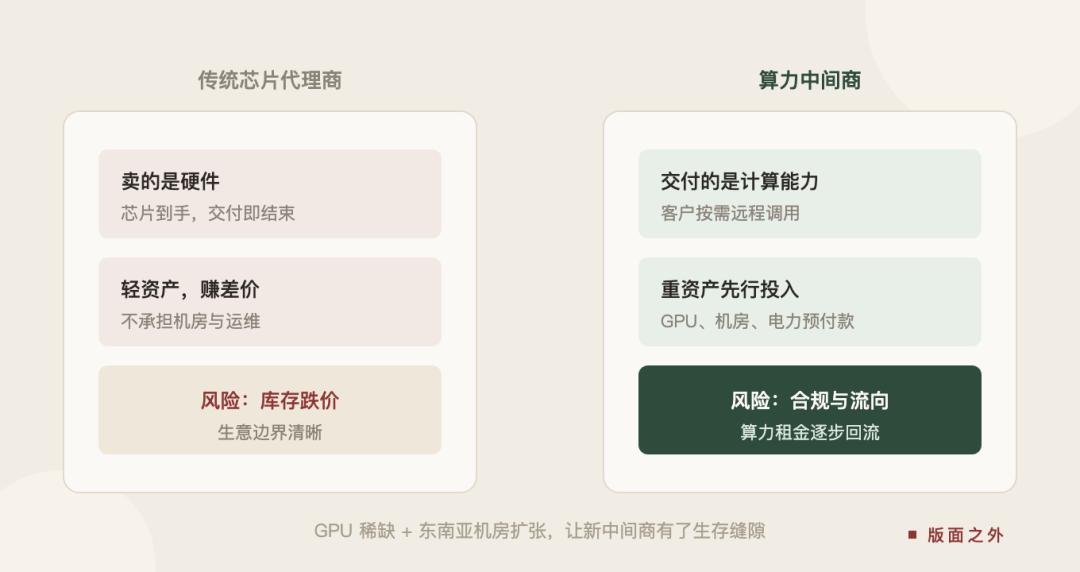
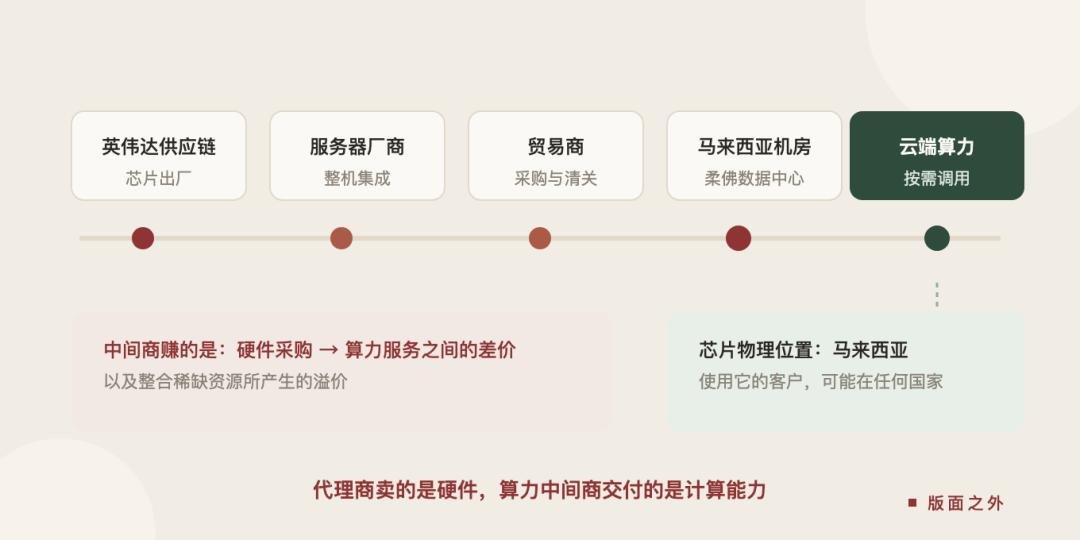
The AI boom first changed how GPUs are allocated. With technology companies worldwide competing for Nvidia chips, intermediaries holding purchasing channels, capital and data-centre resources found a new trade. Megaspeed turned chips into rentable compute. It bought complete GPU servers from Nvidia and its partners, deployed them in data centres in places such as Malaysia, connected them to a cloud platform and rented capacity to customers globally. Clients avoided buying servers or building facilities and accessed GPUs over the network on demand.
This differs from a traditional chip distributor. A distributor sells hardware. A compute broker delivers processing capacity. A GPU leaves the Nvidia chain, passes through server makers and traders, enters a data centre and becomes callable cloud compute. The broker earns the spread between procurement, infrastructure deployment and rental, plus a premium for assembling scarce resources.
Two forces made it work. Global GPU demand far exceeded supply, so anyone who could secure chips and deliver quickly won orders. At the same time Southeast Asian data centres expanded. Singapore is the regional hub but faces land, power and energy constraints, so neighbouring Malaysia, especially Johor, absorbed investment with more available land and electricity. Chips were sourced globally, servers deployed in Southeast Asia and compute delivered across borders. A GPU could sit in Malaysia while its user sat elsewhere, with no physical shipment required.
A multi-billion dollar business in Malaysia
Megaspeed’s expansion tracked the take-off of Malaysia’s data-centre industry. Reuters financial documents show assets rising from about USD 32.9 million in 2023 to nearly USD 3 billion in 2024, almost ninetyfold, with 2024 revenue of USD 294 million. Scale did not mean profit. The company posted an after-tax loss of about USD 20 million in 2024. Compute is capital intensive, with GPU purchases, facility leases, power deposits and deployment all due upfront, followed by depreciation and financing costs.
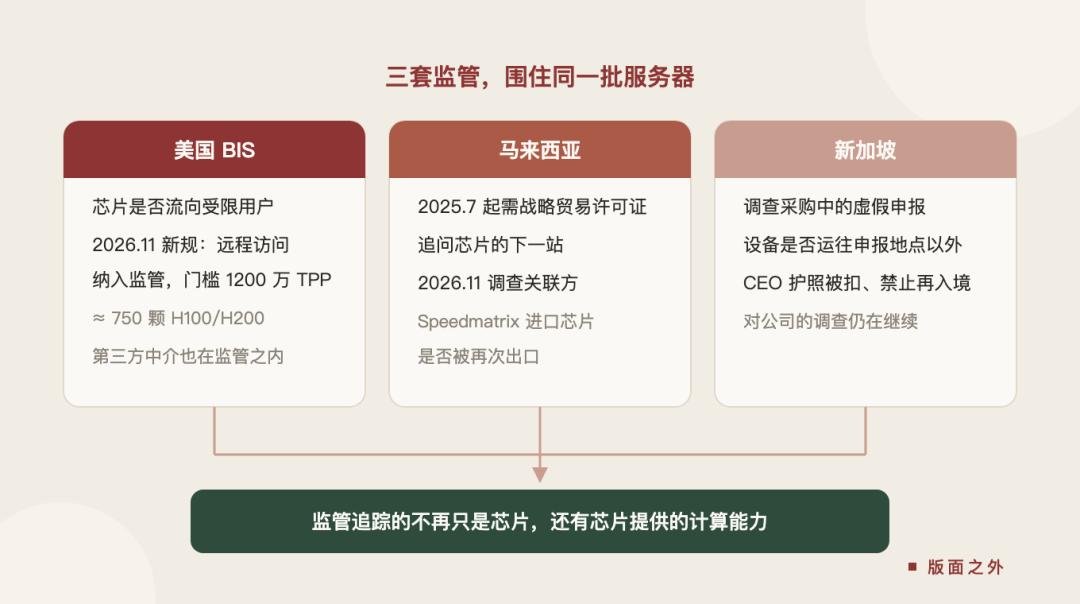
Bloomberg, using Malaysian and Indonesian customs records, counted at least USD 4.6 billion of Nvidia hardware and about 136,000 GPUs imported by Megaspeed and affiliates through the end of November 2025. A network of related entities handled procurement, customs clearance and operations. Malaysia tightened rules in July 2025, requiring strategic trade licences for the export, transhipment and transit of US-origin high-performance AI chips. The rule did not ban local import or deployment. It focused on where chips went after arrival.
The attraction was not only land and power. Chips could be deployed locally while compute was sold into other markets. In March 2025 the Wall Street Journal reported that four engineers flew to Malaysia carrying 15 hard drives each, about 80 terabytes of training data in total, rented local servers and trained a model, then carried the parameters home. The case had no known link to Megaspeed but illustrated the demand Southeast Asian facilities were absorbing.
The 50,000 chip gap
On 24 June 2025 the trouble converged. US Bureau of Industry and Security investigators conducted an end-use check in Singapore and questioned Huang Le. Singapore police questioned her the same day and seized her passport. The two agencies cared about different things. Washington wanted to know whether advanced chips reached restricted end users. Singapore investigated false declarations in server procurement and whether equipment went anywhere other than its stated destination.
Singapore approached the US Justice Department and FBI for help, seeking cooperation from supplier Supermicro, but received limited assistance. In February 2026 police found insufficient evidence to tie Huang to the declared-destination offences but concluded she had knowingly given inaccurate information to downplay her role. She received a stern warning and was barred from re-entry. Investigation of the company and six others continues.
Bloomberg compared trade records with Nvidia’s reported inventory and found that the chipmaker may have sold roughly 50,000 fewer units to Megaspeed than it told the US government. Nvidia offered another explanation, saying it checked additional Megaspeed warehouses and found equipment previously omitted, without giving a quantity. The gap does not prove chips went missing, still less that smuggling occurred. But 50,000 GPUs could support several large compute centres, and the number showed how hard advanced chip supply chains are to trace across contract manufacturers, traders, affiliates and third-party facilities.
The affair reached into government. In summer 2025 Nvidia’s chief legal officer called the US under-secretary for export enforcement to ask whether BIS was involved in the Singapore questioning. Internal BIS communications about Nvidia were subsequently restricted, prompting congressional questions. In November, Axios reported that the Treasury secretary had asked at a White House meeting why Megaspeed was not yet on the entity list, with several agencies supporting restrictions.
Compute arbitrage meets a new rule
Megaspeed’s model depended on a separation. Chips generate compute where they sit, but the user of that compute can be anywhere through a cloud service. On 16 November the US Commerce Department issued an interim final rule extending controls to remote access to advanced computing. It set a threshold of 12 million total processing performance, roughly 750 H100 or H200 chips. Data centres meeting that threshold and serving restricted regions may need a licence, including where access is routed through intermediaries. The rule also covers advanced chip exports, re-exports and transfers involving Malaysia, Singapore, Indonesia, Thailand and Brazil.
Physical location is no longer the only test. The identity of the remote user and the end use now matter. Not all cross-border cloud service is banned, but the compliance task has changed. Megaspeed must now determine who receives each batch of compute and whether access requires a licence. The same data centre and the same GPUs can be rented or not depending on who the customer is.
In November Malaysia said it was investigating whether affiliate Speedmatrix had re-exported imported chips and stressed that routine inspections were not an endorsement. US authorities confirmed the inquiry continues. From a games publisher to a firm whose assets grew ninetyfold in a year, and then to a company surrounded by investigations and new rules, Megaspeed has lived through almost the entire cycle of global compute arbitrage.
Editor’s note: This is an adapted translation of the original 36Kr report. It has been trimmed and restructured for readability for an international business audience. The full original (in Chinese) is at https://36kr.com/p/4078301371406215.