Nvidia is one of the world’s most valuable companies, but it is not only a GPU business. It also runs a fast-moving investment machine. Over the past decade, ecosystem-building stakes brought it customers and revenue and became a core weapon of its growth. By 18 November 2026, IT Orange had recorded 239 Nvidia investment and acquisition events, including 220 equity investments and 19 acquisitions. In 2026 alone it made 71 deals, more than double the 30 in 2023, averaging six or seven a month and outpacing most top-tier venture funds.
Beyond AI models, into the physical base of compute
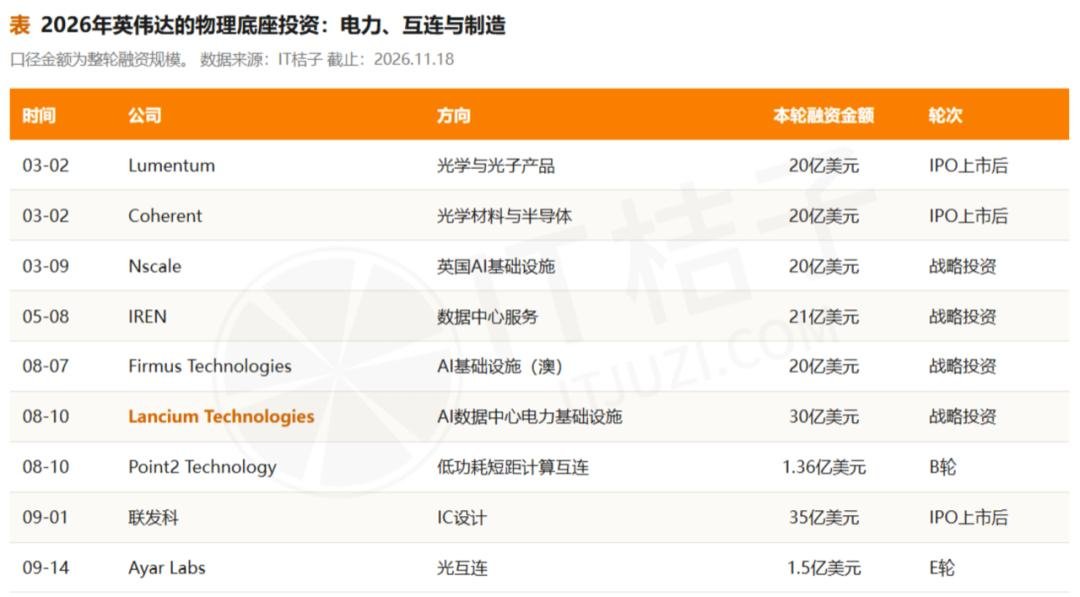
Three structural shifts sit under the rising numbers. The target set has widened from AI stars in the dollar ecosystem to power, optical interconnects and data centres. Reports suggest Nvidia may invest as much as USD 3 billion in Lancium Technologies, which builds power infrastructure for AI data centres. Cheques have also concentrated. The very large sums go to a handful of foundation-model companies such as OpenAI, while most other AI startups receive no more than a few hundred million dollars.
Of the 71 deals in 2026, more than 43 were in artificial intelligence, but the amounts cluster in late-stage rounds. Nvidia put USD 30 billion into OpenAI’s round, which closed at USD 122 billion, joined Anthropic’s USD 30 billion round with a commitment of up to USD 10 billion, and participated in xAI’s roughly USD 20 billion round. These strategic investments function as capital supplied to the largest GPU customers, who then buy compute and return revenue to Nvidia.
The company also moved into areas it rarely touched three years ago. Six deals involved integrated circuits, covering optical interconnects, photonic chips and low-power links. Names included Lumentum, Coherent, Ayar Labs, iPronics and Point2 Technology. Energy and data centres appeared repeatedly, with IREN, Firmus, Lancium, Nscale, Nebius and GMI Cloud all receiving backing. Upstream, Nvidia subscribed to USD 3.5 billion of MediaTek convertible bonds and invested in RISC-V company SiFive. As chip capital flows to power plants, server halls and fibre, the GPU moat is being extended along the whole supply chain.
Many deals, few repeat bets
Across its full history, Nvidia has invested more than twice in 40 companies and three or more times in only 13, under one tenth of its portfolio. In 2026 roughly 70 per cent of targets were new names, yet the large cheques went to familiar ones. Canadian language-model platform Cohere received five rounds over four years, culminating in a Canadian dollar 7 billion round in November 2026 backed by Nvidia and the Canadian government. OpenAI received three consecutive rounds. xAI received three, ending with the early-2026 round. Poolside, Together AI, Runway, Nscale, Ayar Labs and VAST Data each drew three rounds, while World Labs, SSI, Skild AI and Fireworks AI drew two.
Read together, the list shows Nvidia concentrating capital in AI unicorns that consume GPUs continuously, especially foundation-model companies that are also the largest GPU buyers. Money raised flows into compute purchases, with Nvidia as the main supplier. The investor list and the customer list largely overlap, making investment a way of locking in demand ahead of time.
A decade without a mainland stake
The geography of 2026 is extreme. Nearly 50 of the 71 deals went to US startups, with most of the remainder in Britain and South Korea. Mainland Chinese startups were effectively absent. Nvidia did invest early in Chinese autonomous driving, joining TuSimple’s 2017 round and a USD 52 million pre-A round for JingChi, whose successor WeRide later used Nvidia GPUs and DRIVE chips. A 2025 filing disclosed a WeRide holding worth about USD 24.65 million. Then came a near-decade of silence in China’s primary market.
The two rare 2026 deals both sat at the edge. Nvidia subscribed to MediaTek’s USD 3.5 billion convertible bonds, its largest direct investment outside the United States, but the target was a Taiwan-listed company and the instrument was debt before conversion. It also joined a USD 500 million round for embodied-intelligence company AgileX, led by SoftBank. AgileX is not a purely mainland firm. Its founder trained at Harbin Institute of Technology and the German Aerospace Center, its holding company is registered in Munich, and it has an operating team in Beijing. Its engineering lineage is German, its manufacturing capacity Chinese and its compliance identity European.
Two layers explain the pattern. US chip export controls have tightened since 2022, and as a controlled core company Nvidia risks reporting or prohibition duties under the US outbound investment security programme if it invests in Chinese AI or semiconductor firms. Its investment model also depends on ecosystem pre-positioning, with portfolio companies expected to buy GPUs, use CUDA and join NVLink. Chinese AI companies are shifting supply toward Huawei Ascend, Cambricon and Biren, so the loop no longer closes even when a stake is possible.
Not investing says more than investing does. Nvidia’s 2026 map covers ecosystem and AI infrastructure from power to interconnects and from foundation models to robotics. It coincides almost exactly with the boundaries drawn by geopolitics, and the mainland half is missing. For Chinese founders the message is blunt: the companies able to take cheques from overseas chip giants are those whose lineage and registration sit outside the mainland.
Editor’s note: This is an adapted translation of the original 36Kr report. It has been trimmed and restructured for readability for an international business audience. The full original (in Chinese) is at https://36kr.com/p/4077822654321537.