At the 2026 APEC CEO summit, Unitree founder Wang Xingxing offered a fresh verdict on robotics: technical breakthroughs worldwide were approaching a threshold. Days earlier, Jim Fan, who leads GEAR at Nvidia, said much the same at CoRL 2026, arguing that the industry was in summer rather than winter. Such optimistic remarks stand out against the prevailing talk of burst bubbles, capital winter and company closures. Both descriptions are sincere, and the gap between them captures the central contradiction in robotics today.
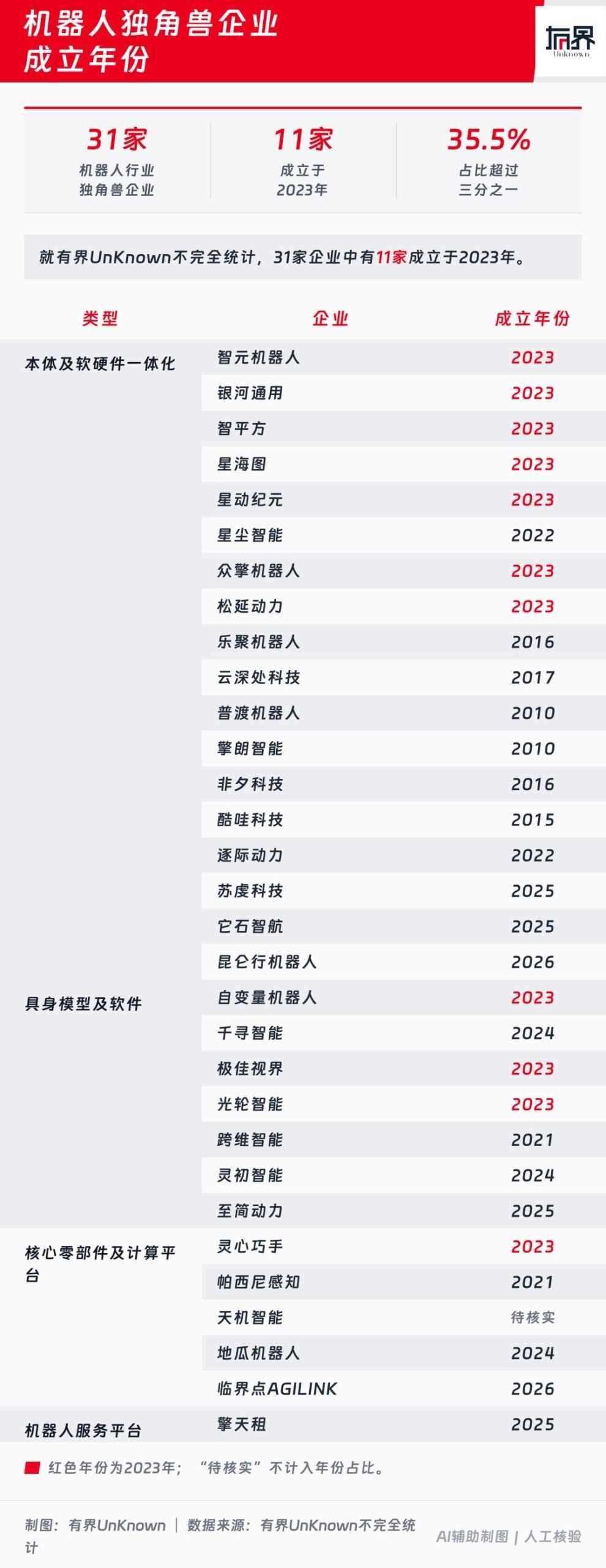
The sector has been pushed too fast, with value delivered well ahead of reality. One incomplete tally counts 31 robot unicorns, more than a third founded in 2023. They reached unicorn status in an average of 1.75 years, against five to seven previously. Some reportedly had not even assembled a full team when valuations tipped them over. The cause traces back to large language models, which convinced markets that scaling laws were real and would eventually appear in robotics too. No robotics scaling law has been found, but that did not stop investors pricing the possibility into valuations.
Capital retreats, technology advances
For years the mismatch was tolerable. Investors only needed a company to list so they could exit. In September 2026 came news that IPO review for robotics companies was tightening. With the exit gate raised, capital demanded fast revenue, pushing young companies toward parcel sorting, factory handling and home services. Robotics remains an early-stage industry with no scaling law, unresolved generalisation and slow commercialisation, so funding began to slow. IT Orange data shows sector financing peaked at RMB 32.8 billion in June 2026, fell to about RMB 24 billion in August and to roughly RMB 11 billion in October, a fall of about 67 per cent from the high.
Technical founders see a different picture. September’s GPT-6 Astra suggested a general foundation model could directly control robots. Figure Helix 2.5 demonstrated cross-scene generalisation across 35 unfamiliar homes. Nvidia’s GR00T 2 learned skills from human demonstration, reducing the need for task-specific and embodiment-specific training data. The International Federation of Robotics expects 655,000 new industrial robot installations worldwide in 2026, up nine per cent. Technology is improving and demand growing, just not enough to support earlier valuations and return expectations.
Where the value is moving
The first shift is that the embodied brain, until recently the darling of capital, faces a stronger competitor. Until 2025 the benchmark was body makers such as Unitree. In the second half of that year the centre of gravity moved from body to brain. Zhongtai Securities data showed domestic embodied-intelligence funding of about RMB 43.8 billion in the first half of 2026, with more than half, RMB 22.25 billion, going to companies whose core business was the embodied brain. Body makers received only about RMB 5.6 billion, or 12.8 per cent. But as foundation-model providers extend into the physical world, standalone brain startups without proprietary data, control capabilities or deployment history are exposed.
The corresponding second shift is that if intelligence becomes easy to buy, the body regains value. Companies that can build reliable hardware, control costs, deliver at volume and repair quickly may matter more. Wang noted that even after an AI breakthrough, manufacturing, reliability and after-sales remain huge challenges when demand moves from tens of thousands of units a year to millions. In the current decision stack, System 2 handles high-level reasoning and planning, the part foundation models are taking. System 1 and System 0 sit closer to hardware, governing force, contact feedback and low-latency response. They still need models, bodies and real interaction data together, which leaves room for specialist firms, though a standalone model layer remains vulnerable.
Lessons from autonomous driving
Autonomous driving offers a reference. The industry moved from Level 4 focus to driver assistance, explored mines, ports, parks and trunk logistics, and tried automated parking. Few firms survived the cycle. Robotics is at a similar junction, with general capability unresolved and companies entering palletising, sorting and handling to earn revenue. Narrowing a scenario does not guarantee a business. The real tests are sustained demand, customer return on investment and whether the product replicates across clients.
Companies doing relatively well deliver reliably in high-frequency need and win repeat orders. EAC Autonomous Driving deployed across mines, while Westwell Science won repeated port purchases. A typical failure path is continuous research spending without revenue and dependence on the next round. Embark, despite targeting the large freight market, began winding down in 2023. Automated parking also shows that a needed feature can become part of a larger system, as Bosch folded driving and parking into a unified compute platform. For robots, palletising and sorting already have mature automation, so new products must prove cost, deployment or flexibility advantages. Multi-format loading, irregular-item sorting and handoffs between machines deserve more attention.
Stretch entered through box unloading and used operating data to improve downtime and repairs. Digit started with tote handling before expanding with customers. Both made a specific task reliable first. A single order is revenue. A batch of repeatable orders is a business. Whether a company can turn one task into a standard product and repeatable delivery will decide who crosses the cycle. The winter and summer are not contradictory. Technology is running toward the future while capital must solve the present. Not everyone who plants a seed reaches harvest.
Editor’s note: This is an adapted translation of the original 36Kr report. It has been trimmed and restructured for readability for an international business audience. The full original (in Chinese) is at https://36kr.com/p/4078037519062147.