An early core member of DeepSeek has started a company. On 19 November, Zhang Bo, former project lead for DeepSeek-VL, announced that Simplex AI had open-sourced Linger, a personal agent that runs on a user’s own computer, operates software, handles email and even coordinates multiple assistants on a single task. A companion local inference project, PolyStrata, was built by an 18-year-old developer on the team.
Zhang left DeepSeek in March 2024, nearly a year before R1 became a phenomenon, returned to Zhejiang University to teach and began building in 2025. In January Simplex AI announced a USD 6 million round led by GL Ventures. Among the departed authors of DeepSeek’s core papers, Zhang is the only one publicly known to have founded a company and shipped a product.
From Microsoft Research to DeepSeek-VL
Zhang graduated from Zhejiang University in 2013, earned a PhD in electronic and computer engineering at Hong Kong University of Science and Technology in 2019 and joined Microsoft Research Asia that May. Over four years he worked on VQ-Diffusion and Rodin, spanning image generation and 3D digital humans. A CoCosNet v2 paper he contributed to was a best-paper candidate at CVPR 2021. He joined DeepSeek in 2023, worked on the first large language model and led DeepSeek-VL, the vision-language model whose technical paper appeared in March 2024. That same month he left.
He then joined the State Key Laboratory of CAD and CG at Zhejiang University as a hundred-talents researcher and doctoral supervisor. He has said he learned the value of focusing on one thing well from DeepSeek’s founder, and tells prospective students to aim for one paper that carries the weight of three rather than chasing volume. Hangzhou Topological Lingxi Technology was registered in February 2025 with Zhang as legal representative, focused on AI agents for overseas markets. Linger was not the first product. In January 2026 Simplex released Lev8, a business information search platform for sales, recruiting and investment, then a lightweight research model called LiteResearcher.
An 18-year-old and the local inference engine
Releasing Linger, Zhang revisited the history of personal computing. In the 1960s computing power sat in large central systems until personal computers put it in ordinary hands. Today most AI models run in data centres and users pay per token. Zhang wants to bring models back to the personal computer.
Linger’s main assistant is called Another Me. It can operate desktop software and browsers, read authorised email and meeting notes, and organise important material into a personal knowledge base. It can act proactively, reminding a user about a deadline found in an email and changing how it reminds them if the same prompt is ignored repeatedly. The team calls that behaviour Dreaming. For complex jobs it can split work among assistants, with one writing code and another checking it.
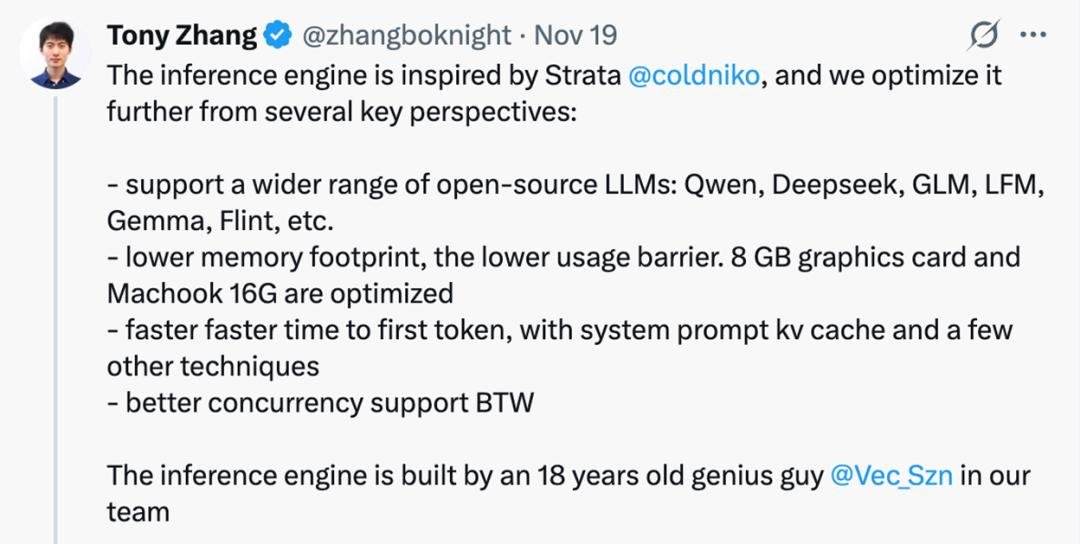
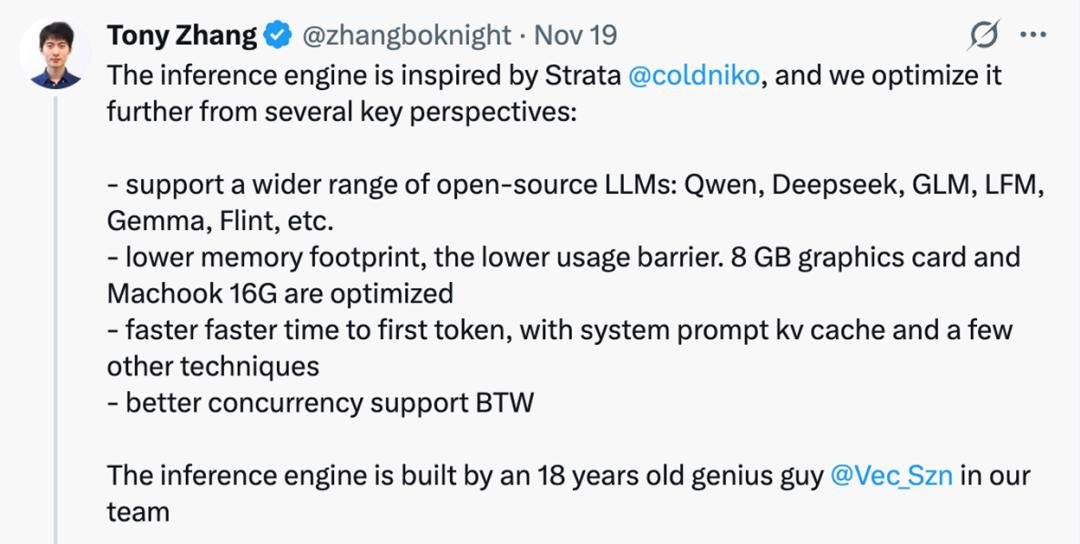
The technical centrepiece is PolyStrata, built by an 18-year-old developer known as VecSzn, a computer science student. The engine compresses models and optimises storage so large models can run on ordinary hardware. With mixture-of-experts models, only part of the network is active at a time. PolyStrata keeps some modules in GPU memory and the rest in system memory or on disk, loading them when needed. Simplex’s tests show a machine with a 12GB RTX 3060 and 64GB of system memory running a 125-billion-parameter Qwen model at 45.5 tokens per second. That does not mean all 125 billion parameters fit in 12GB, and the figures come from company testing without broad third-party verification.
PolyStrata is not built from nothing. Its GitHub page says it extends the open-source Strata engine. After release, users asked about phone connectivity, which Zhang said would arrive within a month, and reported model download bugs the team said it had reproduced.
The token fee question
The most discussed feature is the claim of zero token fees. Running a local model avoids paying a cloud provider, but hardware and electricity remain, and calling external models or apps may cost extra and move data off the machine. Linger allows free local deployment but bars unauthorised commercial hosting of its source. Simplex plans a hosted tier with no price announced yet.
DeepSeek’s core team has been unusually stable. A Caijing review of 27 papers published between January 2024 and April 2026 found 391 distinct internal authors, of whom 25, or 6.4 per cent, were marked as departed. Among the 15 most frequent researchers, only two left. Others who did leave joined Xiaomi MiMo, Tencent Hunyuan, ByteDance Seed or autonomous driving company WeRide rather than founding firms. Observers credit Liang Wenfeng’s philosophy of minimal interference and a flat structure, and since external funding arrived in 2026, clearer option values have added another reason to stay.
Zhang’s path is different. He left before R1, moved into teaching and then products, and is now trying to make existing models affordable on personal machines. Competitors include OpenClaw, NetEase Youdao’s LobsterAI and Alibaba’s QoderWork. The question is not whether the engine works in a test. It is whether ordinary users will install it and keep using it.
Editor’s note: This is an adapted translation of the original 36Kr report. It has been trimmed and restructured for readability for an international business audience. The full original (in Chinese) is at https://36kr.com/p/4078868729599110.