While playing a game, have you ever thought you could make a better one yourself? Not long ago that idea died in three minutes at the sight of a coding tutorial. Today the talk can turn into a web game you can actually click open.
These days the global AI game development leaderboard has turned into a fight. Four days after GPT-6.2 launched, OpenAI briefly held the top three spots on the DesignArena game development board. Before the throne was warm, Anthropic’s Claude Fable 5.2 landed at number one and pushed three OpenAI models into positions two through four.
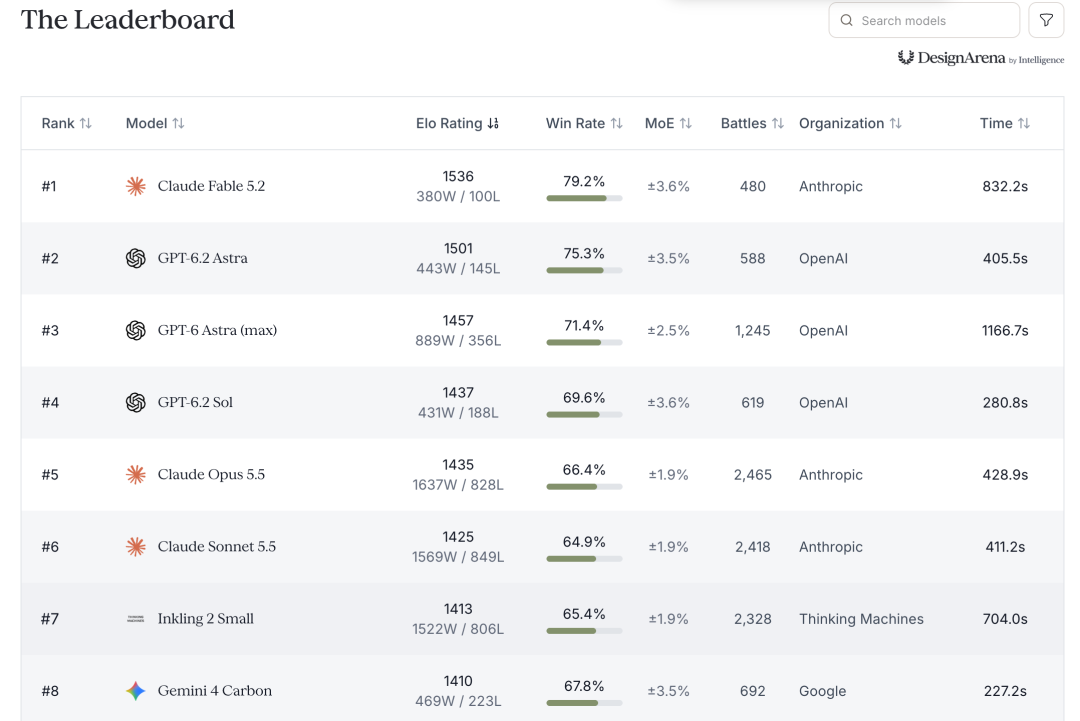
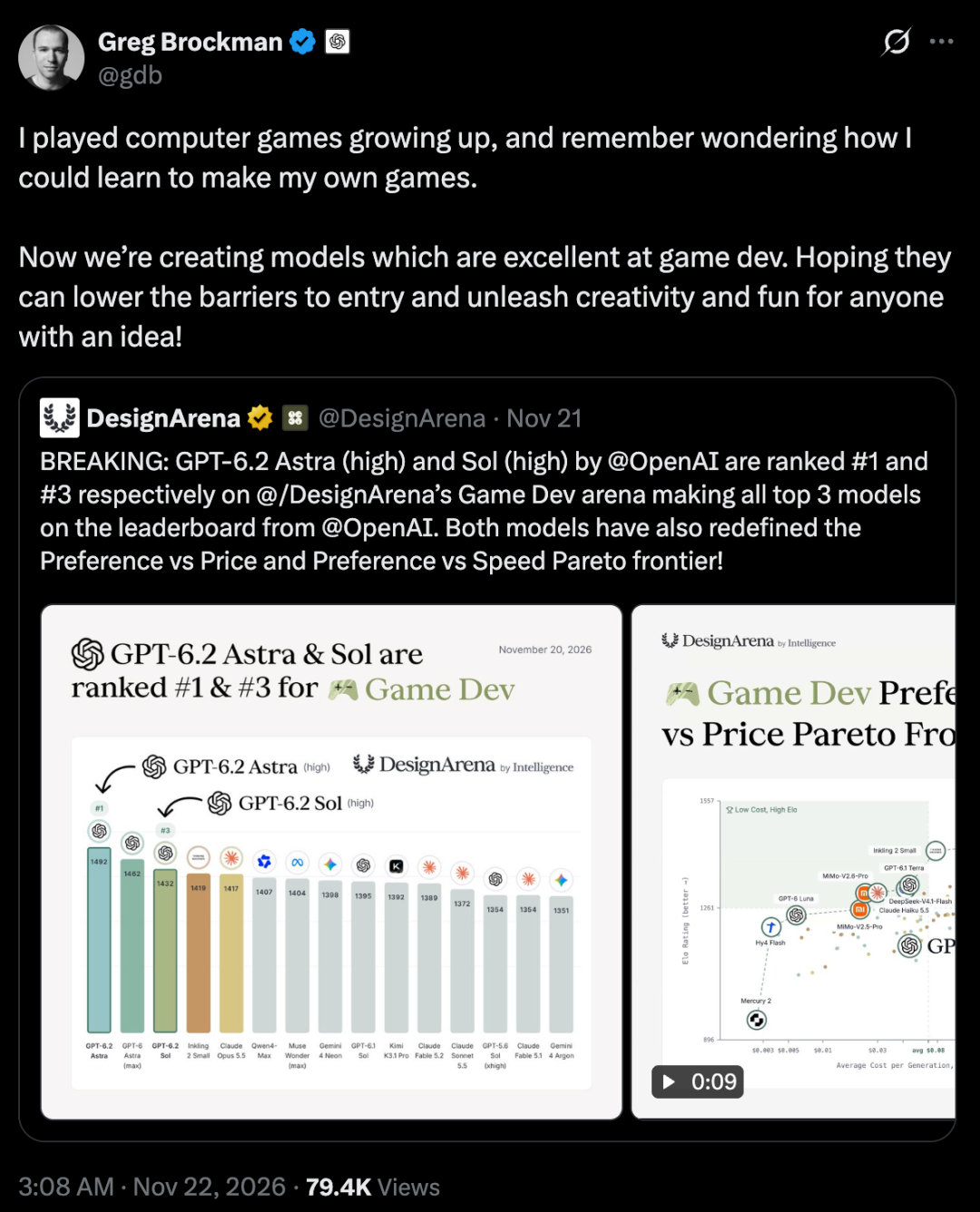
GPT-6.2 Sol still brought the cost of making a game down to USD 0.22 and about 4.7 minutes, cheaper than a bottle of water. Greg Brockman, president of OpenAI, reposted the result while GPT-6.2 still held the top three. As a kid playing games, he wrote, he always wondered how to make one himself. Now anyone with an idea can try.
Even the best models on the board, though, are handing over half-finished work. Opus 5.5, from the same family as Fable 5.2, writes code 1.3 times faster and feels smoother, but lost on first impressions because 84 per cent of its pages were bare. OpenAI’s Astra family won players over with finish. A 3D racer that inverted the steering in half its rounds still collected high votes.
Under five minutes and USD 0.22, anyone can build a game
Plenty of people have had Brockman’s thought. Turn a pet cat into a pixel platform hero. Make a maths formula into a level-based game. Remake a game you got stuck on so you start with an invincible shield. Most gave up as impractical. A large model has now cut the cost of testing such ideas to under two dollars and a few minutes.
On the DesignArena live board before publication, Claude Fable 5.2 sat at number one with 1,536 points, but averaged 832.2 seconds, close to 14 minutes. Positions two through four were all OpenAI. The one that mattered most to ordinary players was GPT-6.2 Sol in fourth. It averaged 280.8 seconds, under five minutes, cost USD 0.22, delivered quality close to the previous champion at about a quarter of the price and roughly 40 per cent faster.
Without knowing a line of code, an ordinary person can now build a web game in the time it takes to wait for a coffee.
Whether the result is fun is not something a benchmark decides. What makes DesignArena interesting is a blunt blind-test rule. A user types one idea. The system randomly draws two models. Each returns a single-HTML-file web game. Real players try them and vote. Elo points decide the ranking.
DesignArena published a deep-dive video comparing the previous generation of GPT-6 Astra with Claude Opus 5.5. Today the two families still show the same temperaments. In the first thirty seconds in a browser, the contrast is obvious.
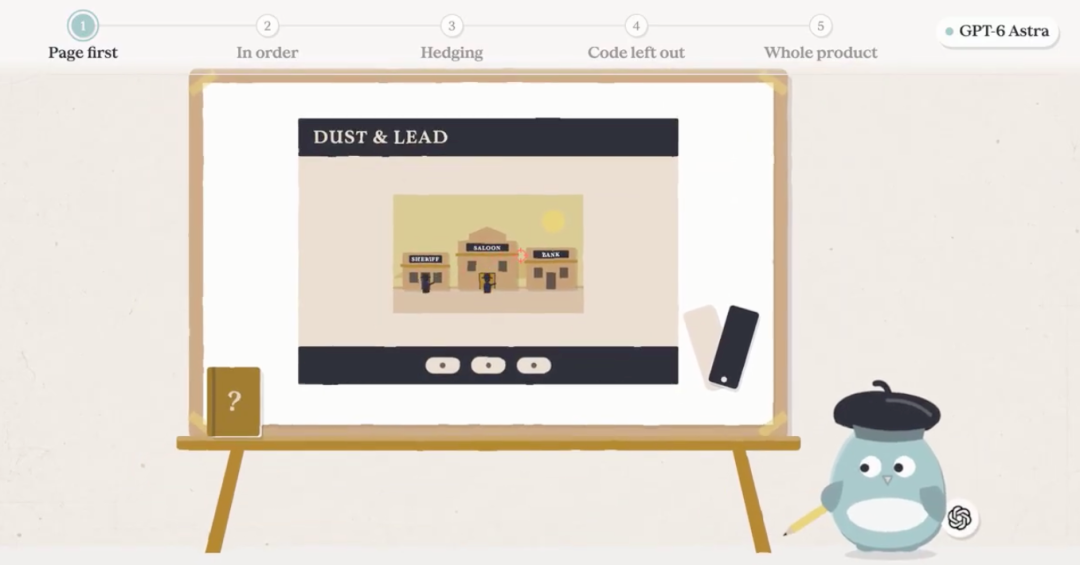
Take Dust and Lead, a western shooter built by GPT-6 Astra. Its first step was page first. It settled the cream-on-dark theme, the top title bar and the bottom control zone before writing a single shooting mechanic. The first quarter of its reasoning never mentioned shooting. It worried about how comfortable the player felt on first sight. It even paused automatically when you switched away to chat, and bundled screen-reader tags and motion-sickness options underneath.
Switch to Touchline 3, a free-kick game from Claude Opus 5.5, and none of that peripheral care exists. The screen is so bare it has no top bar or navigation, just an empty green pitch. But kick the ball and the feel changes. The aiming line accounts only for spin arc. Wind is left for you to judge. Flight time, gravitational drop, wall height and keeper reach all follow physical logic. It has the smell of a hardcore sports game. Opus 5.5 entered its testing step and checked its own camera and rendering detail along the way.
Across roughly 3,000 generation records in the backend, the gap widens. Measured by characters per second, Opus 5.5 wrote code 1.3 times faster than Astra, at a median of about 40,000 characters and an average wait of 4 minutes 51 seconds. Astra ran to about 70,000 characters, nearly twice as long, with an average wait of 10 minutes 50 seconds. Opus was about 44 per cent shorter.
Where did Astra’s extra 27,000 characters go? Nearly half into visual styling, a quarter into wrapper structure and a tenth into menus and buttons. On core gameplay code, Astra actually wrote slightly less than Opus. Across 324 tagged reasoning summaries, Astra spent about 22 seconds per round thinking about how the page looked, producing navigation in 92 per cent of games and near-total accessibility support in sampled code. Opus spent about two seconds on appearance, had navigation in 16 per cent and accessibility in about 9 per cent. But it quietly added a small forgiveness mechanic in 27 per cent of games, brief invincibility after a hit or an extra jump window at a cliff edge. Astra did so in only 8 per cent.
Those touches take patience to notice. A crown won on the first thirty seconds of polish is not a crown that sits comfortably. Days after GPT-6.2 swept the top three, Fable 5.2 landed at number one.
AI can write a game but cannot grind out fun
That raises a harder question. Can someone with an idea really turn it into a game? USD 0.22 and 4.6 minutes have torn down the wall of code between loving games and making them. The cost of testing an idea is close to zero for the first time.
Then inverted steering and jump-free completions pull you back to earth. AI can build the pitch, scoreboard and pause button in under five minutes. What it lacks is the feel of a human hands on a controller or keyboard. It cannot sense how wrong it feels when left turns right, or notice that one missing line of rules makes a level boring the moment you play it.
The first HTML a model returns is a toy that runs. What turns it into a game is pulling a friend over to play a few rounds, using their honest complaints to fix the counter-intuitive glitches and awkward handling, and grinding the shell that looks like a game into one people cannot put down.
Editor’s note: This is an adapted translation of the original 36Kr report. It has been trimmed and restructured for readability for an international business audience. The full original (in Chinese) is at https://36kr.com/p/4081732410610819.
The author’s views are their own and do not necessarily reflect the publisher’s position or constitute investment advice.