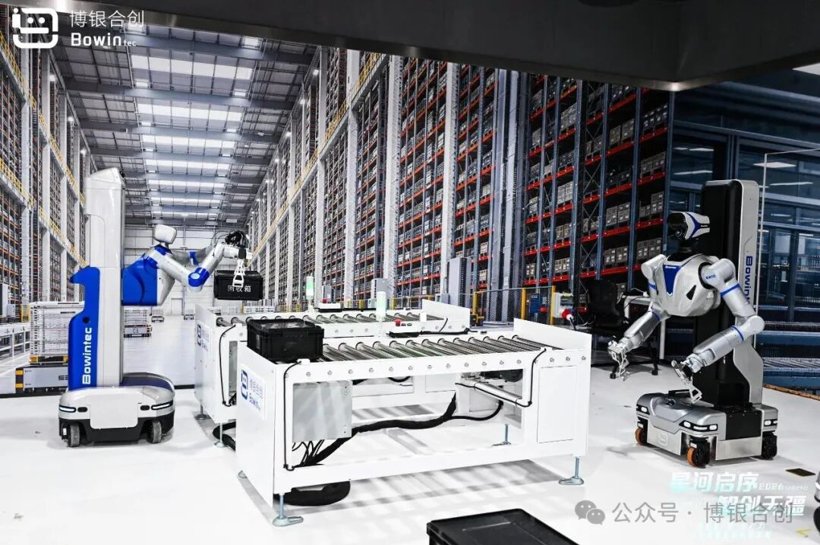
Boyin Hechuang formally opened its Suzhou headquarters on 29 October. The site is not only office and research space. It is built as an industrialisation platform that connects development, simulation testing, scenario validation, small-batch trial production and customer delivery in one place.
At the same event the company disclosed a more consequential fact: it has formally entered the Bosch supplier system.
Why the supplier list matters more than the funding
Jiang Hongquan, a managing partner at Boyuan Capital, described the Bosch system as one of the strictest industrial procurement systems in the world. Getting in, he said, means the product has passed industrial-grade validation, and marks a meaningful step from technical validation to industrial application.
Boyin Hechuang was incubated by Boyuan Capital, the fund under Bosch Ventures, together with Galbot. From inception it has focused on industrial scenarios, with one central question: how to string the robot body, the model, the data and the engineering delivery into a chain that can be replicated and delivered at scale.
On the opening day the company signed embodied AI strategic cooperation agreements with more than a dozen partners, including MG Group, TGW, Dazhihui, Dayan Technology, Zhongqing Perception, Huatai Jiguang, FAIR Innovation and Chuangyitong.
Where the robots already work
Boyin Hechuang is running projects in automotive and auto components, 3C electronics, new energy and logistics, using data collected in real scenarios for model training and validation.
In logistics sorting, the company is working closely with Jiejie Industrial. The two agreed a strategic partnership around AI, embodied robots and logistics, planning to deploy the BW10 series in express parcel sorting. The project is currently in intensive data collection and training, using high-quality scenario data to improve the model and the robot’s operating capability.
In automotive and auto components, United Automotive Electronic Systems is one of the key partners. The two have built a joint embodied AI laboratory called RoboFab, which runs continuous scenario validation and product iteration around real workstations, materials and operating processes in automotive electronics manufacturing.
The BW10-Lite is now in live use for intralogistics at United Automotive Electronic Systems’ Shanghai plant, a step the two sides present as the move from technical validation into industrial application.
The part that decides whether this scales
Embodied AI has produced plenty of capable demonstrations and very few purchase orders. What changes the arithmetic is the gate the Suzhou announcement cleared: a customer whose quality organisation is contractually able to reject the product. Automotive electronics is a demanding first market precisely because the tolerance for a stopped line is close to zero.
The constraint from here is delivery rhythm. A supplier system entry is a permission, not a volume commitment, and the numbers that matter next are units installed per month and the share of those units still running without intervention after a year.
Editor’s note: This is an adapted translation of the original Gasgoo report. It has been trimmed and restructured for readability for an international business audience. The full original (in Chinese) is at https://auto.gasgoo.com/news/202610/30I70476430C601.shtml.