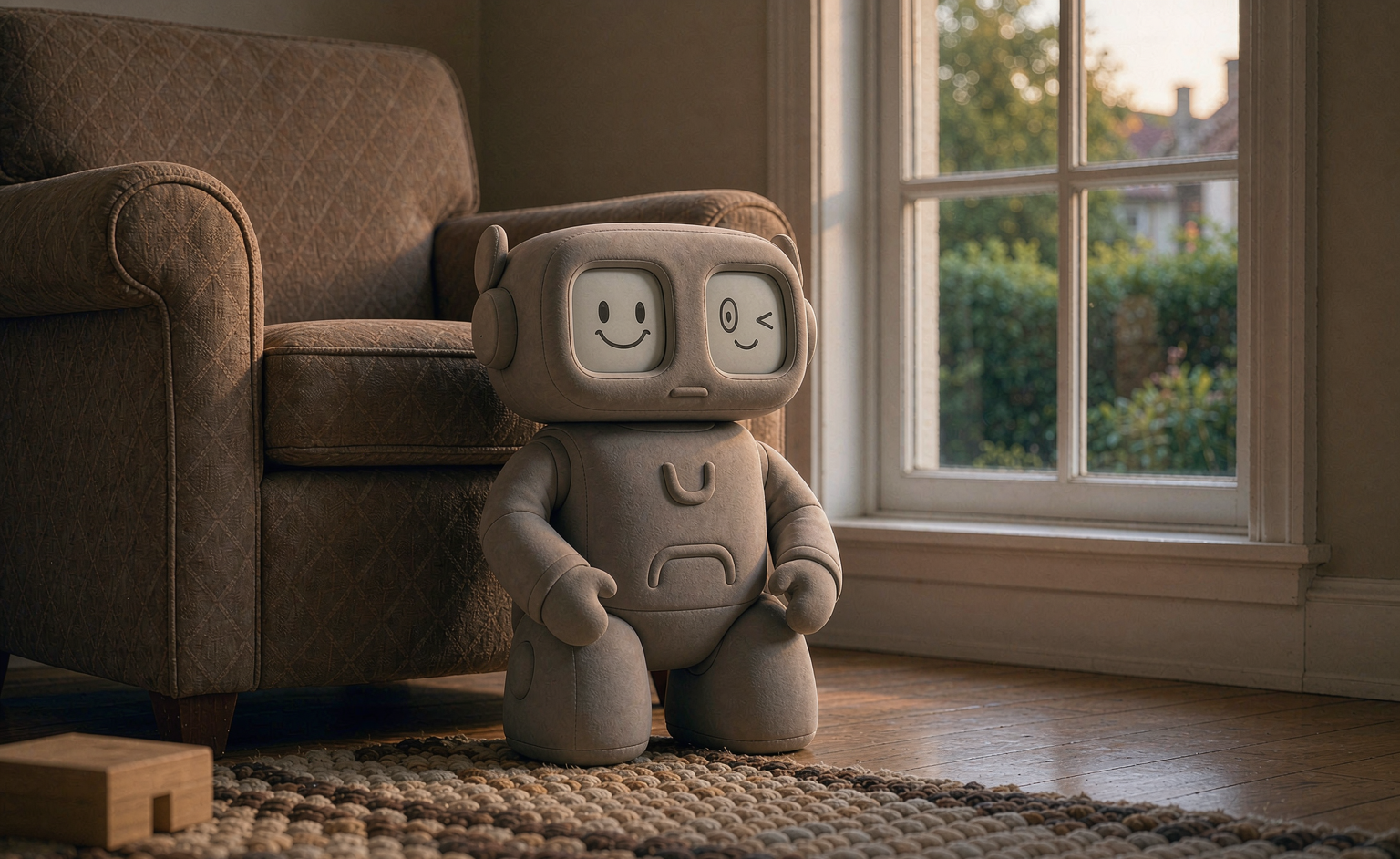
China’s embodied AI money has gone almost entirely into factories, warehouses and logistics lines, where tasks are standard and payback is measurable. The home has been discussed for years and cracked by almost nobody. A 65 centimetre plush robot launched in Beijing in late October is an attempt to reframe that problem rather than solve it with hardware.
What the machine actually is
Xinyan Robotics calls Bubbo 1 an embodied home agent. It has a fabric shell, two expression screens, 13 categories and 26 sensors, six degrees of freedom, autonomous movement, automatic docking, camera-based non-contact heart rate detection and tiered bilingual conversation. The specification is not the interesting part. The robot hosted its own launch event, introducing guests and running the schedule without being prompted, which is the point the company wanted to make: a home agent should come to you rather than wait to be summoned.
The price is RMB 9,499. That sits above a month of paid companionship and well below anything a family would call a luxury purchase, which is exactly where a new category has to start.
Three rungs of understanding a person
Zhao Yanyan, a professor at Harbin Institute of Technology who has worked on affective computing for 20 years, laid out the ladder at the launch. The first rung is emotional perception, reading whether someone is happy or upset, which large models plus a camera now handle credibly. The second is emotional cognition: not that he is unhappy, but why. What event triggered it, what reason went unsaid. The third is emotional interaction, doing something useful with that reading: asking at the right moment, staying quiet at the right moment, walking over at the right moment.
Most products clear the first rung and stall on the second. Recognition of crying works. Interpretation of grievance does not. Comfort scripts work. Judging that silence is better does not. Once a conversation runs several turns, the artificiality shows.
Bubbo responds by deliberately doing some inefficient things. Replies carry a delay, a breath and a boundary. It does not answer instantly or talk continuously, and it returns to its dock when the battery is low or the hour is late. Ren Yongliang, the founder, treats that as product philosophy rather than a defect. A companion is not a customer service line that must be available at all times.
The demand being missed
Jia Nan, a former deputy head of the National Bureau of Statistics, supplied the harder numbers. China had 323 million people aged 60 or over in 2025, with more than 130 million living alone or in empty-nest households. The country moved from an ageing society to a deeply ageing one in about 21 years, faster than the developed economies managed, and the caregiver shortfall exceeds five million.
The gap that follows is not physical. Families are not short of someone to cook or lift. They are short of someone to listen. Jia described her own mother in a care home repeating the same stories, and admitted the impatience that follows hearing them many times. That impatience is precisely the market.
Bubbo aims there. It follows an older person’s reminiscence and turns fragments into a family memoir, detects falls and pushes alerts, offers non-medical prompts from camera and heart rate readings, and syncs mood data with a smart ring. None of that is dramatic. Together it sits in the gap between children with no time, helpers who are unavailable and parents who want dignity.
A Ministry of Industry and Information Technology report puts eldercare service robots at 50 per cent institutional, 30 per cent community and 20 per cent household, with household the fastest growing segment. Companionship robots are growing at about 42 per cent a year, well ahead of nursing robots.
The part that has not been proven
Demand is not payment. Awareness of companionship robots among elderly households is high and actual penetration is very low, held back by age-appropriate interaction design and by willingness to pay. Bubbo looks more like a first-generation attempt to buy real household feedback at a friendly price than a claim to have solved eldercare.
The company’s own success metric is unusual. Ren says the moment the robot learns a skill nobody taught it will be the moment the product works. That is a long way from a specification sheet, and it is the honest framing for a category that has to earn the right to a socket in someone’s home.
Editor’s note: This is an adapted translation of the original OFweek report. It has been trimmed and restructured for readability for an international business audience. The full original (in Chinese) is at https://robot.ofweek.com/2026-11/ART-8321203-8420-30710541.html.