A Shanghai lab says stop brute-forcing compute, and built a brain-inspired world model for robots
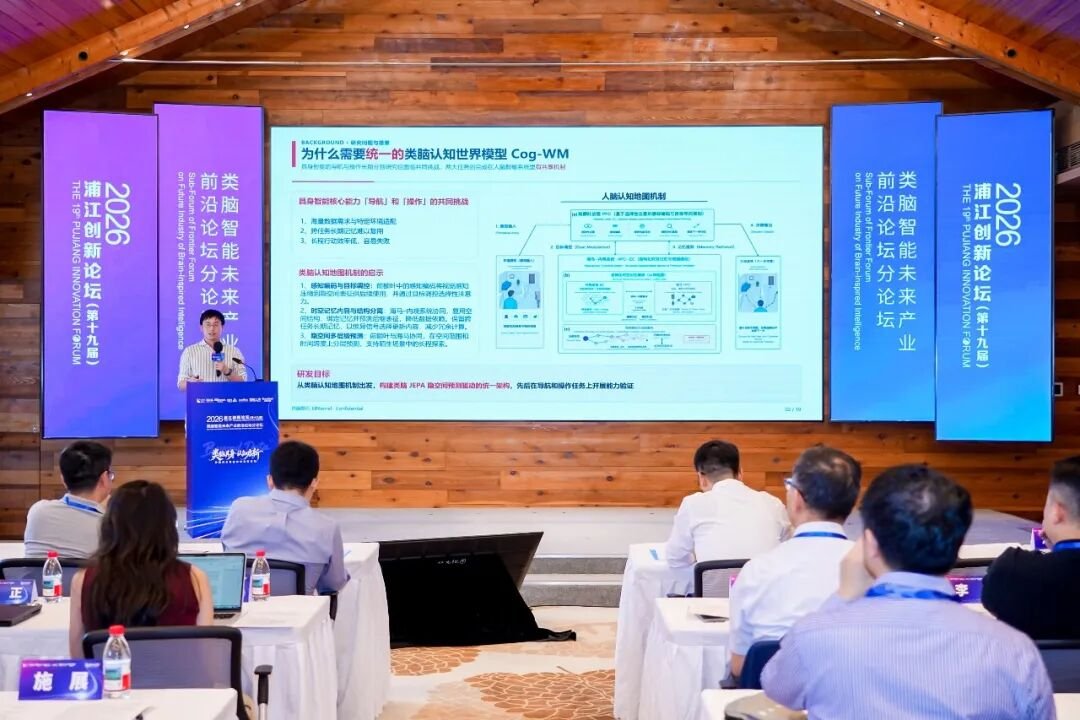
China’s embodied-AI crowd is starting to ask whether pumping more data and compute is the whole answer, and a Shanghai lab just bet it is not. At the Pujiang Innovation Forum on 14 September, EBKernel launched Cog-WM 1.0, a brain-inspired cognitive world model. The claim is plain: replace blind computation with clear brain-like mechanisms, so a robot remembers a space instead of relearning it every shift.
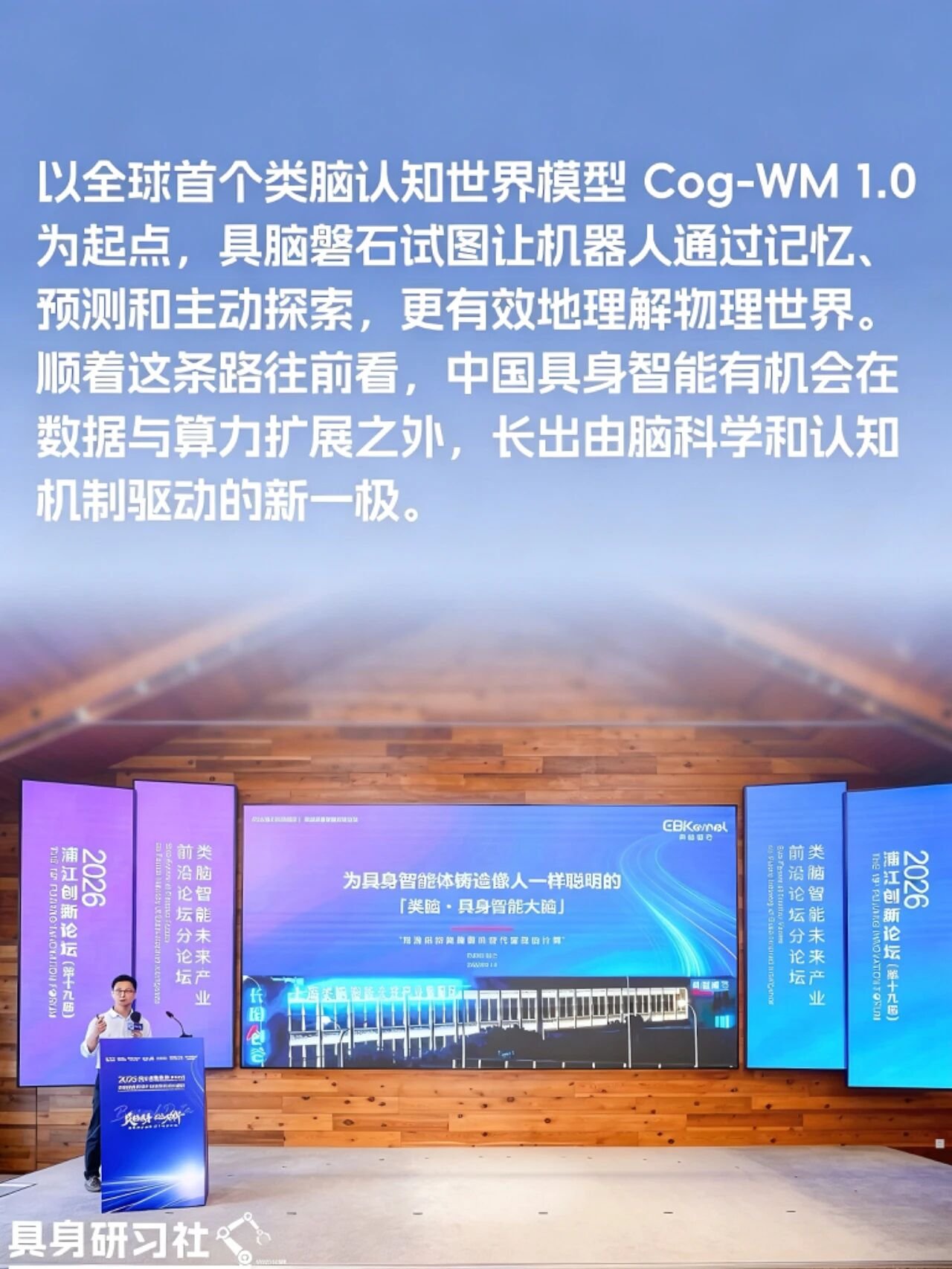
Chief executive Zhu Senhua frames the gap directly. A robot that reaches a shop has finished navigation. The value is what comes after, whether it remembers the route, can find the object it saw earlier, and needs no fresh survey next time. Traditional navigation reads a map. Cog-WM, he says, keeps a memory. The aim is to move part of the environment-adaptation that engineers now do by hand onto the robot itself.
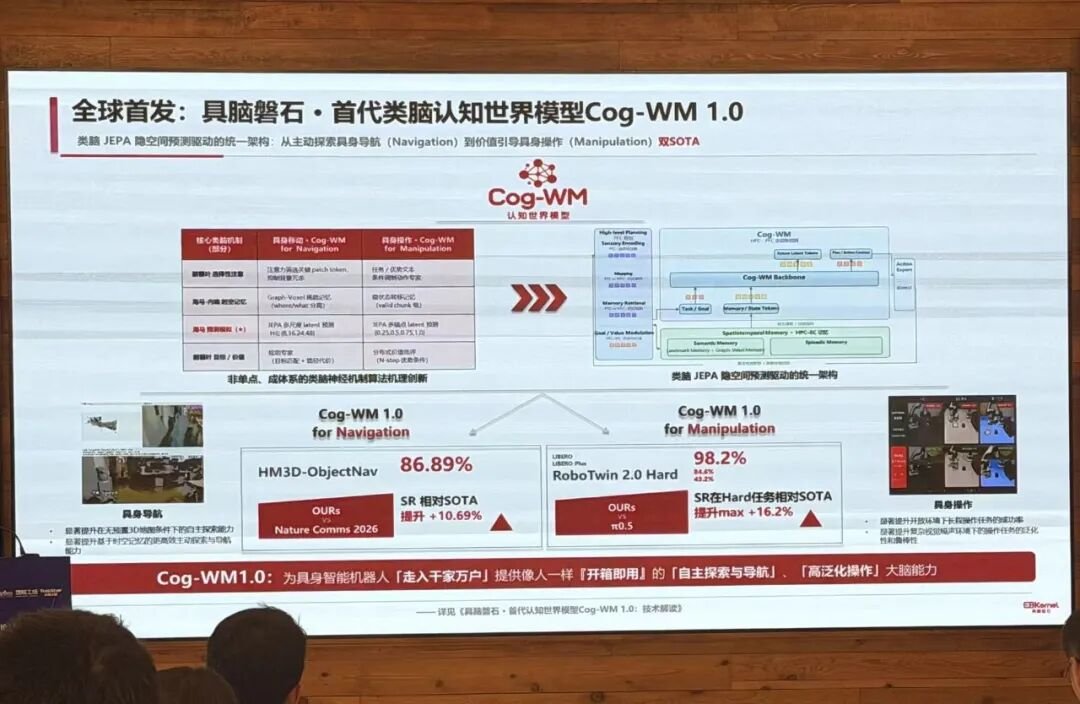
The navigation branch, Cog-WM Nav 1.0, organises space and objects separately and stores their relations in a Graph-Voxel global spatiotemporal memory, updating what is worth remembering when a new observation breaks expectation. On a 50 per cent subset of the HM3D ObjectNav benchmark it reached 86.89 per cent success after training on 145 scenes, 577 trajectories and about 15.4 hours of navigation data. The manipulation branch, Cog-WM Manip 1.0, reached 98.2 per cent on LIBERO, 84.6 per cent on LIBERO-Plus and 43 per cent on RoboTwin 2.0 Hard.
The mechanism borrows from cognitive maps and predictive coding. A robot stores where things are, predicts what happens next, and reuses experience instead of redrawing the map. EBKernel chose navigation first because a single task already exercises the full chain, perception, spatial memory, prediction, exploration and action, and because the neuroscience evidence is strongest there.
The wider point lands for the whole industry. China’s old certainties, a deep supply chain and vast data, are being re-examined. Scale alone, the lab argues, does not guarantee intelligence, and distribution matters more than volume. The interesting move is to grow a second pole from neuroscience, where the data edge may matter less than the architecture.
The following images show the forum setting, the model architecture and the benchmark results referenced above.


Editor’s note: This is an adapted translation of the original OFweek report. It has been trimmed and restructured for readability for an international business audience. The full original (in Chinese) is at https://robot.ofweek.com/2026-09/ART-8321205-8610-30703198.html.
Translated and adapted from OFweek (link).